

Washington / Caracas — January 3, 2026
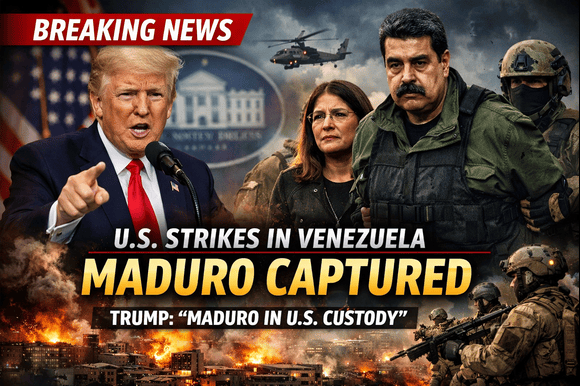
U.S. President Donald Trump has claimed that American forces carried out a major military operation in Venezuela, resulting in the capture of Venezuelan President Nicolás Maduro and his wife, Cilia Flores, a move that—if confirmed—would mark one of the most dramatic U.S. interventions in Latin America in decades.
Speaking from Washington, Trump described the operation as “successful and decisive,” stating that Maduro had been removed from Venezuela and placed under U.S. custody. The president said the action was taken to dismantle what he described as a “criminal narco-state” and to protect regional stability, though independent verification of Maduro’s capture has not been immediately available.
According to U.S. officials, the operation involved targeted military strikes on strategic sites in and around Caracas, including locations believed to be connected to senior government and security leadership. Explosions and heavy military movement were reported by residents in several parts of the capital during the early hours of the operation, fueling confusion and fear among civilians.
The White House said the action was coordinated between U.S. military forces and federal law-enforcement agencies. The U.S. Justice Department later announced that Maduro and Flores would face longstanding federal charges, including allegations of narco-terrorism, drug trafficking, and corruption, charges that the Venezuelan government has repeatedly rejected as politically motivated.
Venezuela Denounces ‘Illegal Aggression’
Venezuelan authorities strongly denied U.S. claims, calling the reported operation an “act of foreign aggression” and a violation of international law. Senior Venezuelan officials demanded proof that Maduro and his wife were alive and in custody, accusing Washington of spreading disinformation to justify military action.
State media in Venezuela reported disruptions to electricity and communications in some areas following the strikes, while security forces were seen deploying across major cities. It remains unclear who is currently exercising effective control over key government institutions.
Political Fallout in Washington
The announcement sparked immediate controversy in the United States. Supporters of Trump within Congress praised the move as a bold step against an authoritarian government accused of widespread human rights abuses and economic mismanagement.
However, critics—including several Democratic lawmakers—condemned the operation, arguing it bypassed congressional authorization and risked plunging the region into deeper instability. Legal experts questioned whether the president had the authority to carry out such an action without explicit approval from Congress or international backing.
International Reaction and Regional Fears
Global reaction has been swift and sharply divided. Some U.S. allies expressed concern over the legality of the operation and warned of dangerous precedents for sovereignty and international law. Countries aligned with Venezuela condemned the reported intervention, calling it an unacceptable violation of a nation’s independence.
Regional analysts warned that any prolonged U.S. involvement in Venezuela could worsen an already severe humanitarian crisis, potentially triggering new waves of migration and unrest across Latin America.
Uncertain Future
As conflicting accounts continue to emerge, the situation on the ground in Venezuela remains unclear. Analysts say that whether or not Maduro has been captured, the announcement alone represents a significant escalation that could reshape U.S.–Latin America relations for years to come.
The White House has indicated that further statements will be issued as events develop.