

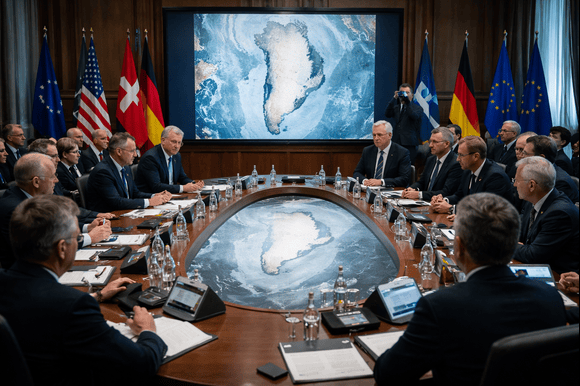
On Tuesday, the so-called Coalition of the Willing — a group largely made up of European leaders — convened in Paris alongside envoys representing US President Donald Trump in an effort to advance discussions on a durable peace agreement for Ukraine.
With Ukrainian President Volodymyr Zelensky asserting that a framework to end the war with Russia is “90% complete,” participants were keen not to endanger continued American involvement in the process.
Yet looming over the ornate Paris gathering was a vast and unsettling issue — one shaped unmistakably like Greenland.
Greenland, the world’s largest island and roughly six times the size of Germany, lies in the Arctic and operates as an autonomous territory under the Kingdom of Denmark. President Trump has repeatedly insisted that the United States wants — and needs — Greenland for reasons of national security.
Denmark’s Prime Minister, Mette Frederiksen, attended the Paris talks. She is a close ally to many EU leaders present and a key Nato partner of the United Kingdom. While none of the nations involved were eager to antagonise Trump, tensions were rising both in Washington and Copenhagen. As a result, six major European powers — including the UK, France and Germany — issued a joint statement on the sidelines of the Ukraine meeting.
The statement stressed that Arctic security must be addressed collectively, in coordination with Nato allies — including the United States — and reaffirmed that decisions regarding Greenland and Denmark’s sovereignty rest solely with Denmark and Greenland themselves.
However, doubts soon emerged over whether this would be enough to restrain Trump’s ambitions. Those doubts were swiftly answered.
Within hours, the White House released its own statement confirming that it was “discussing a range of options” to acquire Greenland — all of them unilateral, including outright purchase.
More alarming for European leaders was language from White House Press Secretary Karoline Leavitt, who said that “utilising the US military is always an option at the Commander-in-Chief’s disposal.”
While Trump has previously voiced interest in Greenland, many European officials quietly dismissed the idea during his first term. But following the Trump administration’s controversial military intervention in Venezuela over the weekend, the mood in Europe has shifted dramatically.
Denmark’s prime minister warned that Trump’s intentions must now be taken seriously. Leaders departed the Paris talks deeply concerned.
The irony is striking. European and Nato leaders are striving to involve the Trump administration in protecting Ukraine’s sovereignty from Russian aggression, even as the US has recently launched a military operation in Venezuela, detaining its president, while simultaneously threatening the territorial integrity of Denmark — itself a Nato member and long-standing US ally.
Copenhagen maintains that if Washington were to seize Greenland unilaterally, it would effectively signal the collapse of the transatlantic defence alliance that has underpinned European security since World War Two.
Trump has never concealed his scepticism of Nato.
Denmark has attempted to engage the US diplomatically over Greenland. Under an existing bilateral agreement, the United States already operates a military base on the island, established during the early Cold War. At its peak, the base housed about 10,000 personnel — a number now reduced to roughly 200. Washington has long been criticised for neglecting Arctic security, a stance that appears to have abruptly changed.
Denmark recently pledged $4 billion to strengthen Greenland’s defence, including investments in naval vessels, drones and aircraft. Yet officials say the Trump administration has shown little interest in dialogue.
On Sunday, Trump reiterated his position, stating that Greenland is “so strategic right now,” claiming it is surrounded by Russian and Chinese vessels. “We need Greenland from the standpoint of national security and Denmark is not going to be able to do it,” he said.
Denmark has firmly rejected that assertion.
Speaking anonymously, one senior EU official said: “This situation has once again exposed Europe’s fundamental weakness when dealing with Trump.”
Although Denmark’s Nordic neighbours quickly voiced support following Trump’s remarks, Europe’s so-called Big Three — the UK, France and Germany — initially remained silent. UK Prime Minister Sir Keir Starmer later stated that Denmark and Greenland alone have the right to decide the island’s future, echoing comments previously made by German Chancellor Friedrich Merz.
French President Emmanuel Macron visited Greenland in December as a symbolic show of solidarity, and the six-nation statement eventually followed. Still, it notably avoided direct criticism of Washington.
Camille Grande of the European Council on Foreign Relations said a stronger message could have been sent had all 27 EU member states — alongside the UK — issued a unified declaration backing Danish sovereignty.
Only six did.
This, analysts argue, is the core of the problem. Trump’s blunt style — often described as bullying — has left European leaders hesitant. Rather than confronting him collectively, many have opted to manage relations cautiously, fearing retaliation.
In an era dominated by major powers such as the US, China, Russia and India, Europe increasingly appears sidelined and vulnerable.
Despite annual pledges to assert itself globally, the EU has struggled to project strength when dealing with Trump. Last year, it failed to follow through on plans to support Ukraine using frozen Russian state assets — a missed opportunity, critics say, to demonstrate resolve.
As a trade powerhouse, the EU has also chosen restraint. After Trump imposed 15% tariffs on EU goods, the bloc declined to retaliate, fearing it might jeopardise vital US security backing.
Greenland has further exposed deep divisions within Europe over how to approach the Trump administration.
Julianne Smith, former US ambassador to Nato, warned that the crisis “risks breaking the EU” and presents an existential challenge to Nato itself.
“Europe must take President Trump and his team seriously when they talk about acquiring Greenland,” she said, urging contingency planning and bold initiatives such as new defence arrangements.
While Nato’s Article 5 does not apply to conflicts between member states, history offers troubling parallels — including Turkey’s invasion of Cyprus in 1974, when Nato did not intervene.
Denmark, though an active Nato member, is small. The United States is by far the alliance’s most powerful force.
European unease is palpable. Though leaders have reaffirmed Denmark’s sovereignty, questions remain about how far they would go to defend it.
“Nobody’s going to fight the United States militarily over Greenland,” White House Deputy Chief of Staff Stephen Miller told CNN on Monday.
Camille Grande argues that the standoff once again highlights Europe’s need to reduce reliance on US security guarantees and to speak with a single voice.
While Trump secured commitments from most Nato allies to boost defence spending, Europe remains dependent on US intelligence, air power, and command systems — a fact Washington knows well.
Nato insiders say European officials are struggling even behind closed doors to contemplate a scenario in which the US moves militarily on Greenland.
But they may soon have no choice.