
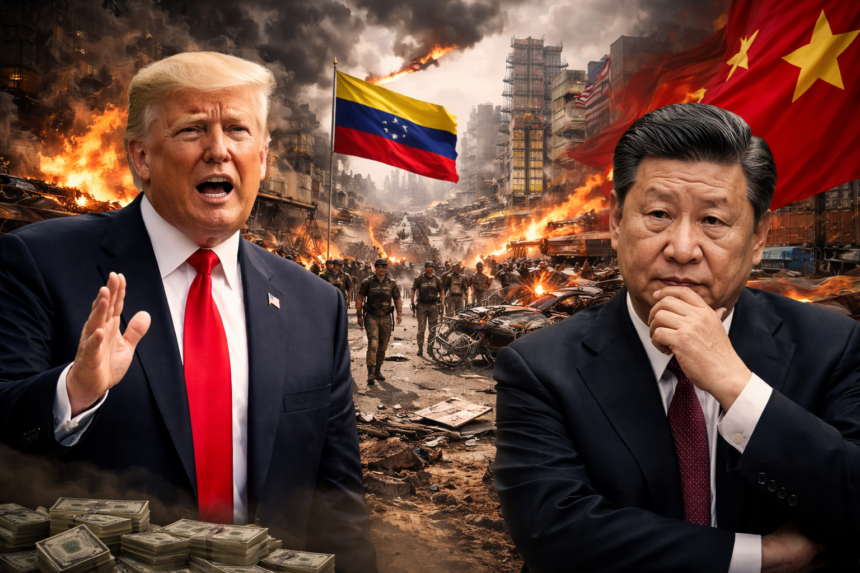
It took only a matter of hours for Donald Trump to shatter a partnership that China had spent decades carefully building.
Just hours before his dramatic capture in a late-night operation, Venezuelan President Nicolás Maduro had been publicly lauding Chinese President Xi Jinping as an “older brother” and praising his “powerful leadership message to the world” during talks with senior Chinese diplomats in Caracas.
China has poured vast political and financial capital into Venezuela, an oil-rich nation that has long stood as one of Beijing’s closest allies in South America. State media in China eagerly broadcast images of the meeting: cordial smiles, formal handshakes and discussions around more than 600 bilateral agreements. But the next image of Maduro that emerged could not have been more different — the deposed leader photographed aboard a US warship, blindfolded, handcuffed, and dressed in grey sweats.
Beijing was among a chorus of nations that swiftly condemned Washington’s extraordinary move against a sovereign state. Chinese officials accused the United States of acting as a self-appointed “world judge” and stressed that international law requires the sovereignty and security of all nations to be respected.
Behind the diplomatic rhetoric, however, Chinese leaders are now making careful strategic calculations — not only to protect their foothold in South America, but also to manage an already strained relationship with Trump, as the rivalry between the world’s two largest powers takes an abrupt and unpredictable turn.
Some observers argue the situation presents an opening for China’s authoritarian Communist Party leadership. Yet it also brings significant risk, uncertainty and frustration. Beijing has long attempted to operate within a global system it helped shape, preferring stability over disruption. Trump’s actions threaten to upend that approach.
China is accustomed to playing the long game, and chaos is not part of its preferred strategy. Trump’s second term has delivered exactly that. Beijing had prepared for renewed trade tensions and believed it successfully weathered earlier tariff battles, demonstrating how dependent global supply chains remain on Chinese manufacturing and technology.
Now, however, China faces a different challenge.
Trump’s aggressive move to seize control of Venezuelan oil has likely deepened Beijing’s suspicions about Washington’s broader intentions. How far is the US prepared to go to curb China’s global influence?
Speaking to NBC News on Sunday, US Secretary of State Marco Rubio made the administration’s stance unmistakably clear: “This is the western hemisphere. This is where we live — and we’re not going to allow it to be a base of operations for adversaries, competitors, or rivals of the United States.”
The implicit warning was aimed squarely at Beijing: leave America’s backyard. China is unlikely to comply, but it will carefully observe what unfolds next.
Some analysts and commentators in China are already drawing comparisons to Taiwan, the self-governing island Beijing considers a breakaway province. President Xi has pledged that Taiwan will eventually be “reunified” with the mainland and has refused to rule out the use of force. On Chinese social media, nationalist voices are asking whether Washington’s unilateral action in Caracas sets a precedent for Beijing to act similarly elsewhere.
There are key differences. China views Taiwan as an internal matter, not subject to international jurisdiction. More importantly, experts say Beijing lacks confidence it could succeed militarily without unacceptable costs. David Sacks of the Council on Foreign Relations argues that US actions in Venezuela do not alter China’s fundamental calculus on Taiwan.
Instead, Beijing will continue its strategy of pressure and coercion aimed at exhausting Taiwan’s population and forcing negotiations. “The US strikes on Venezuela do not change this dynamic,” Sacks writes.
What they do represent is an unwelcome complication for China’s long-term ambitions in the Global South. Beijing’s relationship with Caracas was straightforward: China needed oil, Venezuela needed money. Between 2000 and 2023, Beijing provided more than $100bn in financing for infrastructure projects such as railways and power plants. In return, Venezuela supplied crude to fuel China’s expanding economy.
Last year, roughly 80% of Venezuela’s oil exports went to China — though that accounted for only about 4% of China’s total oil imports. “It’s important to keep perspective,” says Eric Olander, editor-in-chief of The China–Global South Project. Still, Chinese energy giants like CNPC and Sinopec face risks, including possible nationalisation or marginalisation amid political turmoil.
Venezuela also owes Chinese lenders around $10bn in outstanding loans. While the immediate threat to those investments remains unclear, analysts warn the situation could deter future Chinese ventures. Cui Shoujun, a scholar at Renmin University, cautioned on state media that companies must carefully evaluate the risks of potential US intervention before committing to new projects.
Beijing is keen not to undermine the fragile trade truce it recently reached with Washington, but it is equally determined not to surrender its influence in Latin America. Striking that balance will be especially difficult with a US president known for unpredictability.
China’s broader concern is that countries across South America may begin to hesitate before accepting major Chinese investments, fearing they could draw unwanted attention from Washington. The stakes are high: trade between China and the region now exceeds $500bn annually and supplies Beijing with critical food, energy and raw materials.
The US has already pressed Panama to cancel Chinese investments linked to ports and the Panama Canal — a move Olander describes as “deeply troubling” for Beijing.
In response, China may seek to strengthen its position through diplomacy rather than confrontation. It has spent years cultivating influence across the Global South, promoting the idea of a “shared future” and opposing what it calls “unilateral bullying.” That message resonates with governments increasingly uneasy about Washington’s volatility under Trump.
Beijing is clear about its expectations: partners must recognise the “One China” principle and treat Taiwan as an integral part of China. This approach has paid dividends, with several Latin American nations — including Costa Rica, Panama, the Dominican Republic, El Salvador, Nicaragua and Honduras — switching diplomatic recognition from Taiwan to Beijing over the past two decades.
By contrast, Trump’s actions underscore how unpredictable relations with Washington can be. That instability could ultimately benefit China as it seeks to portray Xi as a steady and reliable global leader.
“This matters because Venezuela could easily descend into chaos,” Olander warns. “And history offers a cautionary tale. The US once claimed Iraq’s oil would fund its reconstruction — that never happened. Today, China is the largest buyer of Iraqi crude. A similar outcome in Venezuela is entirely possible.”
For years, China hawks in the US Congress urged Washington to counter Beijing’s growing influence in South America. The US has now acted. What remains uncertain is what happens next.
Everything about this moment is a gamble — and Beijing, by all accounts, despises gambling.