

Just hours before United States special forces carried out the dramatic operation to detain Venezuelan President Nicolás Maduro last Saturday, the embattled leader was hosting China’s special envoy to Caracas. The meeting was intended to reaffirm the two countries’ long-standing “strategic partnership.”
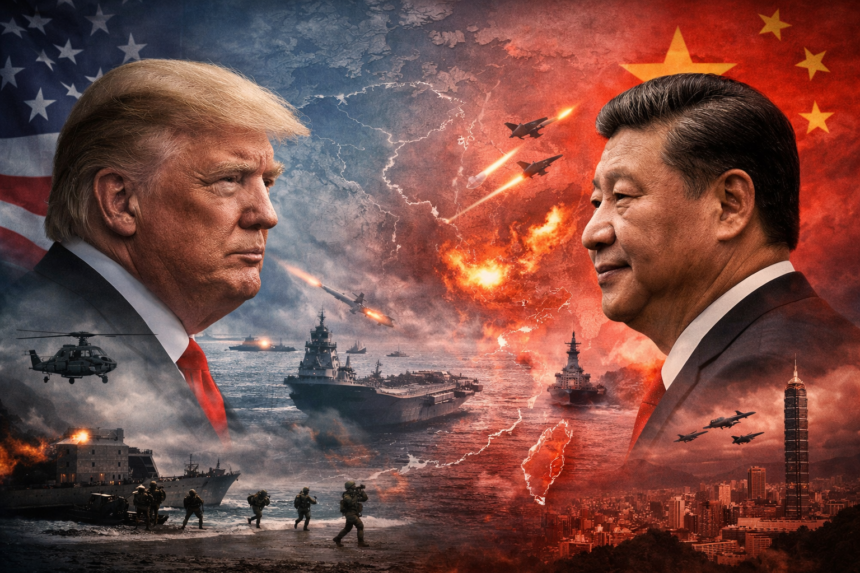
That decades-old relationship is now under strain, raising serious questions about the future of billions of dollars in Chinese investments in Venezuela. At the same time, analysts say Washington’s move has inadvertently handed Beijing an opportunity to strengthen its own geopolitical arguments — not only in Latin America, but also in East Asia, particularly over its claim to self-governed Taiwan.
The episode has revived debate over the Monroe Doctrine, the 19th-century policy asserting US dominance in the Western Hemisphere. Recently resurrected by US President Donald Trump, the doctrine has been reframed as a warning against foreign influence — especially China’s — in the Americas.
Trump formally invoked the doctrine in his most recent national security strategy, released late last year. While the original doctrine was designed to keep European powers out of the region, Trump’s updated version explicitly highlights the need to counter China’s growing economic and political footprint.
Often referred to by analysts as the “Trump Corollary,” the policy calls for a Western Hemisphere that “remains free of hostile foreign incursion or ownership of key assets” and supports secure supply chains — language widely interpreted as a veiled reference to Beijing.
According to reports from ABC News and CNN on Tuesday, the Trump administration has demanded that Venezuela sever ties with China, Iran, Russia and Cuba as a condition for being allowed to restart oil production. The White House declined to confirm or deny the reports, which cited anonymous officials.
Trump has repeatedly criticised Chinese investment across Latin America and previously made the false claim during his inauguration that Beijing controlled the Panama Canal. Following Maduro’s capture, Trump has also renewed controversial calls for the United States to “acquire” Greenland, an autonomous Danish territory, arguing it is vital to American national security.
This week, Trump alleged that Greenland was being overrun by Russian and Chinese vessels, despite the absence of any evidence supporting the claim.
“China will likely interpret these developments as confirmation that the United States is openly comfortable enforcing hemispheric spheres of influence,” said Simona Grano, head of research on China–Taiwan relations at the University of Zurich’s Institute for Asian and Oriental Studies.
Beijing swiftly condemned Maduro’s detention, calling it a “blatant violation of international law” and urging Washington to stop interfering in Venezuela’s internal affairs.
However, Grano noted that the return to sphere-of-influence politics presents both risks and opportunities for China.
“On one hand, it highlights the vulnerability of China’s investments and partnerships in Latin America,” she said. “On the other, it could strengthen Beijing’s perception that Washington would struggle to oppose similar logic in East Asia — even though Taiwan remains a far more sensitive and potentially escalatory case.”
China has vowed to bring Taiwan under its control, by peaceful means or by force if necessary, and views the island’s ruling Democratic Progressive Party as separatist. Taiwan, a democracy of 23 million people, is formally recognised by only 11 countries and the Vatican, though it enjoys strong unofficial support from the United States.
Under the Taiwan Relations Act of 1979 and the “Six Assurances” issued in 1982, Washington has pledged to help Taipei defend itself, even as Beijing insists the issue is purely an internal Chinese matter.
Trump’s renewed emphasis on spheres of influence may offer China additional rhetorical ammunition in global discussions over Taiwan, said Lev Nachman, a political scientist and assistant professor at National Taiwan University.
“The US has created a broader precedent for major powers to act against other states beyond their formal jurisdiction,” Nachman told Al Jazeera.
While China is unlikely to launch an immediate military operation against Taiwan, Nachman argued that Washington’s actions could make it easier for Beijing to justify such a move in the future.
Taiwan is not the only territory China considers to fall within its perceived sphere of influence. Beijing claims most of the South China Sea — an area contested by Vietnam, the Philippines, Malaysia, Brunei and Taiwan — and also asserts sovereignty over the Japanese-administered Senkaku Islands in the East China Sea. China’s disputed eastern border with India has seen deadly clashes, including a war in 1962 and skirmishes since 2020.
On Chinese social media platforms such as Weibo, WeChat and Douyin, the events in Venezuela have sparked intense discussion, with some users openly drawing parallels to Taiwan.
“If the US can illegally invade Venezuela and arrest its president,” one Weibo user wrote in a post that drew more than 1,000 comments, “then the Chinese military can legitimately exercise sovereignty to complete reunification.”
The White House has framed Maduro’s detention as a law enforcement operation and described US air strikes near Venezuelan waters as defensive actions aimed at stopping drug trafficking. None of Venezuela’s neighbouring countries intervened militarily, though several condemned Washington’s actions.
Critics have rejected the administration’s law-and-order justification, but the framing has nonetheless inspired debate among Chinese netizens about how Beijing might pursue Taiwan.
“First issue arrest warrants for pro-independence figures, then send personnel to detain them,” one user suggested. “If others obstruct the process, the military can be used to overcome resistance.”
Experts caution that Venezuela’s situation is unlikely to directly alter China’s immediate strategy toward Taiwan. Grano emphasised that Taiwan represents a fundamentally different scenario due to alliance structures and escalation risks.
Any conflict over Taiwan could rapidly involve the United States and Japan, a US treaty ally. Japanese Prime Minister Sanae Takaichi has warned that an attack or blockade of Taiwan would constitute a “survival-threatening situation” for Japan, potentially justifying military intervention. Such a conflict would also disrupt critical global shipping routes through the Taiwan Strait.
Beijing has not ruled out peaceful unification, even as military pressure around the island continues.
At the same time, the Maduro episode appears to have reinforced perceptions within China that strength is the only safeguard against foreign coercion. “Many netizens expressed shock at the unilateral nature of US actions,” said Jiang Jiang, chief editor of the China-focused Ginger River Review and a researcher at the Xinhua Institute.
William Yang, senior Northeast Asia analyst at the Crisis Group, said the incident demonstrates Trump’s willingness to use force against perceived threats.
“This sends a warning to Beijing that the US is prepared to resort to military options to remove political forces it opposes in Latin America,” Yang said.
Trump’s move against Maduro followed months of threats over alleged ties to drug cartels, alongside US air strikes targeting vessels in the Caribbean and eastern Pacific. The administration has not provided evidence that those killed in the strikes were traffickers or that the boats were bound for the US.
Chinese analyst Qinduo Xu echoed the sentiment, describing the episode as a stark reminder of American power.
“It shows that the US is willing to discard international rules whenever they stand in its way,” Xu said on state-run CGTN.
Experts believe Maduro’s removal will reinforce Beijing’s preference for economic engagement in Latin America without assuming responsibility for the survival of partner governments.
Venezuela has been one of China’s closest regional allies for two decades. After US sanctions in 2019, China became Venezuela’s top oil destination and invested approximately $4.8bn in the country, according to the Rhodium Group. Beijing has also extended loans worth tens of millions of dollars, with Venezuela still owing between $13bn and $15bn, according to estimates cited by Reuters.
In 2023, the two nations signed an “all-weather strategic partnership,” a designation China has granted to only five other countries. However, the agreement does not include military guarantees, limiting reputational damage to Beijing for not intervening.
Gabriel Wildau, managing director at risk consultancy Teneo, said China is likely to remain pragmatic despite growing US pressure.
“Venezuela is not a core interest for China,” Wildau said. “Preserving the broader US–China détente is likely more important.”
Trump is scheduled to visit China in April amid negotiations to ease a trade war that last year threatened global commerce through escalating tariffs.
“Chinese investments in Latin America now face greater political risk from US interference,” Wildau added. “But Beijing is more likely to seek ways to manage those risks than abandon the region altogether.”