
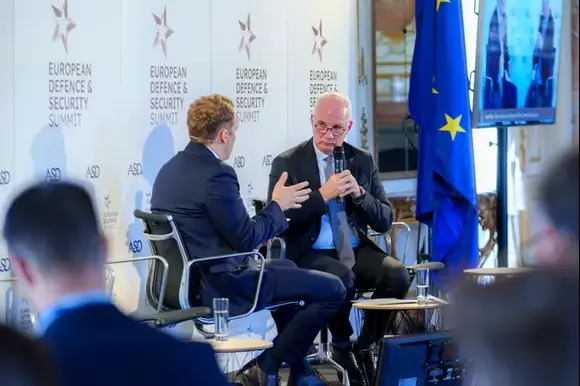
Brussels — European Union leaders have gathered in the Belgian capital amid mounting pressure to show unity as the bloc confronts a convergence of security threats, migration pressures, economic uncertainty and political fragmentation.
At the centre of discussions is defence and security, with the war in Ukraine continuing to reshape European priorities nearly four years after Russia’s full-scale invasion. EU officials say there is growing urgency to strengthen collective defence capabilities, boost arms production and reduce reliance on the United States for long-term security guarantees.
Several member states have pledged to increase defence spending, though divisions persist over how these efforts should be funded and coordinated. Some governments are pushing for joint borrowing, while others insist defence investment must remain a national responsibility.
Support for Ukraine remains a cornerstone of EU policy. Leaders have reiterated their commitment to providing military, financial and humanitarian aid to Kyiv, even as concerns grow about sustaining public backing for continued assistance amid rising living costs across Europe.
European Commission President Ursula von der Leyen said unity was essential in the face of global instability.
“Europe must remain united, resilient and determined to defend its security, its democracy and its values,” she said. “What we decide now will shape the future of our continent for decades.”
Migration has once again emerged as one of the most divisive issues on the agenda. Mediterranean countries such as Italy, Greece and Spain say they are struggling to manage increasing numbers of arrivals and are calling for faster implementation of long-promised asylum reforms.
While EU states have agreed in principle on changes to the bloc’s migration system, disputes over responsibility-sharing, border enforcement and returns have slowed progress, with northern and eastern countries expressing concerns about domestic political backlash.
Economic challenges are also dominating talks. Although inflation has eased across much of the eurozone, economic growth remains fragile, particularly in major economies such as Germany and Italy. The European Commission has warned that weak industrial output, high interest rates and global trade tensions could hamper recovery in the coming year.
EU Economy Commissioner Paolo Gentiloni said the bloc needed to act decisively to remain competitive.
“Europe must invest more and invest smarter,” he said. “Our competitiveness, our climate goals and our social model depend on it.”
Brussels is urging member states to accelerate investment in renewable energy, digital infrastructure and advanced manufacturing, while also debating reforms to fiscal rules that would give governments greater flexibility to support growth.
Political uncertainty is adding to the strain. With European Parliament elections approaching, analysts warn that voter frustration over migration, the cost of living and perceptions of EU overreach could strengthen Eurosceptic and far-right parties in several countries.
Despite internal disagreements, EU leaders insist that cooperation is essential at a time of increasing global rivalry and geopolitical tension. However, diplomats privately acknowledge that maintaining consensus among 27 member states with diverging national interests is becoming more difficult, even as external pressures make unity more important than ever.