

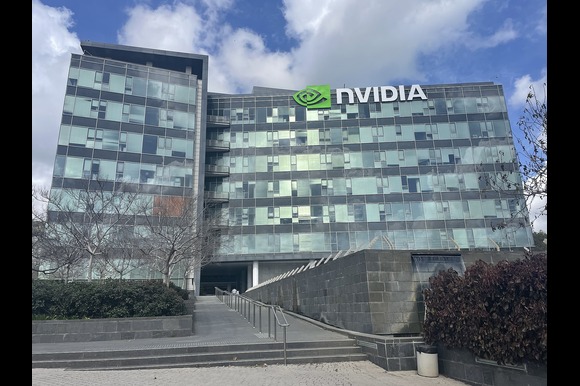
The US government has approved chipmaker Nvidia to resume sales of its advanced artificial intelligence (AI) processors to China, the Department of Commerce confirmed on Tuesday, marking a significant shift in Washington’s export controls on cutting-edge technology.
The approval covers Nvidia’s H200 processor, the company’s second most powerful AI-focused semiconductor, which had previously been restricted over US concerns that such technology could strengthen China’s civilian tech sector and provide advantages to its military capabilities.
According to the Commerce Department, shipments of the H200 to China will be allowed as long as there is adequate availability of the chips within the United States, ensuring that domestic supply needs are not compromised.
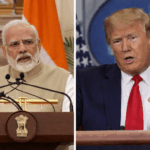
President Donald Trump said last month that his administration would permit chip sales to “approved customers” in China, while imposing a 25% fee on those transactions. Nvidia welcomed the decision, with a company spokesperson telling the BBC that the move would support US manufacturing activity and help sustain American jobs.
The Commerce Department’s Bureau of Industry and Security said the updated export rules apply not only to the H200 but also to several less advanced Nvidia processors. Under the revised policy, Chinese buyers must demonstrate that they have robust security measures in place and provide assurances that the chips will not be used for military purposes.
Despite the easing of restrictions, Nvidia’s most advanced AI chip — the Blackwell processor — remains barred from sale in China. The Blackwell chip is widely regarded as the world’s most powerful AI semiconductor and is a generation ahead of the H200.
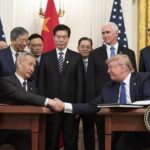
China reacted critically to the announcement. Liu Pengyu, a spokesperson for the Chinese embassy in Washington, told the BBC on Wednesday that Beijing has long opposed what it sees as the politicisation and militarisation of technology and trade.
“We oppose actions that block or restrict China and undermine the stability of global industrial and supply chains,” Liu said. “Such practices do not align with the shared interests of either side.”
Nvidia has increasingly found itself at the centre of geopolitical tensions between the US and China, as both nations compete for dominance in the rapidly accelerating global AI race.
Although President Trump lifted earlier restrictions on Nvidia’s chip exports last July, he simultaneously required the company to share a portion of its China-derived revenues with the US government. Following that move, Beijing reportedly instructed domestic technology firms to reduce reliance on Nvidia products and prioritise locally produced semiconductors.
The directive was intended to strengthen China’s domestic chip industry. However, analysts have consistently noted that Chinese-made AI processors continue to lag behind their US counterparts in performance and efficiency.
Throughout 2025, Nvidia chief executive Jensen Huang repeatedly urged US policymakers to relax export controls, arguing that broad participation in global markets is critical to maintaining America’s long-term technological leadership and competitiveness.
Nevertheless, opposition within the US government has persisted, with some officials warning that allowing advanced chip exports could accelerate China’s military development and slow US progress in artificial intelligence.
While Beijing may remain cautious about its technology sector becoming overly dependent on Nvidia, Chinese firms are still expected to pursue access to H200 chips in the short term, according to semiconductor analyst Austin Lyons. That demand is likely to continue until domestically developed alternatives become more capable.
Lyons added that Nvidia stands to benefit from any restored access to the Chinese market, even if profit margins are reduced due to the US government taking a share of the revenue.
Meanwhile, President Trump’s unconventional proposal to collect a direct cut of Nvidia’s China sales could influence future trade negotiations, said Marc Einstein, an analyst at Counterpoint Research.
“It will be interesting to see whether this model of extracting revenue becomes a template for tariffs or negotiations in other industries,” Einstein said.