


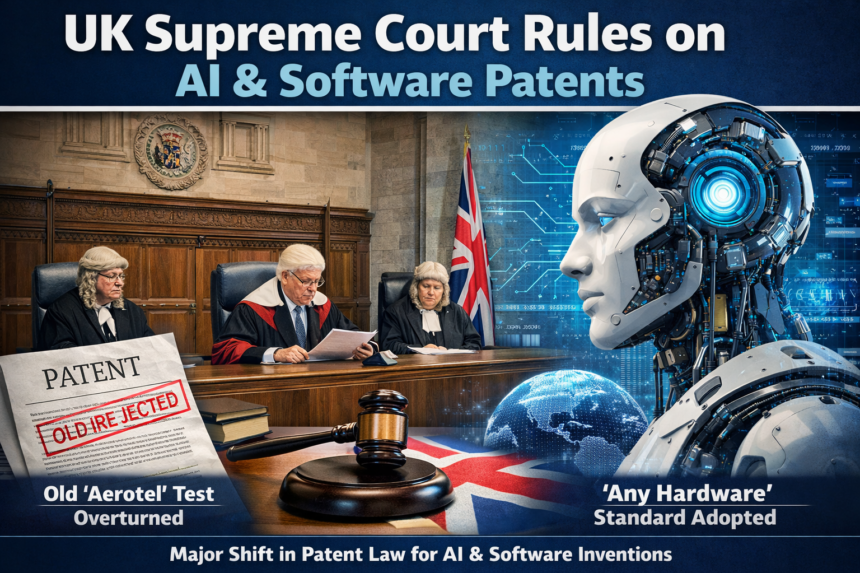
Historic judgment aligns UK approach with European standards and opens new pathway for AI innovators
London | 11 February 2026
In a transformative decision that could redefine the trajectory of artificial intelligence innovation in the United Kingdom, the UK Supreme Court has issued a landmark judgment clarifying the patentability of AI and computer-implemented inventions.
The ruling, delivered in Emotional Perception AI Ltd v Comptroller General of Patents, Designs and Trade Marks [2026] UKSC 3, marks the most significant development in UK software patent law in over two decades.
End of the “Aerotel” Era
For nearly 20 years, UK courts and the UK Intellectual Property Office (UKIPO) relied on the so-called Aerotel test, a four-step framework used to determine whether an invention fell within the statutory exclusion for “programs for computers” under the Patents Act 1977.
The Supreme Court has now decisively departed from that approach.
The Court concluded that the Aerotel framework had led to overly rigid interpretations of computer-implemented inventions and risked placing the UK out of step with European Patent Office (EPO) practice.
Instead, the Court endorsed a more harmonised approach aligned with EPO jurisprudence, particularly the principle that inventions involving “any hardware” should not be automatically excluded from patentability merely because they are implemented through software.
What the Case Was About
The dispute arose from a patent application relating to an AI system capable of recommending content based on emotional responses. The UKIPO had rejected the application on the basis that it was no more than a computer program as such.
The Supreme Court disagreed with the legal reasoning underpinning that refusal.
While the Court stopped short of declaring the invention patentable outright, it clarified that the presence of hardware integration shifts the inquiry away from categorical exclusion and toward substantive examination — namely:
- Novelty
- Inventive step
- Technical contribution
The application has now been remitted for reconsideration under the corrected legal test.
A Major Boost for UK AI Innovation
Legal experts widely regard the judgment as a turning point.
According to leading patent practitioners, the ruling significantly lowers the threshold barrier that previously prevented many AI and software innovations from progressing to full substantive examination.
One London-based patent litigator commented:
“This decision removes a long-standing structural hurdle in UK patent practice. AI developers will no longer face near-automatic exclusion at the eligibility stage. The focus now shifts to technical merit rather than formalistic categorisation.”
Another IP strategist noted:
“The alignment with EPO standards restores predictability. For multinational filers, this reduces divergence risk between UK and European filings.”
Practical Implications for Businesses
The ruling is expected to have immediate and practical consequences:
1. Increase in AI-Focused Patent Filings
AI developers, fintech companies, health-tech innovators, and SaaS providers may now reassess UK filings that were previously deemed non-viable.
2. Re-Evaluation of Rejected Applications
Applicants whose cases were refused under the old Aerotel test may explore revival, appeal, or re-filing strategies.
3. Strategic Drafting Shift
Patent attorneys are likely to place greater emphasis on hardware integration and demonstrable technical effects in claim drafting.
Not a Free Pass for Software Patents
Despite the shift, the Supreme Court was careful to clarify that not all software-based inventions will qualify for protection.
Purely abstract business methods, mathematical methods, or aesthetic algorithms remain excluded.
The key distinction will lie in demonstrating a technical contribution beyond a program “as such.”
As one senior IP barrister explained:
“The decision opens the door, but applicants must still walk through it with strong technical drafting. Inventive step and technical effect will now carry even greater weight.”
A Strategic Moment for the UK
At a time when global jurisdictions are wrestling with AI regulation and innovation policy, the ruling signals the UK’s intention to remain competitive in the technology sector.
By aligning more closely with EPO jurisprudence while preserving national judicial oversight, the Supreme Court has sought to balance innovation encouragement with doctrinal clarity.
For AI startups, investors, and IP strategists, this judgment may prove to be one of the most commercially significant patent decisions of the decade.
Editorial Note
This decision underscores the evolving intersection between law and artificial intelligence. Businesses operating in AI-driven sectors should urgently review their IP strategies in light of this ruling.