

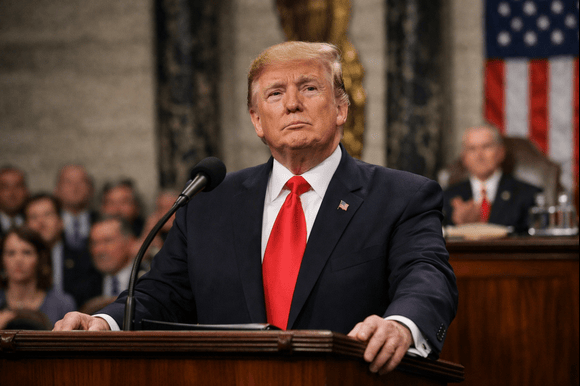
Few addresses to Congress by Donald Trump have carried stakes as high as the State of the Union speech he is set to deliver on Tuesday night, a moment that could shape the trajectory of his second term and the political climate ahead of crucial midterm elections.
Over the past year, Trump has tested the boundaries of presidential authority in ways few of his predecessors have attempted. His administration has pursued sweeping changes across domestic governance and foreign affairs, racking up tangible policy victories while simultaneously igniting fierce political controversy. Some of those moves have energized his supporters, but others have deepened national divisions and drawn sustained opposition.
No matter how his record is judged, Trump will speak to a country markedly different from the one he returned to govern last year. In a matter of months, he has driven forward an ambitious second-term agenda at a rapid pace. His administration has intensified its crackdown on illegal immigration, taken steps that officials say have effectively sealed the southern border, reshaped longstanding foreign alliances, and challenged institutional guardrails embedded in the American system of checks and balances. In doing so, Trump has sought to redefine the scope and power of the presidency itself.
Yet the president’s assertive approach has also triggered significant resistance. Legal challenges, public protests, and institutional pushback have constrained some of his most aggressive initiatives. Opinion surveys suggest that public sentiment has cooled. A recent poll conducted by CNN found that just 36% of Americans approve of the job Trump is doing, while a separate survey by The Washington Post placed his approval rating at 39%. For a president facing midterm voters in just over eight months, Tuesday’s address offers a rare opportunity to reset the narrative.
The November midterm elections will effectively serve as a referendum on Trump’s second term. Voters could reinforce Republican control of Congress or shift power to Democrats, ushering in the prospect of legislative gridlock, intensified oversight, and even renewed impeachment efforts. In that context, the State of the Union stands as Trump’s most prominent platform to appeal directly to millions of Americans in a single, nationally televised event.
Speaking on Monday, Trump previewed what he intends to convey. “We have a country that’s now doing well, we have the greatest economy we’ve ever had and the most activity we’ve ever had,” he said. “It is going to be a long speech, because we have so much to talk about.” The remarks signal a familiar strategy: highlighting achievements while projecting confidence.
According to Robert Rowland, a professor at the University of Kansas and author of a book examining Trump’s rhetorical style, the president’s addresses typically blend boasts of accomplishment with pointed attacks on critics and perceived adversaries. Last year’s speech to Congress, which ran nearly two hours, followed that formula. But Rowland argues that this moment may call for something different.
“State of the Union addresses are normally a time when the president does two things that President Trump essentially never does,” Rowland said. “The president makes a case for his agenda. And they try to broaden the appeal of the agenda of the administration.” Whether Trump pivots toward a more inclusive tone remains uncertain.
Much of his second-term messaging has been aimed squarely at his political base. Expanding that appeal has often seemed secondary to confrontation. However, with approval ratings slipping, the electoral calculus may demand a broader pitch.
Immigration, long a signature issue for Trump, illustrates the tension. His decision to deploy additional federal immigration agents to cities including Minneapolis thrilled supporters—many of whom had brandished “mass deportations now!” signs at the 2024 Republican National Convention. Yet polling suggests that a significant share of Americans believe the administration’s enforcement efforts have gone too far.
Trade policy presents another flashpoint. Trump’s imposition of steep tariffs on several major US trading partners has drawn criticism from economists and business groups. Last Friday, the Supreme Court of the United States ruled that many of the administration’s tariff measures were unlawful, casting uncertainty over the durability of his trade agenda. Although the president has responded by unveiling additional tariffs and pledging an even more expansive approach, the legal and economic ramifications remain unsettled.
The broader economic picture is mixed. Stock markets hover near record highs and unemployment remains low, offering positive talking points for the White House. However, recent data on economic growth fell short of expectations, complicating the narrative of unqualified success. Meanwhile, while inflation has eased from its peak during the presidency of Joe Biden, many Americans say they have yet to experience the lower prices Trump promised on the campaign trail.
Immigration enforcement has also generated backlash beyond polling numbers. The deaths of two US citizens during operations involving immigration officers in Minneapolis sparked widespread protests. In response, the administration scaled back the surge of federal agents in the city, with Trump promising a “softer touch.” Plans to construct or acquire large-scale detention facilities have met resistance from local communities, while congressional Democrats have withheld funding for the Department of Homeland Security pending new legal safeguards—an impasse that shows little sign of resolution.
Last year, White House officials suggested Trump would embark on a nationwide tour focused on economic achievements and policies aimed at tackling affordability concerns—an issue Democrats leveraged effectively in recent state-level contests. That initiative has unfolded only sporadically, and the president has frequently deviated from prepared messaging.
Policy ideas such as imposing caps on credit card interest rates, increasing housing supply, and distributing “tariff refund” checks have advanced slowly, if at all. Although inflation has moderated, household budgets remain strained in many parts of the country, leaving voters unconvinced that economic pressures have fully eased.
Tuesday’s address could serve as a pivotal moment to reshape those perceptions. Trump may also use the speech to justify reports that the US is assembling military assets in preparation for a potential strike on Iran—an escalation that could dramatically alter both foreign policy and domestic political dynamics.
At minimum, the address is likely to provide insight into how Trump and congressional Republicans intend to persuade voters to maintain their majority in November. The president’s instinct, according to Rowland, is unlikely to involve concession.
“Normally, when presidents realise they are angering the public, they pull back and have some kind of mea culpa,” Rowland observed. “That’s not something that President Trump ever does. I expect him to double down on the messages.”
Adopting a different approach might require a measure of humility—an attribute critics argue Trump has rarely displayed during his years in national politics. Whether he chooses to recalibrate or reinforce his combative style could shape not only the reception of Tuesday night’s speech, but the political fortunes of his party in the months ahead.