


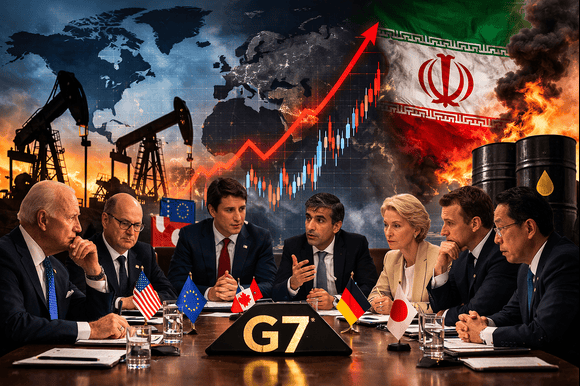
Leaders of the Group of Seven (G7) economies are set to hold an emergency meeting on Monday to address the sharp rise in global oil prices and market instability triggered by the escalating conflict involving Iran, Israel, and the United States.
Finance ministers from the world’s leading industrialised nations, including UK Chancellor Rachel Reeves, will discuss the growing economic risks caused by the crisis and consider measures to stabilise global energy markets.
Oil Prices Surge Past $100
Global oil prices spiked dramatically as fears grow over disruptions to supplies from the Middle East. Benchmark Brent crude oil surged by more than 25% during early trading in Asia, briefly reaching around $119.50 per barrel before easing to approximately $107 later in the day.
Meanwhile, West Texas Intermediate crude, the main U.S. benchmark, climbed to roughly $104 per barrel.
The surge has been driven largely by concerns over the Strait of Hormuz, a strategic shipping route through which roughly 20% of the world’s oil supply normally passes. Shipping activity through the narrow waterway has largely halted since the war intensified more than a week ago.
G7 Considers Releasing Strategic Oil Reserves
According to reports, the emergency G7 discussions may include a coordinated release of petroleum reserves through the International Energy Agency (IEA). Such a move could help stabilise energy markets if supply disruptions continue.
If implemented, it would mark the first major coordinated release since 2022, when the agency intervened following the Russian invasion of Ukraine (2022).
Markets React to Escalating Conflict
Financial markets worldwide have reacted sharply to the intensifying crisis. In the United Kingdom, the FTSE 100 index fell about 1.3%, with most companies experiencing losses.
Across Europe, markets also declined:
- Germany’s DAX Index dropped roughly 1.6%
- France’s CAC 40 fell about 2%
In Asia, the reaction was even stronger. Japan’s Nikkei 225 plunged 5.2%, while South Korea’s KOSPI dropped 6%, triggering a temporary trading halt to prevent panic selling.
Energy Infrastructure Under Attack
The surge in energy prices follows a weekend of escalating military actions across the region. Airstrikes by the United States and Israel targeted multiple sites in Iran, including oil storage facilities.
At the same time, Iran reportedly launched attacks on energy infrastructure in Gulf states. Saudi Arabia said it intercepted two waves of drones heading toward a major oil field overnight.
These attacks have intensified concerns that the conflict could severely disrupt global energy supplies.
Leadership Shift in Iran
Amid the ongoing crisis, Iran has named Mojtaba Khamenei as the country’s new supreme leader following the death of his father, Ali Khamenei. Analysts say the appointment signals that hardline leadership remains firmly in control during the conflict.
Gas Prices and Borrowing Costs Rise
Energy prices are rising beyond oil markets. In the UK, natural gas prices for month-ahead delivery jumped nearly 25%, briefly reaching 171 pence per therm before settling around 156 pence.
Although prices have surged since the conflict began, they remain significantly below the record highs seen in 2022 during the early stages of the war in Ukraine.
At the same time, government borrowing costs in the UK have risen sharply. The yield on two-year government bonds climbed to 4.12%, while benchmark ten-year yields increased to 4.76%, reflecting investor concerns about inflation and economic uncertainty.
Trump Downplays Oil Price Concerns
Despite the rising prices, Donald Trump dismissed fears about the economic impact. Writing on his social media platform Truth Social, the U.S. president argued that temporary price increases are justified if they help eliminate security threats.
He said higher oil prices would be a “small price to pay” for global safety and predicted that energy costs would fall once the crisis is resolved.
Uncertainty Over Duration of Conflict
Energy analysts warn that the key factor for markets now is how long the conflict continues. Experts say prolonged disruption could push oil prices even higher, potentially reaching $120 to $150 per barrel before demand begins to fall.
For now, investors remain on edge as tensions in the Middle East continue to escalate, leaving global markets highly sensitive to new developments.