

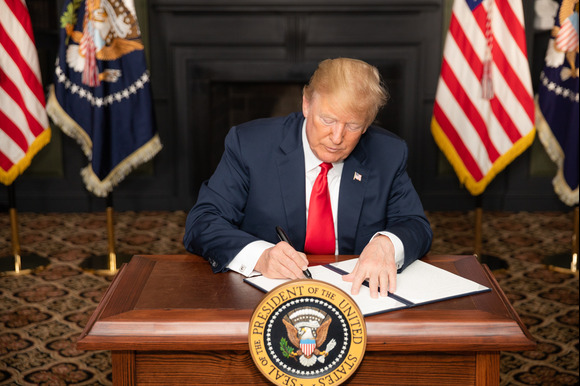
United States President Donald Trump has postponed a self-imposed deadline for launching attacks on Iran’s power grid, extending it to April 6, as he pointed to what he described as progress in negotiations aimed at ending the ongoing war in the region.
The announcement, made on Thursday, comes amid continued US pressure on Tehran to reopen the strategically vital Strait of Hormuz, a key artery for global oil shipments. In a post on Truth Social, Trump wrote: “As per Iranian Government request, please let this statement serve to represent that I am pausing the period of Energy Plant destruction by 10 Days to Monday, April 6, 2026, at 8 PM, Eastern Time.”
He added that diplomatic efforts were underway and dismissed contrary reports, stating: “Talks are ongoing and, despite erroneous statements to the contrary by the Fake News Media, and others, they are going very well.”
This marks the latest in a series of delays announced by Trump since he first threatened to target Iran’s energy infrastructure. On Sunday, he warned that strikes on Iran’s power grid would begin within 48 hours if the Strait of Hormuz was not reopened, vowing to hit energy facilities “starting with the biggest one first.”
By Monday, however, he had already extended the deadline by five days, citing what he described as “good and productive conversations” — claims that Iranian officials have firmly denied. Thursday’s decision represents the second such postponement.
The Trump administration has delivered mixed messaging regarding the trajectory of the conflict, which began nearly a month ago on February 28, when US and Israeli forces launched attacks on Iran.
Targeting Iran’s electricity infrastructure has raised alarm among legal experts and human rights advocates, who warn such actions could constitute violations of international law. Under the Geneva Conventions, deliberate attacks on civilian infrastructure may be classified as war crimes.
Analysts have pointed out that modern conflicts increasingly involve strikes on so-called “dual-use” facilities that serve both civilian and military purposes. In a comparable case, Russian President Vladimir Putin defended attacks on Ukraine’s energy systems as a means of weakening its military-industrial capacity. Nonetheless, the International Criminal Court has issued arrest warrants linked to those operations.
Human rights organization Amnesty International has condemned Trump’s stated plans, describing them as “a threat to commit war crimes,” intensifying scrutiny over the US military campaign.
Despite repeated assertions from the White House that a decisive victory is within reach, the conflict shows little indication of de-escalation. Iran’s continued control over the Strait of Hormuz has had far-reaching consequences, disrupting a route through which more than one-fifth of the world’s oil supply typically flows.
Amid escalating threats to oil tankers, maritime traffic through the strait has slowed dramatically, sending shockwaves across global energy markets. Trump has urged allied nations to assist in reopening the passage, but his calls have so far been met with hesitation from NATO members and other international partners.
Speaking earlier during a cabinet meeting, Trump reiterated his claim that Iran was “begging” for a deal to end the war, even as hostilities continued across the region. He also dismissed reports suggesting that Tehran had rejected Washington’s proposed 15-point ceasefire plan.
“They’ll tell you, ‘We’re not negotiating. We will not negotiate.’ Of course, they’re negotiating. They’ve been obliterated. Who wouldn’t negotiate?” Trump said. “If they make the right deal, then the strait will open up.”
At the same time, US media reports indicate that the White House is weighing the possibility of ground operations in Iran — a move analysts warn could significantly escalate the conflict.
The human cost of the war continues to rise. An estimated 1,937 people have been killed in Iran, while 13 US service members have lost their lives. Dozens more fatalities have been reported across the wider Middle East.
Iranian officials, however, continue to deny that any negotiations are taking place and have warned that attacks will intensify if the US or Israel proceeds with strikes on the country’s energy infrastructure, raising fears of a broader and more prolonged regional conflict.