

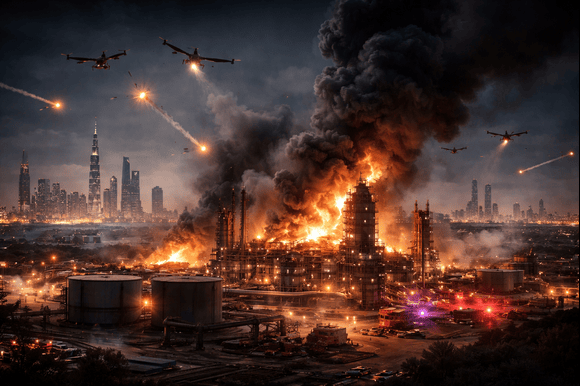
Kuwait has reported that Iranian drone strikes have caused significant damage to two major power and water desalination facilities, while also igniting a fire at a key oil complex, though no injuries have been reported so far.
Officials say the Gulf nation is among several countries absorbing the impact of Tehran’s retaliatory actions following US and Israeli strikes on Iran that began on February 28. Fatima Abbas Johar Hayat, spokesperson for Kuwait’s Ministry of Electricity, Water and Renewable Energy, described the overnight assault as a “criminal aggression” that resulted in “serious material damage” to critical infrastructure, including the shutdown of two electricity-generating units at the affected plants.
The strikes mark the latest in a series of attacks targeting civilian and strategic facilities across Kuwait. Separate drone incidents overnight also triggered a blaze at the Shuwaikh Oil Sector Complex and caused what authorities called “significant damage” to a nearby government office complex.
Reporting from Kuwait City, Al Jazeera correspondent Malika Traina characterized the developments as “devastating,” emphasizing the crucial role desalination plants play in the country’s survival. “Water desalination here and across the Gulf is extremely important,” she said, noting that nearly 90 percent of Kuwait’s drinking water is produced by such facilities.
Kuwait, alongside the United Arab Emirates, has found itself at the “epicentre” of Iran’s recent wave of attacks, according to Al Jazeera’s Victoria Gatenby, reporting from Doha. She warned that fears are mounting across the region that further escalation by Donald Trump and Benjamin Netanyahu could provoke Iran into expanding its strikes on similar infrastructure throughout the Gulf.
Elsewhere in the region, Bahrain also came under attack on Sunday. The country’s national oil company, Bapco Energies, confirmed that an oil storage tank caught fire following an الإيراني strike. The blaze was quickly brought under control, and no casualties were reported, though officials said damage assessments are still ongoing.
Earlier, Bahrain’s Ministry of the Interior had acknowledged the fire without specifying its exact location, later confirming that civil defence teams had successfully extinguished flames that erupted “as a result of the Iranian aggression.” The announcement followed the activation of air raid sirens across parts of the country.
In Abu Dhabi, authorities reported multiple fires at the Borouge petrochemical plant after debris from intercepted projectiles fell onto the site. According to a statement from the Abu Dhabi Media Office, operations at the facility have been immediately suspended while a full damage assessment is conducted. Officials reiterated that no injuries have been recorded.
Meanwhile, Saudi Arabia said it successfully intercepted incoming missiles early Sunday. Despite Iran’s claims that its operations are limited to targeting US military bases and assets, regional observers say recent weeks have shown a clear pattern of strikes hitting civilian and energy infrastructure as well.
Gatenby noted that while Gulf nations have demonstrated “incredible restraint” over the past five weeks, this should not be mistaken for an inability to respond. Increasingly, officials across the region are signaling that their patience is wearing thin and may not remain “unlimited” if such attacks persist.
Saudi Arabia, in particular, has recently emphasized its right to self-defence under Article 51 of the UN Charter, underscoring a potential shift in posture should the situation continue to deteriorate.
Although members of the Gulf Cooperation Council continue to stress that de-escalation and diplomatic dialogue remain their top priorities, analysts and officials alike warn that continued attacks on critical infrastructure could push some states toward a more assertive defensive stance in the near future.