

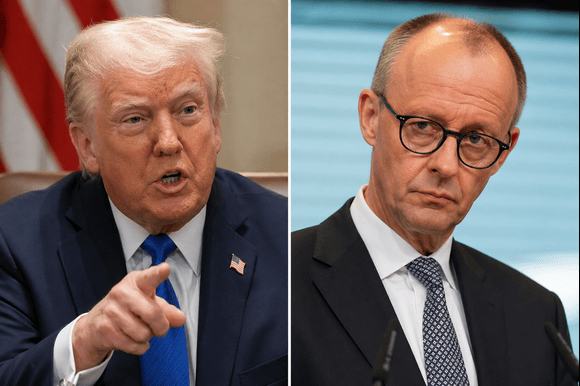
Tensions between the United States and Germany have escalated further as Donald Trump renewed his criticism of German Chancellor Friedrich Merz, highlighting a growing divide between Washington and one of its key European allies over Berlin’s stance on the ongoing war with Iran.
In remarks posted on social media Thursday, Trump suggested that Merz should concentrate more on domestic and regional issues rather than commenting on developments in the Middle East conflict. The US president argued that the German leader ought to prioritise efforts to address the war between Russia and Ukraine—where he claimed Merz has been ineffective—as well as tackle challenges within Germany itself, including immigration and energy concerns. Trump criticised what he described as interference from Berlin in matters related to efforts to counter Iran’s nuclear ambitions.
Trump went on to defend the military campaign against Iran, asserting that the conflict is contributing to global security. He claimed that actions taken against Tehran are making the world, including Germany, a safer place, even as the war continues to drive up global energy prices and fuel economic uncertainty.
The exchange underscores increasing strain within the transatlantic alliance, particularly as the Iran conflict deepens. The United States launched the campaign in coordination with Israel but without consulting its NATO allies, a move that has caused unease across Europe and exposed divisions within the bloc.
On Wednesday, Trump added to tensions by indicating that his administration is considering reducing the number of US troops stationed in Germany. The American military presence there has long been viewed as a cornerstone of Europe’s security framework and a key element of Washington’s commitment to NATO.
German officials have responded cautiously to the possibility of a troop reduction. Johann Wadephul stated that Berlin is prepared for such a scenario, while emphasising the importance of continued coordination within NATO. He noted that discussions with the United States are ongoing and being conducted in a spirit of trust, with Germany awaiting formal decisions from Washington.
The current dispute was sparked by comments from Merz, who had previously aligned closely with the United States and Israel on a firm approach toward Iran. However, he recently raised concerns about Washington’s broader strategy in the conflict. Drawing on past military engagements, Merz pointed to the long-term challenges of entering and exiting conflicts, referencing the experiences of the wars in Afghanistan and Iraq as cautionary examples.
Merz also suggested that the US administration is facing difficulties in negotiations with Tehran, describing the situation as one in which Washington risks being outmanoeuvred by Iran’s tactics. He highlighted Tehran’s refusal to engage in direct talks until certain conditions—such as lifting the naval blockade on its ports—are met.
Trump responded sharply to those remarks earlier in the week, dismissing Merz’s assessment and stating that the German leader does not understand the situation.
German officials have since attempted to soften the tone of the dispute. Wadephul clarified in an interview that Merz’s comments were intended to highlight what Berlin views as Iran’s problematic behaviour during negotiations. He echoed Washington’s criticism of Tehran, saying that Iran appears to be delaying meaningful engagement and failing to negotiate in a constructive manner.
Germany remains a significant military supporter of Israel and has maintained a strong موقف in backing its actions. At the same time, Berlin has faced criticism domestically and internationally over its handling of pro-Palestinian activism, with some groups alleging increased restrictions, arrests, and surveillance measures.
Earlier in the conflict, when Israel initiated airstrikes on Iran, Merz had voiced strong support, stating that Israel was effectively carrying out actions on behalf of the broader international community.
Despite the recent friction with Washington, Merz has reaffirmed Germany’s commitment to the transatlantic alliance. Speaking on Thursday, he emphasised that Berlin remains firmly aligned with NATO and values its longstanding partnership with the United States. He described the alliance as central to Germany’s strategic outlook, particularly during what he called a turbulent period in global affairs.
However, Trump has continued to express frustration with NATO, particularly over its reluctance to become directly involved in the Iran conflict or assist in efforts to reopen the strategically crucial Strait of Hormuz by force.
The US president has consistently framed the war as a necessary step to prevent Iran from developing nuclear weapons. This position, however, has been complicated by previous assessments from American intelligence officials. Tulsi Gabbard stated last year that there was no evidence Tehran was actively building a nuclear weapon.
In the months leading up to the renewed military campaign, Trump had repeatedly asserted that earlier US strikes on Iranian nuclear facilities in June 2025 had effectively destroyed the country’s nuclear programme. He described those actions as having “obliterated” Iran’s capabilities, a claim that continues to be debated among analysts and policymakers.
As the war continues and diplomatic tensions rise, the strike between Washington and Berlin reflects broader challenges facing the transatlantic alliance, with disagreements over strategy, military involvement, and long-term objectives becoming increasingly difficult to bridge.