


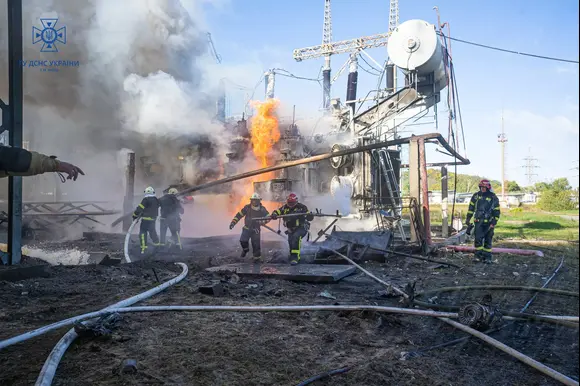
Russian drone and missile strikes across Ukraine have killed at least 10 people and injured a further 76 over the past 24 hours, according to Ukrainian officials, as the intensity of cross-border attacks continues to escalate.
Authorities reported fatalities across five different regions, underscoring the widespread impact of Moscow’s ongoing campaign of aerial assaults targeting Ukrainian cities and infrastructure. The strikes are part of a sustained pattern of drone and missile attacks that have intensified in recent months.
At the same time, Ukrainian President Volodymyr Zelensky said Ukrainian forces had carried out retaliatory operations against Russian naval and energy assets. According to Zelensky, three Russian oil tankers, a cruise missile-capable warship, and a patrol vessel were struck in separate attacks on two Russian ports.
While detailed assessments of the damage to the ships have not been released, Zelensky stated that the targeted tankers were part of Russia’s so-called “shadow fleet,” which he said is used to circumvent Western sanctions imposed after Moscow launched its full-scale invasion in 2022.
Ukraine’s air force reported that Russia launched a total of 269 drones overnight. Of those, 249 were either intercepted or neutralised through electronic jamming systems. Despite the high interception rate, officials confirmed that 19 drones successfully struck targets directly, while a ballistic missile also hit one location. Additionally, falling debris from intercepted drones caused damage in several areas.
Casualties were recorded in multiple regions. Ukrainian officials said that three people were killed in separate incidents in the Kherson region. Two fatalities were reported in each of the Odesa, Donetsk, and Zaporizhzhia regions, while one person was killed in the Sumy region. The attacks left dozens injured and caused significant damage to residential and infrastructure sites.
Meanwhile, Russia’s military claimed that Ukraine had launched at least 334 drones targeting its territory, with the north-western Leningrad region described as one of the primary areas affected. Russian officials said that export terminals in the region, along with facilities in other areas, have come under repeated Ukrainian strikes in recent weeks.
These Ukrainian operations have focused heavily on Russian oil infrastructure. Kyiv maintains that such strikes are aimed at weakening Russia’s ability to fund its war effort. Ukrainian officials claim the attacks have disrupted billions of dollars’ worth of Russian energy exports.
On Sunday, Zelensky said that infrastructure at the Primorsk oil terminal on the Baltic Sea—located near Finland—had sustained significant damage. He added that an oil tanker and a patrol boat were hit during the same operation. According to the Ukrainian leader, a third vessel struck at the site was a Karakurt-class corvette, a type of warship designed to carry Kalibr cruise missiles.
In a separate development, Zelensky earlier reported that two additional oil tankers were hit by Ukrainian drones near the entrance to the Black Sea port of Novorossiysk, one of Russia’s key export hubs.
“These tankers were actively used for transporting oil. Now they will not be,” Zelensky wrote in a post on Telegram, indicating that the vessels were no longer operational following the strikes.
The statement was accompanied by black-and-white video footage that appeared to show a naval drone approaching one of the targeted tankers, highlighting the increasing sophistication and reach of Ukraine’s maritime drone capabilities.
Russian authorities have largely downplayed the impact of such attacks on their infrastructure. However, there are growing indications that the Kremlin is increasingly concerned about Ukraine’s ability to carry out long-range strikes deep داخل Russian territory.
Earlier in the week, the Kremlin announced that it would scale back its annual Victory Day military parade on 9 May, which commemorates the defeat of Nazi Germany in World War II. Officials cited what they described as a “terrorist threat” from Ukraine as the reason for reducing the scale of the event.
Ukraine has significantly stepped up its drone campaign inside Russia in recent months, more than four years into the full-scale conflict. These operations mark a shift toward targeting critical infrastructure and military assets far beyond the immediate front lines.
Kyiv insists that its strikes are directed at legitimate military and economic targets that support Russia’s war effort. At the same time, Ukrainian officials continue to accuse Moscow of deliberately targeting civilians through its ongoing missile and drone attacks across Ukrainian cities.
The latest exchange of strikes highlights the escalating nature of the conflict, with both sides intensifying their use of drones and long-range weapons, raising concerns about further destabilisation in the region.