

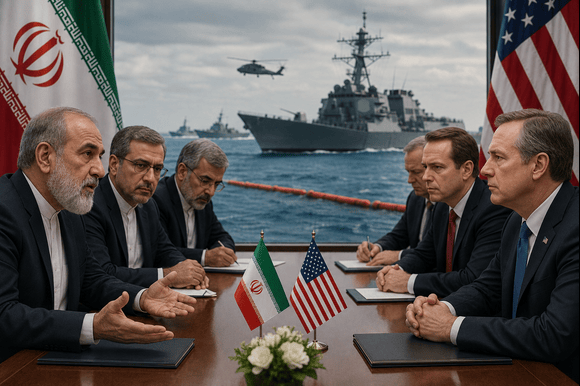
Iran has formally responded to a United States proposal aimed at ending the ongoing conflict between the two countries, with the reply delivered through Pakistani mediation, according to Iran’s state-run IRNA news agency.
The report, published on Sunday, said the Iranian response outlines a framework for negotiations that would initially focus on halting military hostilities and restoring maritime security in the Gulf region and the Strait of Hormuz one of the world’s most critical oil shipping routes.
A Pakistani diplomatic source also confirmed to that Islamabad had transferred Tehran’s response to Washington, underscoring Pakistan’s growing role as a key intermediary in the sensitive negotiations.
The US had earlier presented Iran with a 14-point proposal designed to establish a path toward de-escalation and a possible long-term settlement. Under the American proposal, Iran would be required to commit to abandoning any effort to develop nuclear weapons and suspend all uranium enrichment activities for at least 12 years.
The proposal further demanded that Tehran surrender approximately 440 kilograms (970 pounds) of uranium enriched to 60 percent purity a level that has raised international concern because it is close to weapons-grade material.
In exchange, Washington reportedly offered a gradual lifting of economic sanctions imposed on Iran, the release of billions of dollars in frozen Iranian assets abroad, and an end to the US naval blockade targeting Iranian ports.
The diplomatic developments come at a particularly sensitive moment, just days before US President Donald Trump is scheduled to visit China, a country that remains one of the largest buyers of Iranian oil and maintains major strategic and economic interests in the region.
Despite the ongoing diplomatic efforts, tensions in and around the Strait of Hormuz remain high. Over the past week, US and Iranian forces have exchanged fire in the waterway, although neither side has formally declared the collapse of the ceasefire that has technically remained in effect since April 8.
President Trump has repeatedly argued that Iran is under severe economic pressure due to the American naval blockade, which began at 14:00 GMT on April 13. According to Washington, the blockade has significantly reduced Iran’s oil exports and is costing Tehran millions of dollars every day.
However, analysts say Iran still possesses enough political resilience and economic capacity to endure the pressure for an extended period, especially with support from regional allies and continued oil trade with countries such as China.
Iranian parliamentary speaker Mohammad Bagher Ghalibaf, who is also leading Tehran’s negotiating team in the ceasefire discussions, stated earlier this week that a sustainable ceasefire would only be possible if the United States agreed to lift its naval blockade.
Tehran has also responded aggressively to Washington’s measures. Iranian authorities closed the Strait of Hormuz to foreign commercial traffic and seized several foreign-flagged vessels in recent weeks. Before the full closure, Iran had selectively allowed ships from countries considered “friendly” to continue passing through the strategic route.
The closure of the strait has alarmed governments and financial markets worldwide because nearly a fifth of global oil shipments normally pass through the narrow waterway.
Reporting from Islamabad, Al Jazeera correspondent Kamal Hyder said Pakistan is now actively encouraging Iran to soften some of its positions and seek compromise in order to prevent further escalation.
Hyder noted that details of Tehran’s response remain highly confidential due to the sensitive nature of the diplomacy involved.
“Other countries including Qatar, Saudi Arabia, Turkiye, and China are also maintaining close contact with Iran and its foreign minister as part of wider mediation efforts,” he said.
According to Hyder, regional powers are increasingly concerned about the broader economic fallout from the continued tensions in the Gulf, particularly the impact of disruptions in the Strait of Hormuz.
“The stakes are extremely high,” Hyder said, adding that Pakistan itself is facing serious economic strain because of soaring fuel prices triggered by instability in global oil markets.
He said Islamabad’s relatively balanced relations with both Tehran and Washington could place Pakistan in a favourable position to help broker some form of breakthrough in the coming days.
“The next few days will be critical,” Hyder added. “Everything will depend on how positively the United States responds to the Iranian position.”
Meanwhile, Abbas Aslani, a senior research fellow at the Center for Middle East Strategic Studies, described Iran’s latest communication not as a direct acceptance or rejection of the American proposal, but rather as an attempt to clarify Tehran’s interpretation and concerns regarding the US demands.
Speaking to Al Jazeera, Aslani said an agreement focused initially on peace and de-escalation could help build trust between the two sides and create momentum for broader negotiations.
However, he warned that the talks could quickly collapse if Washington insists on conditions Tehran views as unacceptable, particularly demands related to exporting its highly enriched uranium or suspending enrichment activities for an extended period.
“If the US continues to insist on those demands,” Aslani said, “it could make reaching any final agreement impossible.”
With mediation efforts intensifying and pressure mounting on all sides, diplomats say the coming week may determine whether the region moves toward a broader settlement or slides deeper into confrontation.