


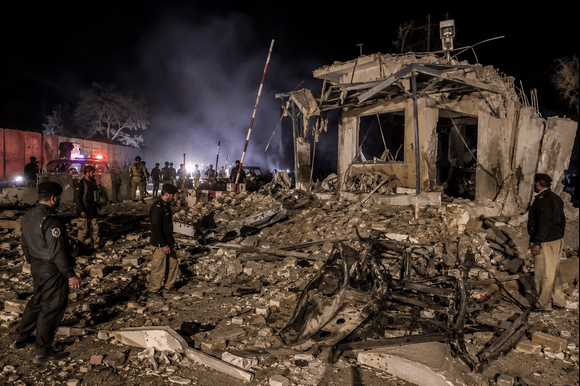
At least 15 police officers were killed after a devastating suicide car bombing followed by a coordinated armed assault on a security checkpoint in north-western Pakistan, authorities said on Sunday.
The attack took place late Saturday night in the city of Bannu in Pakistan’s Khyber Pakhtunkhwa province, an area that has frequently witnessed militant violence in recent years.
According to police officials, the assault began when a suicide bomber drove a vehicle packed with explosives directly into a police guard post at the checkpoint. The massive blast ripped through the facility, destroying large sections of the structure and killing officers stationed there.
Security officials said the force of the explosion reduced the checkpoint to rubble, scattering debris, shattered concrete and twisted metal across the surrounding area.
After the explosion, armed attackers reportedly stormed a nearby adjoining building and opened fire on surviving police personnel. Authorities said reinforcements dispatched to the scene were also ambushed and came under heavy gunfire as the attack unfolded.
A newly formed Islamist militant alliance known as Ittehad-ul-Mujahideen claimed responsibility for the operation. The group is believed to have links with Tehreek-e-Taliban Pakistan (TTP), commonly referred to as the Pakistani Taliban.
Police officials confirmed that rescue teams managed to pull three officers alive from the wreckage hours after the explosion. The injured personnel were rushed to a nearby hospital for treatment and were later reported to be in stable condition.
Emergency crews and rescue workers continued search operations through the night amid fears that additional victims could still be trapped beneath the collapsed structures.
Photographs and videos circulating from the site showed scenes of extensive devastation, with burned vehicles, collapsed walls and wreckage spread around the destroyed checkpoint.
Senior police officer Sajjad Khan praised the actions of security personnel who responded during the assault, saying officers displayed exceptional bravery despite the scale and intensity of the attack.
“Our force showed courage and resilience in an extremely difficult situation,” Khan said in an official statement issued after the attack.
He strongly condemned the bombing, describing it as a “cowardly act of extremism”, and vowed that those responsible would be brought to justice.
“This intolerable act by extremists will not go unanswered, and the blood of the martyrs will be accounted for,” the statement added.
Pakistan’s President Asif Ali Zardari also condemned the attack and expressed condolences to the families of the slain officers.
In a statement released by the presidency, Zardari said the entire nation stood firmly with its security forces in the fight against militancy and terrorism.
“The nation stands shoulder-to-shoulder with its brave security personnel,” the statement read.
“The evil intentions of terrorists will ultimately be defeated.”
The deadly assault is the latest in a growing wave of militant attacks targeting security forces and civilians across Pakistan, particularly in Khyber Pakhtunkhawa and neighbouring Balochistan province.
Pakistan has witnessed a sharp increase in violence over the past two years, with armed groups intensifying attacks on military bases, police stations, checkpoints and government installations.
In February, dozens of people were killed and more than 160 injured in a suicide bombing at a mosque in the capital Islamabad. That attack was claimed by the armed group Islamic State.
The mosque bombing came only days after multiple coordinated gun and bomb attacks struck Pakistan’s south-western Balochistan province, where separatist insurgents have long waged a violent campaign against the state.
Pakistani authorities have repeatedly accused militant organizations operating from Afghan territory of orchestrating attacks inside Pakistan.
Islamabad maintains that fighters use safe havens across the border to plan and launch operations targeting Pakistani security forces and civilians.
The Afghan Taliban government, however, has consistently denied those accusations, insisting it does not allow Afghan soil to be used against neighboring countries.
Security analysts say the emergence of new militant alliances has complicated Pakistan’s counterterrorism efforts.
According to the Pakistan Institute for Conflict and Security Studies, Ittehad-ul-Mujahideen was established in April 2025 through an alliance between the Hafiz Gul Bahadur Group (HBG), Lashkar-e-Islam and Harkat Inqilab-e-Islami Pakistan (HIIP).
The organisation reportedly seeks to coordinate militant activities and strengthen cooperation among various armed factions operating in north-western Pakistan.
Analysts note that the Hafiz Gul Bahadur Group has previously carried out multiple attacks in and around Bannu, making the district one of the most volatile regions in Khyber Pakhtunkhawa.
Meanwhile, the Combating Terrorism Center at the United States Military Academy at West Point has previously identified Lashkar-e-Islam as an ally of the Pakistani Taliban.
Security forces in Pakistan remain on high alert following the latest bombing, with authorities fearing further retaliatory attacks by militant groups in the coming days.