

Israel Expands West Bank Military Raids After Deadly Shooting as UN Condemns Escalating Settler Violence
Israeli forces have intensified their military operations across the occupied West Bank, carrying out large-scale raids and arresting dozens of Palestinians following a deadly shooting that left four Palestinians and two Israeli soldiers dead, further escalating tensions in the already volatile territory.
On Saturday morning, Israeli troops launched an extensive operation in the village of Tal, southwest of Nablus, where Friday’s deadly confrontation occurred. According to local sources, nearly 50 Palestinians were detained as Israeli soldiers searched approximately 70 homes across the village. Videos circulated by the Quds News Network showed two blindfolded Palestinian men being escorted away by heavily armed Israeli troops during the operation.
The Israeli military described the campaign as part of an “extensive” security operation initiated in response to Friday’s attack near the illegal Havat Gilad settlement in the northern West Bank.
The military escalation followed orders issued on Friday by Israeli Prime Minister Benjamin Netanyahu and Defence Minister Israel Katz, who instructed security forces to launch a “wide-scale military operation” targeting Palestinian villages throughout the occupied West Bank after an attack near Havat Gilad killed two Israeli soldiers and wounded three others.
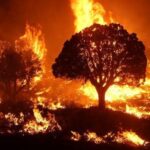
While Israeli forces expanded their operations, violence involving Israeli settlers also intensified across the region. Palestinian residents and eyewitnesses reported that groups of settlers attacked several Palestinian communities in the Nablus governorate, setting fire to homes, agricultural land and other civilian property.
The Palestinian Health Ministry said that at least 87 Palestinians have been killed by Israeli forces or settlers across the occupied West Bank since the beginning of the year. According to the ministry, 21 of those deaths were attributed to Israeli settlers. Palestinian officials and human rights organisations argue that settler violence has surged amid the ongoing war in Gaza and has been encouraged by what they describe as insufficient international pressure on Israel, as well as inflammatory rhetoric from far-right Israeli ministers Itamar Ben-Gvir and Bezalel Smotrich.
International criticism of the latest violence also intensified on Saturday. Francesca Albanese, the United Nations Special Rapporteur on the situation of human rights in the occupied Palestinian territories, condemned the attacks on Palestinian civilians, describing them as “pogroms.”
In a statement posted on the social media platform X, Albanese accused both Israeli settlers and the Israeli military of acting together during attacks on Palestinian communities.
“Pogroms against defenceless civilians all over the West Bank, while Gaza is under fire,” she wrote.
Albanese argued that responsibility extended beyond Israel’s political leadership and could not be attributed solely to Prime Minister Netanyahu or “a few rotten apples.”
She renewed her call for an immediate international arms embargo on Israel and urged countries to suspend trade with the country, saying such measures were required under international law.
Israeli human rights organisations have likewise called on the international community to take urgent steps to curb what they describe as state-backed settler violence. Rights groups say attacks by settlers have increased significantly since Israel launched its military campaign in Gaza in 2023, warning that the lack of accountability has encouraged further violence throughout the West Bank.
Israeli military operations continued well beyond Tal on Saturday. Security forces carried out additional raids in the northern city of Jenin, as well as in surrounding towns and villages across the governorate. Troops searched multiple homes while maintaining a heavy military presence throughout the area.
Elsewhere in the northern West Bank, Israeli forces entered the city of Tubas and later advanced into the Far’a refugee camp located south of the city.
According to the Palestinian news agency Wafa, a large convoy of Israeli military vehicles entered Tubas, deploying soldiers throughout several neighbourhoods. Troops reportedly conducted house-to-house searches for approximately three hours before moving towards the nearby refugee camp.
Israeli forces also launched operations in several other locations across the occupied territory. These included the village of Far’ata, east of Qalqilya, where Al Mayadeen English reported that at least eight Palestinians were injured during clashes with Israeli forces.
Additional raids were reported in the Aqbat Jabr refugee camp near Jericho and in the village of Kobar, located within the Ramallah and el-Bireh Governorate, as military operations spread across multiple areas of the West Bank.
Meanwhile, Palestinian families in Tal held overnight funerals for the four Palestinians killed during Friday’s violence.
Residents said Israeli authorities prevented them from conducting the funerals during daylight hours, forcing families to bury their relatives overnight under tight restrictions. According to local reports, only a limited number of mourners were permitted to attend the funeral processions.
Friday’s confrontation in Tal has become one of the deadliest incidents witnessed in the West Bank in recent months, with conflicting accounts emerging over how the violence unfolded.
Israeli civilians are generally prohibited from entering Tal because the village falls under the administrative control of the Palestinian Authority. However, videos recorded during the incident appear to show armed Israeli settlers confronting groups of Palestinian residents.
Separate footage circulating online appears to show a Palestinian man wresting a firearm from one of the settlers before fatally shooting him in what observers have described as an apparent act of self-defence. Israeli soldiers subsequently opened fire, killing the Palestinian man. Three other Palestinians also lost their lives during the confrontation.
Ubai Al Aboudi, a Palestinian rights activist based in Ramallah, told Al Jazeera that settler attacks against Palestinian communities have become systematic rather than isolated incidents.
He said the violence occurring in Tal reflects a much broader pattern unfolding across the occupied West Bank.
“This is not an isolated incident. It is happening all across the West Bank,” Al Aboudi said.
He noted that Tal had also come under attack only a week earlier, on July 18, when Israeli settlers entered the village posing as hikers.
According to Al Aboudi, the settlers set fire to a family home while its occupants remained inside.
“So-called hikers, as Israeli officials called them, came into the village, burned a family house with the family still inside it, and it was a miracle that the residents of Tal were able to get that family out of the house before they were burned alive,” he said.
Human Rights Watch has also urged Israeli authorities to take immediate action to prevent further retaliatory attacks by settlers against Palestinian civilians.
Sarah Sanbar, acting Israel and Palestine researcher at Human Rights Watch, said the Israeli government had failed to prevent the attacks on Tal and now had an obligation to stop further violence before the situation deteriorated further.
“The Israeli government didn’t prevent the settler attacks on Tal village, so now it needs to stop settler reprisals and escalating military action that will make a bad situation worse,” Sanbar said.
She warned that years of inadequate law enforcement and continued impunity for attacks by settlers had transformed the occupied West Bank into what she described as “a powder keg waiting to explode.”
Sanbar concluded that decisive and immediate action is urgently needed to prevent further bloodshed as tensions continue to rise across the occupied Palestinian territory.