


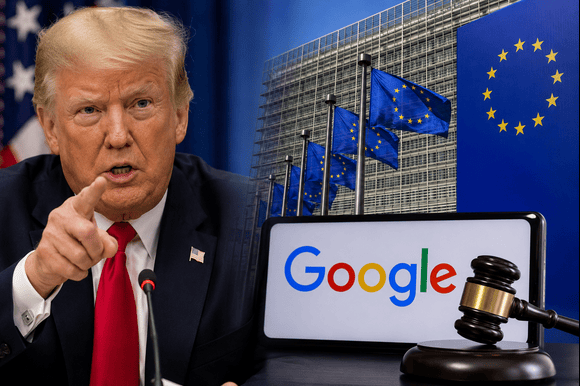
United States President Donald Trump has threatened to impose steep new tariffs on the European Union and launch a fresh trade investigation after Brussels imposed a $1 billion antitrust fine on Google, accusing the bloc of unfairly targeting American technology companies and warning that Europe “will pay a very big price” for its actions.
Speaking on Friday, Trump sharply criticised the European Commission’s decision to penalise Google, describing the action as politically motivated and discriminatory towards US businesses. He argued that the European Union has repeatedly singled out American technology firms while benefiting economically from the United States.
Calling the penalties against Google and other US technology companies “highly unethical,” Trump declared that the United States “is not a ‘PIGGYBANK’ for Europe,” signalling that Washington could respond with significant economic measures if Brussels continues what he views as unfair treatment of American businesses.
In a post on social media, Trump also blamed the previous administration for allowing such policies to continue unchecked.
“This illegal and highly discriminatory practice started at these high levels during the first year of the Sleepy Joe Biden Administration, but it’s not going to continue during the Trump Administration,” he wrote.
Trump’s remarks came a day after the European Commission announced a $1 billion fine against Google, concluding that the company had violated the European Union’s Digital Markets Act by giving unfair preference to its own services in online search results while restricting app developers from directing consumers to alternative purchasing options outside its platform.
The Commission ruled that Google had used its dominant market position to promote its own shopping, travel and other digital services ahead of competing businesses, limiting fair competition within the European digital marketplace.
European regulators also found that Google had prevented application developers from steering customers toward better offers or subscription services available outside the Google Play Store, a practice they said restricted consumer choice and harmed market competition.
The European Commission divided the financial penalty almost equally between the two separate breaches identified during its investigation. Regulators have given Google 60 days to bring its business practices into compliance with European competition rules or face additional periodic penalties that could amount to as much as five percent of the company’s average daily global turnover.
The latest enforcement action has added fresh strain to relations between Washington and Brussels at a time when trade tensions between the two allies had appeared to be easing after months of negotiations.
European Commission Executive Vice President Teresa Ribera, who oversees competition policy, defended the decision on Thursday, describing the ruling as both firm and proportionate.
Ribera said the Commission’s action was “decisive yet balanced,” arguing that companies should succeed because of the quality and competitiveness of their products rather than through ownership advantages or market dominance.
Google strongly rejected the European Commission’s findings.
Kent Walker, one of the company’s senior executives, criticised the ruling, arguing that it would ultimately harm consumers instead of improving competition.
Walker described the decision as an example of “product degradation” driven by complaints from a relatively small number of competitors. He maintained that regulatory intervention should encourage innovation and improve digital products rather than weaken services relied upon by millions of users.
The latest penalty marks another chapter in the European Union’s long-running legal battle with Google, which has faced repeated antitrust enforcement from Brussels over the past several years.
Since 2017, European regulators have imposed multiple multi-billion-dollar penalties on the technology giant over a range of competition concerns.
Among the largest was a $4.5 billion fine related to Google’s Android mobile operating system, a decision that was upheld on appeal earlier this month.
Last year, Google was also fined $3.4 billion over alleged anti-competitive practices within its online advertising business, further reinforcing the European Union’s aggressive approach towards regulating major digital platforms.
The newest fine has once again placed trade relations between the United States and the European Union under renewed pressure.
Earlier this week, US Trade Representative Jamieson Greer warned that the European Union’s regulatory approach towards American technology companies could undermine a trade agreement reached in Turnberry, Scotland, last year.
The deal had helped ease trade disputes by limiting US tariffs on a range of European exports and was viewed as an important step towards improving transatlantic economic relations.
Greer cautioned that continued legal action targeting major US technology firms could jeopardise the progress made under that agreement and risk reopening broader trade disputes between the two economies.
European officials, however, have dismissed suggestions that their competition policies are influenced by international political pressure.
Brussels insists that enforcement decisions are based solely on European law and regulatory obligations rather than diplomatic considerations or trade negotiations with foreign governments.
Despite those assurances, Trump has signalled that his administration is prepared to respond aggressively if European regulators continue imposing heavy financial penalties on American companies.
The US president said his administration is considering launching an investigation under Section 301 of the US Trade Act, a legal mechanism used to examine whether foreign governments are engaging in unfair trade practices that discriminate against American businesses.
A Section 301 investigation typically involves a lengthy review process and could take several months before formal conclusions are reached.
However, trade experts note that while such an investigation proceeds, the Trump administration could choose to impose tariffs on selected European goods much sooner if it determines that immediate action is warranted.
The latest dispute underscores growing tensions between Washington and Brussels over digital regulation, competition policy and trade, with both sides defending their respective legal frameworks while raising the possibility of a renewed transatlantic trade confrontation that could affect major industries and global markets.