

Ukraine’s recent political upheaval may appear to have eased following the appointment of an acting defence minister and a new commander-in-chief of the armed forces, but the controversy surrounding President Volodymyr Zelensky’s decision to remove Mykhailo Fedorov as defence minister continues to cast a shadow over the government in Kyiv.
Although new military leadership is now in place, the political repercussions of Zelensky’s cabinet reshuffle on 15 July remain far from resolved. The dismissal of Fedorov, one of Ukraine’s most popular and recognisable political figures, has sparked sustained public protests and intensified debate over the president’s leadership at a critical stage in the country’s war with Russia.
Even as air raid sirens continue to sound across Ukraine and Russian missiles and drones are intercepted almost daily, political tensions have become an increasingly prominent issue within the country’s capital.
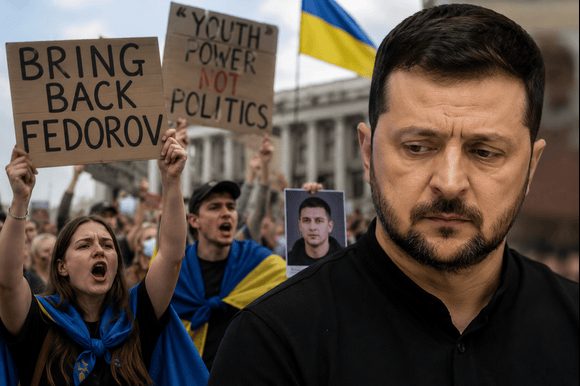
Supporters of Fedorov, many of them young Ukrainians who admire his reputation for driving technological innovation and digital transformation, continue to gather in daily demonstrations demanding that Zelensky reverse his decision and reinstate the former minister.
The protests have highlighted growing frustration among younger Ukrainians, many of whom view Fedorov as a symbol of modern leadership and believe his removal represents a setback for the country’s reform agenda.
Speaking publicly on Thursday, Fedorov confirmed that he had declined several alternative positions offered by President Zelensky following his dismissal.
According to Fedorov, there are only three government roles that carry sufficient authority to influence Ukraine’s wartime strategy: defence minister, commander-in-chief of the armed forces or president.
His remarks immediately fuelled speculation about his long-term political ambitions.
“If you don’t have a ministry under you, you don’t have a budget, and you don’t actually have the authority to do something,” former deputy defence minister Alina Frolova explained while discussing why other government positions would hold significantly less influence.
Fedorov’s reference to the presidency did not go unnoticed by political observers.
Several analysts interpreted the comments as the clearest indication yet that the former defence minister may now see himself as a future challenger to Zelensky.
One former defence official suggested that Fedorov effectively became a credible presidential contender the moment he was removed from office.
However, Ukraine remains under martial law because of Russia’s ongoing invasion, and the country’s constitution prohibits presidential elections during wartime.
As a result, some politicians question whether publicly positioning himself for future leadership is appropriate while the country remains locked in an existential conflict.
One opposition member of parliament, speaking anonymously, criticised Fedorov’s approach.
“He’s being childish,” the lawmaker said.
“He’s looking to further his political career, which I think is just stupid in the circumstances where we are.”
Supporters of President Zelensky argue that the president has worked extensively behind the scenes to stabilise the political situation, particularly regarding one of the most contentious decisions involving the military’s senior leadership.
Following the departure of General Oleksandr Syrskyi as commander-in-chief, Zelensky eventually selected Major General Mykhailo Drapatyi, a 43-year-old officer widely respected for his battlefield leadership and previous command of Ukraine’s land forces.
The appointment has received broad support from military figures and political observers.
Former government adviser Yuriy Sak said the president had undertaken extensive consultations before making the decision.
“He consulted pretty much every significant figure in the Ukrainian army,” Sak said.
“So the decision that he has taken now is very well informed, and I support it because General Drapatyi is a young, battle-proven, modern general who will take our defences to a new level, hopefully.”
Despite the positive reception to Drapatyi’s appointment, many analysts believe the decision only partially addresses the broader political crisis created by Fedorov’s dismissal.
Ironically, Zelensky himself rose to power in 2019 largely because he represented youthful leadership, political renewal and a break from traditional politics.
Critics now argue that the president underestimated the extent to which younger Ukrainians identify with Fedorov’s image as an energetic reformer and technology-driven policymaker.
Oleksandr Merezhko, a member of parliament from Zelensky’s Servant of the People party, acknowledged why many young voters continue to support the former minister.
“It’s quite natural that people want to see someone who is a warrior against corruption, who is very modern, who is young,” Merezhko said.
“People want to see something like that in politics, which they consider to be dirty and full of hypocrisy. They need heroes.”
However, Merezhko also suggested that Fedorov’s growing popularity may ultimately have contributed to his removal.
He argued that Zelensky has previously shown a willingness to sideline influential political figures whom he perceives as potential rivals.
Referring to Robert Greene’s book The 48 Laws of Power, Merezhko summarised the situation with one familiar phrase.
“Don’t outshine your master.”
Many political analysts believe the primary objective behind last week’s cabinet reshuffle was to reduce Fedorov’s growing political influence.
Instead, they argue, the move has had precisely the opposite effect.
“His removal has led to the opposite result,” Merezhko observed.
“His rating soared. Just soared.”
While few question Fedorov’s energy, commitment and ability to inspire innovation, some experts believe public perceptions of his achievements have become exaggerated.
Several analysts point out that Ukraine had already made considerable progress in developing medium-range and long-range strike capabilities before Fedorov assumed responsibility for the defence ministry.
They also argue that many of the country’s military technological advances are the result of collaboration across thousands of private companies and defence specialists rather than the work of any single individual.
“The energy and clarity he brought to the job was impressive and he showed immense personal courage,” one former European defence official said.
“But the thing that will carry on regardless is the innovation culture. It’s 2,000 companies, not a single individual.”
Some politicians have expressed even stronger criticism of how Fedorov is perceived by the public.
An opposition MP, who requested anonymity, argued that many protesters misunderstand how Ukraine’s defence institutions actually function.
“Ninety-nine per cent of these young people on the street have no clue how the ministry of defence is operating, how the general staff is operating,” the lawmaker said.
“They think Fedorov is good because he wants to fight with drones and Syrskyi was bad because he was looking for people to fight. It’s a dramatic simplification which is totally wrong.”
Nevertheless, observers acknowledge that such public sentiment is understandable in a country that has endured more than a decade of conflict with Russia.
Many Ukrainians naturally hope that rapidly advancing drone technology, autonomous systems and artificial intelligence can increasingly replace frontline soldiers, reducing the need for further mobilisation and protecting families from additional losses.
Despite the political turbulence, government officials emphasise that Ukraine must quickly move beyond the controversy as the country prepares for another difficult winter.
Russian forces are widely expected to launch renewed attacks against Ukraine’s energy infrastructure during the colder months, making national unity increasingly important.
“We need to prepare for how we will get through the winter,” President Zelensky said in a message published on Telegram on Thursday.
Although the political dispute has undoubtedly damaged Zelensky’s public standing and created fresh challenges for his administration, most politicians and defence analysts interviewed believe the controversy is unlikely to significantly weaken Ukraine’s military position on the battlefield.
Ukraine continues to expand what Zelensky has described as its “long-range sanctions” campaign against Russia, targeting strategic economic assets and increasing pressure on Moscow’s economy.
Meanwhile, fighting along Ukraine’s extensive frontline has changed relatively little in recent months.
Military experts describe a vast “kill zone” stretching approximately 15 to 30 kilometres wide, where drones provide constant surveillance and rapidly target any movement by personnel or military equipment, making large-scale advances extremely difficult for either side.
As one of Europe’s youngest democracies, Ukraine’s political institutions continue to face extraordinary pressure under the strain of Russia’s full-scale invasion.
Despite internal political disagreements and leadership disputes, many observers argue that the country’s democratic system, military institutions and civil society have repeatedly demonstrated resilience, adaptability and determination in the face of unprecedented wartime challenges.