

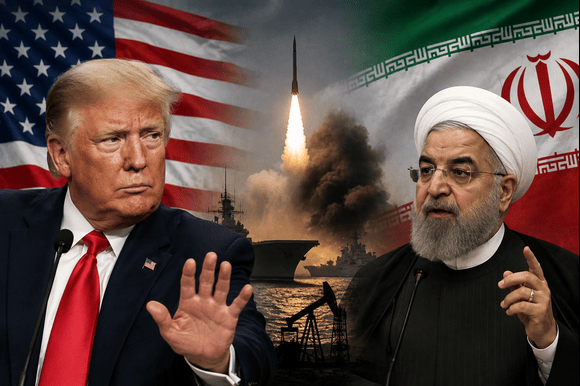
Iran has rejected US President Donald Trump’s assertion that fresh negotiations aimed at ending the conflict would begin on Monday, after Trump said he had cancelled what he described as potentially “massive” military strikes against the country.
Speaking to reporters aboard Air Force One on Sunday, Trump said Iran was aware of the scale of the planned military operation because it had seen the preparations taking shape.
“They knew the extent of the attack because they saw it forming,” Trump said, adding that discussions with Tehran were taking place through a negotiating process.
“We’re talking to them in the form of a negotiation. It begins tomorrow afternoon,” the US president said.
Earlier, Trump wrote on his Truth Social platform that Iran and several US allies in the Middle East had asked Washington to delay military action. He claimed that the broad “perimeters” of a possible agreement had already been established and that there was growing confidence a deal could be reached.
However, Iran’s foreign ministry rejected those claims on Monday, saying Tehran was not engaged in negotiations with the United States and that no new talks with Washington had been scheduled.
Foreign ministry spokesperson Esmaeil Baghaei said Iran was instead holding discussions with Oman in an effort to reach “an understanding over a path to ensure the security of shipping passage through the Strait of Hormuz”.
Previous contacts between Washington and Tehran have often been conducted indirectly, with regional governments and other intermediaries helping to facilitate communication between the two sides.
Trump has repeatedly expressed confidence that a negotiated settlement to the war was close. However, those predictions have been followed by renewed exchanges of military strikes, raising doubts about whether diplomatic efforts can produce a lasting agreement.
During his comments aboard Air Force One, Trump declined to provide a specific deadline for reaching an agreement with Tehran.
“We’ll just see how it is. We’re ready to go anytime we want,” Trump said, before adding: “I’m not looking to kill people.”
The US president did not explain where the negotiations he referred to would take place or identify the officials or representatives expected to participate.
Trump also said Saudi Arabia’s Crown Prince Mohammed bin Salman, along with major US partners in the region, including the United Arab Emirates and Qatar, had urged Washington not to carry out military strikes over the weekend.
“We were all set to go,” Trump said. “The reason they asked is [that] they think there’s a deal.”
“There’s a deal on Hormuz, and there will be a deal on the nuclear,” he added, referring to the strategic Strait of Hormuz and the long-running dispute surrounding Iran’s nuclear programme.
Global oil prices fell during Asian trading on Monday after Trump announced that the planned strikes had been postponed and suggested that diplomatic progress could be possible.
Brent crude was down by about 4.5%, trading at $83.98 (£62.26) per barrel. US-traded crude also declined by approximately 4.6% to $80.74 (£59.85) per barrel.
Energy markets have experienced significant volatility since the conflict began on 28 February. Traders have closely monitored the impact of the war on shipping routes and the movement of energy supplies through the Strait of Hormuz.
The narrow waterway is one of the world’s most important energy transit routes, with roughly 20% of global crude oil and liquefied natural gas supplies normally passing through the strait.
Iran’s semi-official Mehr news agency denied that Tehran had requested the United States to postpone further military action. The agency described Trump’s statements as “nothing but a new lie”.
Speaking aboard Air Force One, Trump said the military operation that had been prepared would have represented “the biggest attack since World War Two”. He suggested that launching the strikes could have damaged the possibility of reaching a negotiated settlement to end the conflict, which has continued for several months.
Trump declined to say whether the planned military action had included possible strikes on Iranian energy infrastructure. International law experts have warned that attacks deliberately targeting certain civilian energy facilities could potentially constitute war crimes, depending on the circumstances and the military purpose of the targets.
Iran’s acting Defence Minister Majid Ibn al-Reza said earlier that Tehran considered every threat made by its opponents to be serious and credible, even when such statements appeared to be part of psychological warfare.
“We will neither be caught off guard nor remain passive,” he said.
Trump has previously issued severe and apocalyptic warnings to Tehran before later saying that diplomacy should be given an opportunity to prevent further escalation.
In a Truth Social post published on Saturday, Trump said the United States was “locked and loaded and ready to go against the Islamic Republic of Iran, at levels of Military Terror, Strength, and Power not seen since World War II”.
However, he added that cancelling the planned military action could serve “the future benefit of the world and, likewise, the survival of a successful and prosperous Iran”.
On 7 April, Trump warned that “a whole civilisation will die tonight” if Iran refused to participate in peace negotiations. At that time, he also threatened possible attacks on civilian infrastructure and power facilities.
Those warnings eventually led to historic face-to-face negotiations in Pakistan, led by Vice-President JD Vance. Despite the high-level diplomatic engagement, the talks did not produce an agreement.
The Trump administration has also largely dismissed polling and economic data indicating that the war and its wider financial consequences are unpopular among many Americans, including a significant number of Republican voters.
Opinion polls showing broad dissatisfaction with the administration’s handling of the conflict have caused concern among some conservative political strategists ahead of the November midterm elections.
The growing public criticism has increased pressure on the administration as it attempts to balance military threats, diplomatic efforts and domestic political concerns while the conflict continues without a clear resolution.