

Moroccan authorities have intercepted more than 100 migrants who were reportedly attempting to reach the Spanish North African exclave of Ceuta, as security forces intensified their presence along the border following warnings of a possible new mass crossing.
According to Moroccan security sources cited by Spanish media and Reuters, 111 people were detained in and around the northern Moroccan town of Fnideq, known as Castillejos in Spanish. The town is located roughly 3km (1.8 miles) from the border with Ceuta. Most of those detained were reportedly migrants from sub-Saharan Africa.
The attempted crossing comes around two weeks after an unprecedented influx of migrants into Ceuta, when approximately 78,000 people reportedly reached the Spanish exclave by sea within a matter of hours. The city’s mayor said around 100 people died during the episode, while also stating that the overwhelming majority of those who arrived had subsequently returned to Morocco.
Following that mass arrival, Moroccan and Spanish authorities significantly increased security around the border amid growing concerns that another large-scale attempt could take place.
The latest security operation was reportedly prompted by messages circulating on social media encouraging migrants to gather and attempt another mass crossing during the weekend.
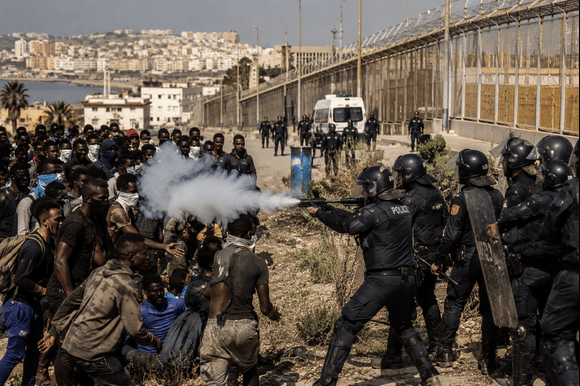
Moroccan police, including officers wearing riot-control equipment, were reported to have used tear gas to disperse groups of migrants who had gathered on hills close to Fnideq. Security forces moved to prevent the groups from advancing towards the heavily guarded border area.
Earlier in the week, Morocco’s government said it was closely monitoring what it described as social media posts and messages “of unknown origin” that were calling for a mass crossing on Saturday. Authorities warned that anyone organising or participating in an illegal mass crossing could face prosecution.
Security measures were further strengthened on Saturday. Spanish newspaper El País reported that security at the entrance to the breakwater leading towards Ceuta was around 10 times stronger than it had been the previous day.
Morocco reportedly deployed army personnel, navy speedboats and drones to monitor the coastline and surrounding areas. Spanish authorities also reinforced their side of the border, with Madrid deploying more than 1,500 security officers to patrol the area and prevent another large-scale influx.
Spain has also taken additional physical measures following last month’s crisis, including the installation of a metal fence and a floating barrier intended to prevent migrants from reaching the territory by sea.
The latest incident comes as tensions continue to surround migration routes between Morocco, Spain and other European Union countries. Although the situation around Ceuta had appeared to calm after the mass influx in late July, the episode has triggered a wider political dispute among European countries that share the continent’s open-border arrangements.
Italy suspended the 29-member Schengen free-movement arrangement with Spain and introduced border checks on people arriving from Spain. The decision was supported by Finland and Denmark, while the Czech Republic went further by calling for Spain’s membership of the Schengen system to be temporarily suspended.
The Spanish government reacted angrily to the measures. Prime Minister Pedro Sánchez argued that Ceuta is not part of the Schengen area and that migrants arriving there had therefore not entered mainland Spain or gained the right to travel onward to other European countries under Schengen’s free-movement rules.
Madrid urged Italy to remove its additional border controls. However, when Rome refused, Spain introduced its own measures, citing concerns about the possibility of another major influx around 15 August.
Italian Foreign Minister Antonio Tajani defended his government’s decision on Saturday, saying Italy had been concerned about the possibility of another large wave of migrants reaching Ceuta.
Tajani said Italy was not engaged in a “battle” against Spain and insisted that its border checks were simply intended to monitor arrivals carefully.
He also argued that Spain should focus its attention on Morocco rather than criticising Italy’s decision to strengthen controls, saying the source of the migration problem was on the Moroccan side of the border rather than Italy’s measures.
The renewed security operation highlights the continuing sensitivity of the Ceuta border, one of Europe’s most closely monitored migration routes. With Moroccan and Spanish forces maintaining a heightened presence and authorities closely tracking social media calls for further crossings, officials remain on alert for any attempt to repeat the mass movement witnessed last month.