

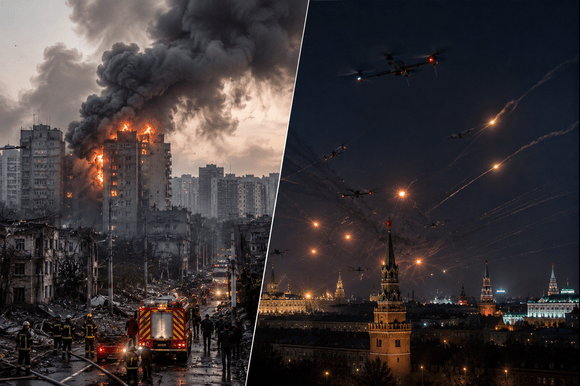
Russia and Ukraine exchanged another series of long-range attacks overnight, with a busy market in Kyiv suffering heavy damage during Russian strikes and officials in the Moscow region reporting what they described as a massive Ukrainian drone assault.
The attacks, which took place on Sunday, August 16, highlighted the growing use of missiles and drones by both sides to strike targets far beyond the front lines of the war.
In the Ukrainian capital, firefighters spent hours battling a large blaze after Russian missiles and drones struck the city. One of the hardest-hit locations was the Petrovka book market in Kyiv’s Obolonskyi district, where flames destroyed sections of the trading area and damaged businesses belonging to dozens of vendors.
The market is a well-known commercial centre where books and a variety of other goods are sold. Emergency services worked throughout the night to prevent the fire from spreading further as thick smoke rose over parts of the city.
Kyiv authorities said the attack began shortly after air-raid sirens sounded across the capital. Several explosions were heard, and fires broke out in more than one district.
Mayor Vitali Klitschko said emergency crews were deployed to multiple locations, while the city’s military administration reported that several people were injured during the attack.
The strikes on Kyiv formed part of a much wider Russian aerial offensive against Ukraine.
In Kryvyi Rih, President Volodymyr Zelenskyy’s hometown, Russian missiles hit the ArcelorMittal steelworks, one of the country’s major industrial facilities. Ukrainian officials said two people were killed and another 14 were wounded.
The attack damaged equipment linked to the plant’s power supply and blast furnaces, forcing parts of the facility to suspend operations while repairs were carried out.
Other regions of Ukraine also came under attack, including the Sumy area, where officials reported additional casualties.
President Zelenskyy condemned the latest Russian strikes, accusing Moscow of deliberately targeting civilian infrastructure and intensifying its air campaign.
He said Russia had dramatically increased the number of weapons launched against Ukraine over the previous week.
According to Zelenskyy, Russian forces fired more than 1,550 attack drones, nearly 1,560 guided aerial bombs and 62 missiles at Ukrainian towns and cities during the previous seven days.
He noted that many of the missiles were ballistic weapons, which remain among the most difficult threats for Ukraine’s air-defence systems to intercept.
While Ukraine was dealing with the Russian barrage, authorities in Russia said they were facing one of the largest Ukrainian drone attacks of the war.
Moscow Mayor Sergei Sobyanin said hundreds of drones had been launched towards the capital region. He claimed around 600 drones were headed for Moscow and that Russian air defences destroyed 201 over the area.
Russia’s Defence Ministry later said its forces had intercepted a total of 822 Ukrainian drones across the country during the latest wave of attacks. Those figures have not been independently confirmed.
Moscow Region Governor Andrei Vorobyov described the raid as an exceptionally large drone attack, saying it was among the biggest directed at the region since the conflict began.
Several fires and instances of damage were reported around Moscow following the drone strikes.
One of the most significant incidents occurred in Podolsk, south of the capital, where a warehouse belonging to Wildberries, Russia’s largest online retailer, caught fire.
The warehouse, located at the Koledino industrial complex about 45 kilometres south of Moscow, was engulfed by flames, sending a large plume of smoke into the air.
Vorobyov said an 83-year-old man was killed after a drone struck a private house in Podolsk. Several other people were injured in the Moscow region during the attack.
Additional fires were reported at industrial and warehouse sites in the Domodedovo area. Authorities also temporarily disrupted flights at several airports serving Moscow while air-defence forces responded to the incoming drones.
Elsewhere in Russia, officials reported five more deaths in the Rostov region linked to the broader Ukrainian drone campaign, while another person was reportedly killed near Belgorod.
Ukraine has steadily expanded its ability to launch drones deep into Russian territory during the war.
Kyiv has increasingly targeted oil depots, ports, warehouses, factories and other infrastructure that it says supports Russia’s military operations.
Some recent Ukrainian strikes have focused on facilities connected to Wildberries. Ukrainian officials have alleged that certain sites linked to the company are involved in military logistics, an accusation that Russian authorities have rejected.
The latest exchange of attacks illustrates how the conflict has increasingly extended far beyond the battlefield.
Both Russia and Ukraine are relying more heavily on long-range drones and missiles to hit military, industrial and economic targets hundreds of kilometres from the front.
Ukraine’s improved drone capabilities have allowed it to reach infrastructure deep inside Russia, while Moscow continues to launch large numbers of drones, cruise missiles and ballistic missiles against Ukrainian cities and industrial sites.
The attacks have also renewed concerns about Ukraine’s air-defence resources.
Ukrainian leaders have repeatedly asked Western allies for more interceptor missiles and additional Patriot air-defence systems, particularly to defend against Russia’s ballistic missile attacks.
Although Ukrainian forces have become increasingly effective at shooting down slower-moving drones, ballistic missiles remain a much greater challenge because of their speed and trajectory.
The overnight violence also affected neighbouring NATO territory.
Romanian authorities said an unidentified drone entered the country’s airspace during the wider exchange of attacks.
A Spanish F-18 fighter jet operating as part of NATO’s air-policing mission reportedly intercepted and destroyed the drone after it crossed into Romanian territory.
NATO officials said the aircraft appeared to have originated from Russia, although Moscow had not immediately responded to the allegation.
The incident was the latest example of drones linked to the Ukraine war entering the airspace of NATO countries, raising concerns about the possibility of the conflict spilling beyond Ukraine’s borders.
Despite continued diplomatic efforts aimed at ending the war, the latest strikes showed no immediate signs of a reduction in military activity.
Russia continues to say that its attacks are aimed at military and strategic targets, while Ukraine argues that Russian strikes regularly damage civilian infrastructure and endanger civilians.
Kyiv, meanwhile, says its long-range drone operations are intended to weaken the logistical and industrial systems that sustain Russia’s military campaign.
The destruction at Kyiv’s market, the damage to a major steel plant, and the extensive drone attack reported around Moscow all demonstrate the widening reach of the conflict.
More than four years after Russia launched its full-scale invasion of Ukraine, civilian communities and economic infrastructure on both sides remain vulnerable to increasingly sophisticated long-range attacks.
For residents of Kyiv, the latest night brought another round of sirens, explosions and fires, followed by hours of emergency work to extinguish flames and assess the damage.
As both countries continue to improve their missile and drone capabilities, the latest exchange suggests that long-range strikes will remain a central feature of the conflict, with cities and infrastructure far from the front lines continuing to face the risk of attack.