


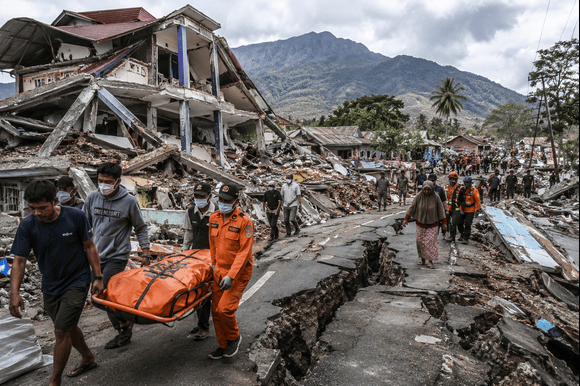
Indonesia Earthquake Death Toll Rises to 51 as Thousands Displaced and Rescuers Search for Survivors
At least 51 people have been killed and around 5,000 others displaced after a powerful earthquake struck Indonesia’s island of Flores, leaving widespread destruction across several provinces and sending rescue teams searching through damaged buildings for survivors.
The shallow magnitude 7.7 earthquake struck shortly before 05:00 local time on Saturday, corresponding to 22:00 GMT on Friday. The powerful tremor was followed by hundreds of aftershocks, further damaging already weakened structures and complicating rescue and relief operations.
Indonesia’s National Disaster Management Agency, known as BNPB, said preliminary assessments indicated that more than 900 homes had suffered severe damage, while hundreds of other buildings were also affected. The agency reported that the main earthquake had been followed by 341 aftershocks as emergency teams continued to assess the scale of the disaster.
Officials warned that the number of casualties and the extent of the destruction could increase as rescue workers reach remote communities and examine damaged buildings.
The earthquake struck at a depth of only around 15km beneath the Earth’s surface, making the shaking particularly powerful at ground level. It was reportedly felt across a wide area, with residents as far west as Bima reporting the tremors.
The disaster has become Indonesia’s deadliest earthquake since 2022, when a major earthquake in West Java killed hundreds of people and caused widespread destruction.
Manggarai Among Worst-Affected Areas
Manggarai province has emerged as one of the areas most severely affected by the latest earthquake.
According to preliminary figures released by authorities, 24 people had died in Manggarai, while another 17 fatalities were recorded in neighbouring East Manggarai province.
Three deaths were reported in Sikka province, while at least one person was killed in each of Ngada, Ende and West Manggarai provinces.
Authorities said the number of casualties remained provisional because rescue and assessment operations were still under way.
Thousands of people have already been forced to leave their homes because of structural damage and fears that further tremors could cause additional buildings to collapse.
The BNPB said 3,356 people had been displaced in Sikka province, while another 2,078 people had been evacuated in Manggarai. Overall, around 5,000 people were reported to have been displaced by the earthquake.
The disaster has also left dozens of people injured.
Deputy Health Minister Benjamin Paulus Octavianus said 36 people had suffered serious injuries in East Nusa Tenggara province, while another 77 people sustained minor injuries.
Medical workers have been treating victims under difficult conditions, with some healthcare facilities themselves damaged by the earthquake.
Ruteng Regional Hospital in Manggarai was among the buildings affected. Images from the hospital showed sections of ceilings in operating theatres and clinic areas collapsing, leaving medical staff unable to safely use some parts of the facility.
Patients were subsequently moved into temporary tents outside the damaged hospital as medical teams continued providing treatment.
Hospital spokesperson Rista Mari told BBC Indonesian that staff were still waiting for promised medical assistance.
She said hospital workers had been informed that help would be provided but that supplies had not yet arrived, adding that the facility urgently needed assistance.
More Than 1,000 Buildings Damaged
The full scale of the destruction remains unclear because the earthquake struck a remote and mountainous part of Indonesia, where some communities are difficult to reach.
Early assessments indicate that more than 1,000 homes may have been damaged when severely affected residential buildings are combined with the other structures reported by authorities.
Schools, healthcare facilities, government offices and other public buildings were also among the structures damaged by the powerful shaking.
Rescue operations have therefore involved more than simply searching collapsed homes. Emergency teams have also had to assess roads, bridges, medical facilities and other critical infrastructure before they can be safely used.
Landslides triggered by the earthquake have blocked roads leading to some villages, slowing the movement of rescue teams and emergency supplies.
Despite the difficult terrain, experienced rescue workers continued their efforts throughout the day to reach people who may have been trapped beneath rubble.
The BNPB said providing essential supplies and meeting the basic needs of people who have been evacuated were among the government’s highest priorities during the emergency response.
The agency said tonnes of emergency supplies had been sent towards Manggarai to support people forced from their homes.
Authorities are also working to establish temporary shelters and ensure that displaced families have access to food, drinking water and medical care.
Port Damage Causes Panic in Maumere
The earthquake caused serious damage in Maumere, the largest town on the island of Flores.
Video recorded at the town’s port showed large pieces of concrete breaking away from the terminal building as people waited to board an inter-island ferry.
The powerful shaking caused panic among passengers gathered at the port. Some people were reportedly thrown into the sea after the gangway leading to one of the vessels collapsed.
The incident highlighted the widespread impact of the earthquake beyond residential areas, with transport infrastructure also suffering damage.
Emanuel Melkiades Laka Lena, the governor of East Nusa Tenggara province, said some of those killed had been asleep when buildings or other structures collapsed on top of them.
The timing of the earthquake, which struck before dawn, increased the danger because many residents were still inside their homes and asleep when the ground began shaking.
People living in several affected communities described being suddenly thrown awake by the force of the earthquake.
Arnold Welianto, a resident of Talibura, a coastal village in Sikka, told the BBC that he was suddenly awakened by the shaking and immediately rushed towards his child’s room.
He said the experience was extremely frightening and that many residents quickly fled their homes following the earthquake.
Tsunami Warning Lifted
The earthquake also briefly triggered fears of a tsunami.
Residents in coastal areas reported seeing the sea recede after the earthquake, prompting concern that a large wave could follow.
A tsunami warning was initially issued, leading around 2,000 people to evacuate themselves to safer areas, including higher ground.
The warning was lifted approximately three hours after the earthquake after authorities detected no significant rise in sea levels.
Although the tsunami threat passed, officials continued urging residents to remain cautious and avoid coastal areas until they were confident that conditions were safe.
For people whose homes had already been damaged, the threat of additional aftershocks remained a major concern.
BNPB advised residents to stay calm and avoid entering buildings that had suffered structural damage or showed signs that they could collapse.
Authorities also urged people to remain away from damaged structures while engineers and emergency officials assessed their condition.
Second Major Earthquake Highlights Indonesia’s Seismic Risk
As rescuers continued dealing with the devastation on Flores, another major earthquake elsewhere in Indonesia served as a reminder of the country’s exposure to powerful seismic activity.
A second earthquake measuring 6.9 struck another part of the country, adding to concerns in a nation that regularly experiences earthquakes and volcanic eruptions.
Indonesia lies along the meeting point of three major tectonic plates, making it one of the world’s most earthquake-prone countries.
The country forms part of the Pacific “Ring of Fire”, a vast zone surrounding the Pacific Ocean that is characterised by intense tectonic activity, frequent earthquakes and numerous active volcanoes.
Indonesia’s location means that earthquakes can occur across different parts of the archipelago, sometimes causing devastating consequences for communities located near fault lines or coastal areas.
The latest disaster on Flores has once again highlighted the challenges facing emergency services in remote parts of the country.
Mountainous terrain, damaged roads and landslides can make it difficult for rescuers to reach isolated villages quickly. When hospitals and other public buildings are also damaged, authorities face additional difficulties in treating injured people and accommodating those who have lost their homes.
Rescue and Relief Efforts Continue
Rescue workers have continued searching damaged structures for anyone who may still be trapped beneath rubble.
Emergency teams are also clearing roads blocked by landslides and debris to establish routes for ambulances, aid workers and supply vehicles.
Authorities are prioritising areas where the greatest number of people have been displaced and where local infrastructure has suffered significant damage.
The BNPB said emergency logistics had already been sent to Manggarai, while additional assistance is expected to reach other affected areas as access routes are restored.
Medical teams are working under particularly challenging conditions. The damage to Ruteng Regional Hospital means some patients have had to receive treatment in temporary medical tents rather than inside the main hospital building.
Officials are also assessing other healthcare facilities to determine whether they remain structurally safe and capable of handling the number of injured people requiring treatment.
The earthquake has left thousands of residents facing uncertain conditions as authorities determine whether their homes can be safely occupied again.
For those unable to return, temporary shelters and emergency assistance will be required while assessments and reconstruction begin.
The authorities have not yet provided a complete estimate of the financial cost of the disaster, with assessments still taking place across the affected provinces.
Residents Urged to Remain Vigilant
Officials continue to warn residents against returning to damaged buildings, particularly while aftershocks are still being recorded.
The 341 aftershocks reported by BNPB have added to concerns that weakened structures could collapse even after the main earthquake has passed.
Residents in coastal areas have also been advised to remain alert and follow official instructions following the initial tsunami warning.
Emergency agencies have urged people to rely on official information rather than unverified messages circulating on social media.
The priority remains locating survivors, treating the injured, providing shelter and delivering food and other essential supplies to communities that have been cut off.
With rescue teams still working across remote areas, authorities say the full impact of the earthquake will take time to establish.
The death toll of at least 51 is already expected to make the disaster Indonesia’s most deadly earthquake in several years, but officials have warned that the figures could change as more communities are reached.
The scale of damage to homes, hospitals, schools, government buildings and transport facilities demonstrates the enormous challenge facing the authorities.
For residents across Flores and East Nusa Tenggara, the immediate focus remains survival and recovery after one of the strongest and most destructive earthquakes to strike the region in recent years.
As rescue operations continue, emergency workers are racing against time to reach those trapped beneath rubble, while thousands of displaced residents wait for food, medical assistance and safe shelter.
The earthquake has once again demonstrated the dangers faced by communities living along Indonesia’s highly active tectonic zone, where powerful earthquakes, volcanic eruptions and tsunami threats remain a recurring part of life.