


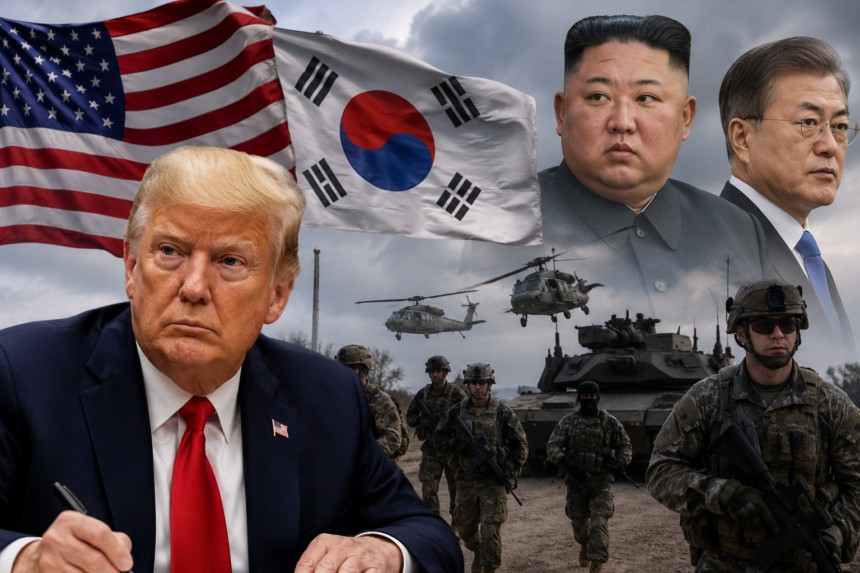
President Donald Trump has announced that the United States will “substantially reduce” its joint military exercises with South Korea, saying the drills are costly and send an unnecessarily hostile signal to North Korea.
Trump linked the decision to what he described as his “very good relationship” with North Korean leader Kim Jong Un, raising fresh questions about Washington’s approach to Pyongyang and the future of the US-South Korea security alliance.
In a post on his Truth Social platform, Trump argued that the exercises were expensive, with a large portion of the costs being covered by the United States. He also said the military drills sent a message that was “totally inappropriate and hostile” toward North Korea.
The announcement came less than 24 hours after Trump shared an old photograph of himself with Kim from 2019, describing the two as “great friends” despite the “unfriendly look” in the particular photograph.
Trump’s comments came as the US and South Korea were preparing to begin their annual joint military exercises. He said on Sunday that it was already “too late to cancel” the drills because they were due to begin on Monday, but indicated that future exercises would be significantly scaled back.
South Korea said it was reviewing Trump’s remarks while stressing the importance of maintaining close consultations with Washington. Seoul also expressed hope that an improved relationship between Washington and Pyongyang could eventually create an opportunity for meaningful dialogue with North Korea.
Earlier, South Korean authorities had said the planned military exercises would proceed as scheduled.
The South Korean presidential Blue House said Seoul would continue diplomatic discussions with Washington over military cooperation, including issues connected to the Strait of Hormuz, while also consulting with the United States on the details of their joint military training.
Trump also referred to South Korea’s refusal to participate in US efforts related to the “denuclearisation” of Iran. In his social media post, he said he had recently asked South Korea’s president whether the country wanted to join the United States in the denuclearisation of the Islamic Republic of Iran, adding that Seoul had responded, “No thanks!”
The reference appears to reflect growing tensions between Washington and some of its traditional allies over their willingness to support US military and logistical operations connected to the conflict with Iran.
Trump has previously expressed frustration with allies that have been reluctant to become directly involved in the conflict, including Japan, France and the United Kingdom.
The decision to reduce US-South Korean military exercises has prompted concern among security experts, who argue that any savings could be outweighed by the potential damage to military readiness and deterrence.
Leif-Eric Easley, a professor at Ewha University in Seoul, said combined US-South Korean defence exercises were essential to ensuring both militaries remained prepared and capable of responding to potential threats.
He warned that reducing the exercises could weaken coordination between the two countries, slow efforts for South Korea to assume greater responsibility for its own defence and undermine deterrence against possible conflicts elsewhere in Asia.
Easley also argued that the financial savings from reducing the drills would be relatively small, while the potential diplomatic benefits of improving relations with North Korea remained uncertain.
The latest joint exercise, known as Ulchi Freedom Shield, was announced by US and South Korean military leaders last week. Officials said the 11-day exercise would be similar in scale to previous years and would involve approximately 18,000 South Korean troops.
During the announcement, military officials also highlighted the threat posed by North Korean soldiers who have been deployed to support Russia’s war in Ukraine.
US military spokesperson Ryan Donald said American and South Korean forces were taking the threat into account in their training, referring specifically to North Korean troops who have gained battlefield experience while fighting alongside Russian forces.
Around 28,500 US military personnel are currently stationed in South Korea, making the American military presence a central part of the two countries’ defence alliance.
North Korea has strongly opposed the joint exercises. On Friday, its foreign ministry condemned the drills, describing them as a rehearsal for an aggressive war.
The military exercises also come shortly after South Korea, the United States and Japan detected another North Korean missile launch. Pyongyang has conducted a series of ballistic missile tests in recent weeks despite United Nations restrictions banning such activity.
North Korea has accelerated the development of its nuclear weapons and missile programmes since high-profile diplomatic efforts between Kim and Trump collapsed in 2019.
Trump and Kim held several meetings during Trump’s first presidency, but negotiations over North Korea’s nuclear programme ultimately failed to produce a lasting agreement. Trump became the first sitting US president to enter North Korea when he crossed the military demarcation line during a meeting with Kim seven years ago.
For South Korea, Trump’s latest announcement represents a complicated and potentially contradictory message.
On one side, Seoul has repeatedly urged Trump to re-engage with Pyongyang, and his emphasis on his relationship with Kim could raise hopes that Washington may succeed in bringing the North Korean leader back to negotiations.
On the other hand, Trump’s comments suggest that he remains dissatisfied with South Korea’s reluctance to provide direct military or logistical assistance to US operations connected to Iran.
The disagreement comes at a sensitive moment for the US-South Korea alliance. Trump has repeatedly questioned the cost of America’s military presence on the Korean Peninsula and has argued that Washington provides South Korea with security without receiving enough in return.
He has also criticised the number of US troops stationed in South Korea and the financial burden associated with maintaining the American military presence.
For Seoul, however, the US troop deployment remains a key pillar of its national security strategy and a critical component of its alliance with Washington.
South Korea has attempted to ease some of the tensions with the Trump administration. Earlier this year, Seoul committed $350bn towards investment in the United States, seeking to strengthen economic and diplomatic ties.
South Korean President Lee Jae Myung also described Trump as a “peacemaker” last year, highlighting Seoul’s efforts to maintain a constructive relationship with the US president.
Trump’s latest move is not without precedent. During his first term, he suspended US-South Korean military exercises in 2018 while pursuing negotiations with Kim Jong Un over North Korea’s nuclear programme.
At the time, Trump described the annual exercises as “provocative” and referred to them as “war games”, arguing that cancelling them would save the United States a “tremendous amount of money”.
The exercises were subsequently scaled back again in 2020 amid the Covid-19 pandemic.
Speculation had already been growing that Trump could once again suspend or reduce the scale of US-South Korean military exercises, and some analysts had even predicted that his administration could consider reducing the number of American troops stationed on the peninsula.
The latest announcement comes shortly after South Korea’s president proposed talks with North Korea on formally ending the Korean War.
Although active fighting ended with an armistice in 1953, the two Koreas remain technically at war because no formal peace treaty was ever signed.
For Seoul, the possibility of renewed US-North Korea diplomacy could offer an opportunity to reduce tensions on the peninsula. However, any significant reduction in joint military preparedness could also create concerns about whether the US commitment to South Korea remains as strong as before.
Trump’s decision therefore puts the alliance in a delicate position, balancing his desire to pursue better relations with Kim Jong Un against the military requirements of deterring North Korea.
While Pyongyang has yet to respond directly to Trump’s latest comments, the North Korean government has consistently described US-South Korean military exercises as a threat.
The coming weeks could therefore prove important for determining whether Trump’s latest remarks represent a temporary adjustment designed to encourage dialogue with Kim, or the beginning of a broader change in America’s military posture on the Korean Peninsula.
For South Korea, the challenge will be to preserve its defence cooperation with Washington while supporting diplomatic efforts that could potentially bring North Korea back to negotiations.