


US President Donald Trump’s Middle East envoy Jared Kushner has arrived in Israel, where he is expected to meet Prime Minister Benjamin Netanyahu on Monday as Washington steps up efforts to advance its proposed peace plan for Gaza.
Kushner’s visit comes shortly after he held rare direct talks with representatives of Hamas, focusing on how to implement the US-backed roadmap for ending the conflict and establishing a new political and security arrangement in the Gaza Strip.
The talks represent one of the most significant recent diplomatic contacts involving Hamas and senior figures connected to the Trump administration. They come at a particularly sensitive moment, with Israel having rejected a 15-point US proposal that calls for Hamas and other armed groups in Gaza to completely disarm, Israeli forces to withdraw from the territory and Gaza to eventually be governed by a new civilian Palestinian administration.
Last month, Trump’s Board of Peace said it had secured an agreement in principle for the “complete disarmament” of Hamas and other armed factions operating in Gaza.
However, the proposal has faced strong opposition within Israel. Netanyahu has insisted that Hamas must first surrender its weapons before Israel agrees to any substantial military withdrawal.
The Israeli government’s rejection of the US plan prompted criticism from several Muslim-majority countries, which issued a joint statement on Sunday warning that Israel’s position could undermine Trump’s efforts to achieve peace in Gaza.
Eight countries — Egypt, the United Arab Emirates, Qatar, Saudi Arabia, Jordan, Turkey, Pakistan and Indonesia — condemned Israel’s rejection of the plan and expressed support for efforts to move the peace process forward.
Trump established the Board of Peace as an international organisation initially focused on finding a solution to the Gaza conflict. The organisation has since been given a broader remit and is intended to become involved in addressing conflicts and international disputes beyond Gaza.
A Palestinian official told the BBC that Kushner, who is also Trump’s son-in-law, met a Hamas delegation led by the group’s new leader, Khalil al-Hayya, during talks in Egypt on Sunday.
Hamas later issued a statement calling on mediators and the Board of Peace to put pressure on Israel to accept the proposed roadmap and move ahead with the next stage of the process.
The meeting between Kushner and Hayya is believed to be the first high-level engagement between the two sides since a ceasefire agreement for Gaza was reached last year.
The talks reportedly included senior international figures involved in the US-led peace initiative. Nickolay Mladenov, the high representative for Gaza to the Board of Peace, and former British Prime Minister Tony Blair were reportedly involved, alongside representatives from Egypt, Qatar and Turkey, all of which have played important roles as mediators during previous negotiations.
There has been no detailed official account of the discussions. However, reports indicate that the talks focused on practical steps that could potentially lead to the dismantling of Hamas’s military capabilities, the transfer of governing authority in Gaza and an eventual withdrawal of Israeli forces.
A source familiar with the meeting told CBS News, the BBC’s US partner, that discussions included the beginning of a process to transfer governing responsibilities to the National Committee for the Administration of Gaza.
The proposal would ensure that Hamas has no future governing role in the territory, while also facilitating an Israeli military withdrawal and establishing an international stabilising force in Gaza.
While in Egypt, Kushner also met Egyptian President Abdel Fattah al-Sisi as part of Washington’s wider diplomatic efforts.
According to Israeli media reports, Mladenov and Blair are also expected to meet Netanyahu on Monday in an attempt to persuade the Israeli prime minister to support at least parts of Trump’s proposed roadmap.
Netanyahu, however, has repeatedly made clear that he does not intend to accept an Israeli withdrawal before Hamas is fully disarmed.
“The IDF will not carry out any withdrawal until Hamas is genuinely disarmed,” Netanyahu said last week, making clear that the issue remains a major obstacle to the implementation of the US proposal.
The Israeli prime minister’s position puts him at odds with Washington at a time when Trump is attempting to use his influence to move both Israel and Hamas towards the next stage of the peace process.
Netanyahu is also facing significant political pressure at home. He is expected to face a difficult October election as he seeks to retain power, while his governing coalition includes far-right ministers who have consistently advocated a tougher approach towards Hamas and the war in Gaza.
Many Israelis also remain deeply sceptical about whether Hamas is genuinely prepared to surrender its weapons and abandon any future political role in Gaza.
Among the strongest opponents of the US-backed proposal is Israeli National Security Minister Itamar Ben Gvir, who earlier this month described the draft plan as unacceptable.
In a podcast interview with Rom Braslavski, an Israeli hostage taken during the Hamas-led attack of 7 October, which aired on 15 August, Ben Gvir was asked about the possibility of Israel reducing its military operations in Gaza.
According to the Associated Press, he said it was no secret that he disagreed with Netanyahu over the issue.
Ben Gvir argued that Israel should continue carrying out aggressive military operations and called for targeted killings of Hamas figures. His remarks included inflammatory comments about people in Gaza, drawing further attention to the divisions within Israel’s governing coalition over how the conflict should proceed.
The disagreement highlights the political difficulties facing Netanyahu as he attempts to balance pressure from the Trump administration with demands from members of his own coalition for continued military action.
The US proposal has also created uncertainty over the future of Israeli military operations in Gaza.
Following Israel’s rejection of the 15-point plan, there appeared to be a temporary pause in Israeli airstrikes, reportedly following a request from Washington. However, the lull did not last, and Israeli military operations have since resumed.
The Israel Defense Forces said on Sunday that it had carried out strikes against Hamas and Islamic Jihad militants in Khan Younis and Nuseirat.
Local medical officials said several people living in a tent camp in Khan Younis were injured in the latest attacks.
Israel and Hamas have continued to accuse one another of violating the ceasefire, further complicating efforts to preserve the truce and move towards a longer-term settlement.
The ceasefire officially came into effect on 10 October last year and remains in place, although the conflict has continued to claim lives and Israeli military strikes have been reported on an almost daily basis since the agreement.
According to Gaza’s Hamas-run health ministry, more than 1,200 people have been killed since the ceasefire began. The figures are considered reliable by the United Nations, while UNICEF has reported that at least 300 children have been among those killed during the post-ceasefire period.
The latest diplomatic push is therefore taking place against the backdrop of continued violence and an increasingly complicated political situation.
The joint statement issued by the eight Muslim-majority countries on Sunday warned that Israel’s rejection of the Trump administration’s proposal could threaten efforts to establish lasting peace.
The involvement of the United Arab Emirates was particularly notable because the Gulf state normalised diplomatic relations with Israel five years ago under the Abraham Accords.
The UAE has maintained its diplomatic relationship with Israel while also calling for an end to the conflict and greater humanitarian assistance for Palestinians.
The wider war began after the Hamas-led attack on southern Israel on 7 October 2023. Around 1,200 people were killed during the attack and 251 others were taken hostage, according to Israeli authorities.
Israel responded by launching an extensive military campaign across Gaza aimed at dismantling Hamas and recovering the hostages.
According to Gaza’s health ministry, more than 73,000 people have been killed during the war, including 21,280 children.
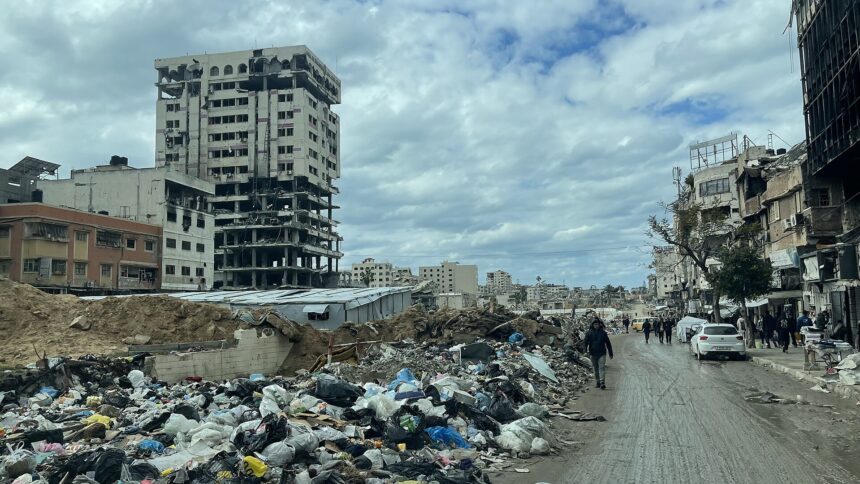
The scale of displacement has also been enormous. The United Nations estimates that approximately 1.9 million people, equivalent to around 90% of Gaza’s population, have been displaced since the conflict began.
The humanitarian crisis has added further urgency to the international diplomatic efforts.
For the Trump administration, Kushner’s meetings with Hamas representatives and his expected discussions with Netanyahu represent an attempt to overcome the main obstacles preventing the implementation of the US peace plan.
The proposal requires Hamas to give up its weapons and accept that it will have no future governing role in Gaza, while Israel would eventually withdraw its forces and allow the territory to be administered by a new civilian Palestinian body.
An international stabilising force would also potentially be deployed to help maintain security during the transition.
For Hamas, the key issues include the future of Israeli forces in Gaza, the humanitarian situation and the political structure that would govern the territory.
For Israel, the central demand remains the complete disarmament of Hamas before any significant military withdrawal takes place.
Those competing positions leave Kushner and the wider US diplomatic team facing a difficult task as they attempt to turn the broad principles of Trump’s plan into concrete arrangements that both sides can accept.
Kushner’s meeting with Hamas is nevertheless significant because direct engagement at such a senior level has been rare, particularly since the collapse of previous diplomatic efforts.
The talks could provide an opening for further negotiations, but major disagreements remain over disarmament, Israeli troop withdrawals, governance and security arrangements.
Netanyahu’s meeting with Kushner and other senior figures involved in Trump’s Board of Peace will therefore be closely watched as Washington attempts to determine whether its proposed roadmap can move beyond the diplomatic stage.
The success of the initiative will depend largely on whether the US can persuade Israel to accept a phased withdrawal while obtaining credible guarantees that Hamas will surrender its military capabilities and relinquish control over Gaza.
With violence continuing despite the ceasefire and political pressure increasing on all sides, the coming negotiations could determine whether Trump’s latest peace initiative becomes a framework for a longer-term settlement or another diplomatic effort that fails to overcome the fundamental divisions between Israel and Hamas.