


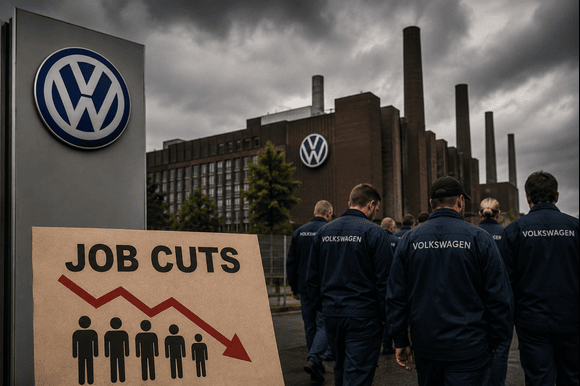
Volkswagen has approved plans to eliminate another 50,000 jobs by 2030 as the German automotive giant moves ahead with the biggest restructuring programme in its nearly 90-year history.
The latest workforce reduction means the company now expects to cut a total of around 100,000 positions by the end of the decade. Volkswagen had already announced plans in March to reduce its workforce by approximately 50,000 jobs as part of a major effort to reduce costs and improve the competitiveness of the group.
The restructuring comes as Volkswagen faces significant challenges across some of its most important markets, including declining profits, weaker vehicle sales and increasingly intense competition from Chinese carmakers.
The Volkswagen Group, which owns a wide range of major automotive brands including Volkswagen, Audi, Porsche and Skoda, is also examining the future of four German manufacturing plants as it seeks to bring production capacity more closely in line with demand.
Volkswagen Chief Executive Oliver Blume described the latest restructuring decision as a strong indication of the company’s determination to secure its long-term future.
In a statement issued by the company, Blume said Volkswagen was taking responsibility for its workforce while making the changes required to ensure the business remained competitive in an increasingly difficult global automotive market.
The additional job reductions had been anticipated after Blume indicated in July that Volkswagen was considering further workforce cuts. The company’s latest announcement confirms that the reductions will form a major part of its long-term restructuring strategy.
Investors responded positively to the news, with Volkswagen shares rising by around 7% in Frankfurt on Friday morning.
The sharp rise in the company’s share price reflects investor expectations that the restructuring measures could help Volkswagen lower expenses, simplify its operations and strengthen profitability over the coming years.
Volkswagen Faces Growing Pressure
Volkswagen’s decision comes at a challenging period for the company and the wider European automotive industry.
The carmaker has experienced a significant decline in profits in recent years, with weaker sales and intense international competition putting pressure on its financial performance.
China has become a particularly difficult market for Volkswagen. The company was once one of the strongest foreign automotive brands in the country, but its position has been weakened by the rapid growth of domestic Chinese manufacturers.
Chinese carmakers have expanded quickly by introducing increasingly advanced electric vehicles and other technologies while maintaining lower production costs. Their growing presence has increased pressure on established European manufacturers such as Volkswagen, which are simultaneously attempting to invest heavily in the transition towards electric and software-driven vehicles.
Volkswagen has also experienced weaker sales in the United States. The US market has become more challenging for international manufacturers following the introduction of tariffs on imported vehicles under President Donald Trump’s administration.
The combination of weaker demand, higher costs, technological change and growing competition has forced Volkswagen to reassess the size and structure of its global workforce.
The company said a fundamental adjustment to its global workforce capabilities was necessary to protect its competitiveness and respond to changing customer demand and developments in technology.
Volkswagen said the group-wide workforce adjustment would involve approximately 50,000 positions, including management jobs.
Four German Plants Under Review
As part of the restructuring, Volkswagen is also examining the future of four of its German production facilities.
The company is considering possible changes involving plants in Emden, Zwickau, Hanover and Neckarsulm. Volkswagen has previously acknowledged that production capacity at these locations is greater than current demand requires.
Rather than immediately confirming the closure or permanent reduction of the facilities, the company said it was assessing alternative uses for the plants.
The review could potentially involve changing the type of products manufactured at the facilities or finding other industrial and commercial purposes for the sites.
The future of Volkswagen’s German factories is particularly sensitive because the company remains one of the country’s largest industrial employers and has historically played a major role in Germany’s manufacturing economy.
The planned workforce reductions are therefore expected to have significant consequences not only for Volkswagen employees but also for communities and businesses that depend on the company’s factories and supply chains.
Fewer Models and Simpler Production
Volkswagen is also planning to significantly reduce the complexity of its vehicle portfolio.
The company said that by 2035 it intends to cut the number of models it produces by 50%.
It also plans to reduce the complexity of its overall product offering by approximately 75%.
Volkswagen said the strategy would allow it to concentrate on what it considers its “most compelling vehicles” and produce greater volumes of each model.
The company believes that simplifying its model range and increasing production of individual vehicles will help reduce manufacturing and development costs.
The strategy represents a major shift for a company whose global success has historically been built on offering a broad range of models across different market segments.
Volkswagen now believes that a more streamlined portfolio will allow it to operate more efficiently while concentrating investment on vehicles that are most attractive to customers.
The company is also facing major technological changes across the automotive sector. The rapid expansion of electric vehicles, increasing use of software and connected-car technology and changing consumer preferences are forcing traditional carmakers to rethink how they design, manufacture and sell vehicles.
Unions Seek Protection for Workers
The restructuring has also involved negotiations with employee representatives and Germany’s powerful industrial union IG Metall.
Christianne Benner, president of IG Metall and deputy chair of Volkswagen’s Supervisory Board, said the carmaker had worked hard to find acceptable solutions to what she described as a crisis situation.
IG Metall has traditionally played an influential role in negotiations over employment and working conditions at Volkswagen, and the scale of the proposed job reductions is expected to remain a major issue for workers and their representatives.
The challenge for the company will be balancing the need to reduce costs with the need to maintain skilled workers and preserve its ability to develop and manufacture new generations of vehicles.
A Global Workforce of More Than 660,000
Volkswagen remains one of the world’s largest automotive employers.
As of 2025, the group employed more than 660,000 people worldwide across its various brands and operations.
Its portfolio extends well beyond the Volkswagen-branded vehicles and includes Audi, Porsche, Skoda, Seat, Bentley and Lamborghini, among others.
The scale of the proposed cuts therefore represents a significant adjustment to the company’s global workforce.
Although the reductions will take place over several years rather than immediately, the plan highlights the extent of the pressure facing traditional automotive manufacturers.
Volkswagen’s difficulties in China have been particularly significant because the country was once one of the group’s most important sources of sales and growth.
Chinese manufacturers have rapidly improved the quality, technology and appeal of their vehicles while taking advantage of lower production costs. Companies such as BYD have expanded aggressively beyond China, increasing their presence in markets across the United Kingdom, the European Union and Southeast Asia.
Their expansion has created a new competitive environment for European carmakers, particularly in the electric vehicle market.
Volkswagen Attempts to Protect Its Future
The latest restructuring plan represents Volkswagen’s attempt to adapt to these changing conditions while protecting its long-term position in the global automotive industry.
Reducing its workforce, simplifying its vehicle range and reconsidering the use of manufacturing facilities are all designed to lower costs and make the company more flexible.
However, the scale of the restructuring also demonstrates the difficulties facing traditional carmakers as they attempt to compete with new automotive companies while investing billions in new technologies.
Volkswagen’s leadership has argued that significant changes are necessary to ensure the company remains competitive in the years ahead.
With another 50,000 jobs now expected to be eliminated, the company is entering one of the most consequential periods in its history.
The future of its German plants, the reduction of its model range and its ability to compete with rapidly expanding Chinese manufacturers will all play an important role in determining whether Volkswagen can restore profitability and maintain its position as one of the world’s leading automotive groups.
For employees, investors and the wider German industrial sector, the restructuring marks a major turning point for a company that has been at the heart of the country’s automotive industry for generations.