


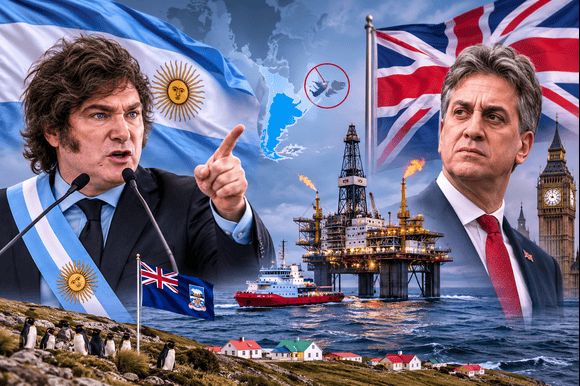
Argentina’s President Javier Milei has intensified the long-running dispute with the United Kingdom over the Falkland Islands, warning that his government will impose economic sanctions on companies involved in oil exploration and development activities near the British overseas territory.
In a strongly worded national address, Milei said Argentina was entering a new phase in its campaign to reclaim sovereignty over the islands, which Argentina calls the Islas Malvinas. He argued that the international environment was increasingly favourable to Buenos Aires and pointed to indications that the United States could be reconsidering its longstanding position of neutrality over the territorial dispute.
Milei specifically singled out the Sea Lion oilfield, where British energy company Rockhopper Exploration and Israel-based Navitas Petroleum are preparing to move ahead with major exploration and development activities. The Argentine president described the project as a “clear and present danger” to his country’s territorial claims and warned that Buenos Aires could not allow the companies to proceed without consequences.
The latest confrontation marks another significant escalation between Argentina and Britain, more than four decades after the two countries fought a 74-day war over control of the Falkland Islands in 1982.
The British government has rejected Argentina’s latest threats and reiterated that its position on the islands remains unchanged. Foreign Secretary Ed Miliband said the UK’s commitment to the Falklands was “unwavering”, stressing that the islands would remain British because that was the overwhelming preference of their residents.
Downing Street also reaffirmed the government’s position, stating that the Falkland Islands would remain a British Overseas Territory for as long as the islanders themselves wanted that status.
British officials have repeatedly emphasised the principle of self-determination, arguing that the people living on the islands have the right to decide their own political future and determine how their natural resources are developed.
“This is not the first time Argentine governments have made economic threats against the islanders,” Miliband said. “We are clear that the Falkland Islanders’ right of self-determination extends to the right to exploit their own natural resources.”
Defence Secretary Wes Streeting similarly described Britain’s commitment to the Falkland Islands as “absolute and unshakeable”.
Commenting on Milei’s latest statement, Streeting said the Argentine president’s remarks appeared to be driven largely by domestic political considerations rather than by developments on the islands themselves.
“Milei’s statement overnight tells us more about domestic politics in Argentina than it does about the Falkland Islands,” he said in a post on X.
The dispute centres on sovereignty over the remote archipelago in the south-west Atlantic Ocean. Argentina maintains that the islands are historically and legally part of its territory, while Britain has exercised control over the Falklands for nearly two centuries and maintains that the islanders have the right to determine their own future.
Milei reiterated his government’s position during his address at the presidential palace, saying that the Falklands were “historically and legally” Argentine territory.
However, it remains unclear precisely what form the proposed sanctions would take or how extensively they would affect the companies involved in the Sea Lion project.
Argentina already has legislation allowing the government to restrict or penalise activities by oil companies involved in projects that Buenos Aires considers unauthorised in the disputed territory. Milei’s proposed measures could therefore build upon existing legal mechanisms rather than representing an entirely new sanctions framework.
The immediate focus of the dispute is the Sea Lion oilfield, located roughly 130 miles from the Falkland Islands. The field is believed to contain an estimated 1.7 billion barrels of oil, making it a potentially transformative discovery for the small island economy and a strategically important resource in the wider sovereignty dispute.
The scale of the Sea Lion field is considerable when compared with major oil developments in the United Kingdom. The Rosebank oilfield, located around 80 miles west of the Shetland Islands in the North Sea, has been estimated to contain approximately 300 million barrels of oil.
The two companies behind the Sea Lion development, Britain’s Rockhopper Exploration and Israel’s Navitas Petroleum, are expected to begin extracting oil from the field within the next two years.
Milei has warned that Argentina must act before the project reaches the point where large-scale extraction becomes possible.
“If we do not act swiftly in a few months, they will have the material capacity to access the oil that lies underneath our sea – something that has never happened before,” the Argentine president said.
The companies, however, have indicated that they do not currently expect Argentina’s latest threats to derail their plans.
In a joint statement, Rockhopper and Navitas said they believed the recent developments were not expected to have a material impact on activities connected with the Sea Lion project, including the timetable for its development.
Rockhopper has previously described the crude expected from the field as “highly marketable”, highlighting the potential commercial value of the project.
Navitas has also publicly showcased preparations already taking place in the Falklands. The company has highlighted infrastructure projects including the construction of a dock, a heliport and accommodation facilities intended to support workers involved in the oil development.
The prospect of offshore oil production has therefore added a new economic dimension to the decades-old sovereignty dispute.
While the question of who owns the islands has remained unresolved, the discovery and planned exploitation of substantial oil reserves have created additional incentives for both sides to defend their respective positions.
Milei has argued that British oil exploration violates the spirit of international agreements concerning the Falklands dispute. He has referred to a United Nations resolution calling on Britain and Argentina to refrain from taking unilateral actions that could aggravate the dispute while negotiations over sovereignty remain unresolved.
Britain, however, maintains that the Falkland Islanders have the right to develop their economy and make use of resources located around the islands.
The political disagreement is also unfolding against a backdrop of increasing uncertainty over the United States’ position.
Milei has claimed that President Donald Trump and the US administration are assessing whether Washington should reconsider its historical approach to the Falklands question.
Argentina has traditionally sought international support for its sovereignty claim, while the United States has generally attempted to maintain a neutral position on the dispute.
Milei said there were now signs that this position could be changing.
He also announced plans for a new naval base in Tierra del Fuego, Argentina’s southernmost province, as part of a broader effort to strengthen the country’s presence in the South Atlantic.
The Argentine president presented the developments as evidence of a changing geopolitical environment, arguing that Argentina had become an increasingly important partner for Washington.
“That is not empty words as they understand that Argentina is a reliable partner and a valuable ally for decades to come,” Milei said.
He also characterised Britain as a nation “in decline” and argued that global geopolitical changes were creating new opportunities for Argentina’s long-standing claim.
“There are winds of change in the world that are favourable to our claim,” Milei added.
His comments came shortly before remarks by Trump that appeared to add further uncertainty to the issue.
When asked in an interview with GB News whether the United States would come to Britain’s assistance in the event of a potential territorial dispute, Trump responded by criticising Britain’s support for the United States during its war with Iran.
Trump has previously indicated that the American position on the Falklands is among a number of foreign-policy positions currently under review.
The remarks have attracted particular attention in Argentina because of Milei’s close relationship with Trump and his efforts to strengthen diplomatic and economic ties between Buenos Aires and Washington.
Hours before Milei delivered his speech, Sarah Rogers, a senior US State Department official, posted a photograph of herself alongside the Argentine president. She accompanied the image with the caption: “Exciting things are happening in the Western Hemisphere.”
The timing of the post further fuelled speculation in Argentina that Washington could be moving towards a closer relationship with Buenos Aires on issues involving the South Atlantic.
For the Falkland Islanders themselves, however, the prospect of renewed confrontation with Argentina has generated concern and frustration.
In a 2013 referendum, residents overwhelmingly rejected the idea of ending the islands’ British status. Almost 100% of voters supported remaining a British Overseas Territory, with 99.8% voting in favour and only three people voting against.
Teslyn Barkman, a former member of the Falkland Islands Legislative Assembly, said Milei’s latest speech was likely to have angered residents across the islands.
Speaking from Stanley, the Falklands’ capital, Barkman said the islands had developed a growing economy and that residents remained firmly committed to their British identity.
“We have a burgeoning economy for a small place,” she said, adding that the islands would “remain forever British”.
The proposed sanctions are therefore particularly significant because they would target the energy companies whose projects could provide the Falklands with a major new source of economic revenue.
The Sea Lion field has the potential to transform the economic outlook of the islands if production proceeds as planned. However, its development is also likely to become one of the most contentious issues in the continuing dispute between Buenos Aires and London.
For Milei, the oil project provides a tangible target for his government’s campaign over the Falklands. Rather than focusing solely on the broader and more difficult question of sovereignty, his administration can point to a specific project and argue that action is necessary before oil extraction begins.
The Argentine president has insisted that his government cannot simply stand by while companies extract resources from waters that Buenos Aires considers part of Argentine territory.
The dispute also carries significant domestic political implications for Milei.
His popularity has fallen to around 34%, according to recent polling cited in the debate, and Argentina is approaching another presidential election. Milei faces a serious political challenge from his former vice-president, Victoria Villarruel, who has taken a strongly nationalist position on the Falklands.
Villarruel, a pro-military politician, has previously criticised Milei’s diplomatic approach to the sovereignty dispute and argued for a tougher position on the issue.
The Falklands remain deeply embedded in Argentina’s national identity, meaning that any perceived weakness on the issue can carry significant political costs for Argentine leaders.
The planned sanctions could therefore serve several purposes for Milei: putting pressure on British and international companies, strengthening Argentina’s legal and diplomatic claim, and demonstrating to domestic voters that his government is willing to take a more assertive approach towards Britain.
The dispute also allows Milei to connect economic policy, national sovereignty and Argentina’s wider geopolitical strategy.
The 1982 conflict remains a defining moment in relations between the two countries.
Argentine forces landed on the Falkland Islands in April 1982 in an attempt to establish control over the territory, prompting Britain to dispatch a military task force to the South Atlantic.
After 74 days of fighting, British forces regained control of the islands.
The war resulted in the deaths of 255 British military personnel, three Falkland Islanders and 649 Argentine military personnel.
Despite the passage of more than 40 years since the conflict, the sovereignty dispute has never been fully resolved.
Relations between Britain and Argentina have improved and deteriorated at different times since the war, but the Falklands question remains one of the most sensitive issues in Argentine foreign policy.
The latest dispute over the Sea Lion oilfield risks reopening some of the tensions that have remained beneath the surface for decades.
Milei’s government has made clear that it intends to pursue Argentina’s claim through diplomatic, legal and economic measures rather than accepting the status quo.
Britain, meanwhile, has shown no indication that it is prepared to compromise on sovereignty, repeatedly pointing to the wishes of the islanders and their overwhelming support for remaining British.
The oilfield has consequently emerged as a new flashpoint in an old dispute.
With billions of barrels of potentially valuable crude beneath waters claimed by both countries, the development of Sea Lion could have major economic consequences for the Falklands while simultaneously creating a new source of diplomatic confrontation between Buenos Aires and London.
For now, the oil companies involved insist that their plans remain on schedule. Argentina is threatening economic measures to prevent or discourage the development, while Britain maintains that the islanders have the right to exploit their own natural resources.
The question of whether those competing positions can coexist peacefully could become increasingly difficult as the Sea Lion project moves closer to production.
More than four decades after the Falklands War, the sovereignty dispute therefore remains unresolved — and the prospect of significant offshore oil production has given Argentina and Britain a fresh reason to clash over who controls the waters and resources surrounding the islands.
The latest escalation demonstrates that, despite the passage of time, the Falklands remain a powerful symbol of national identity in Argentina and a firmly defended British territory for the United Kingdom and its island residents.