


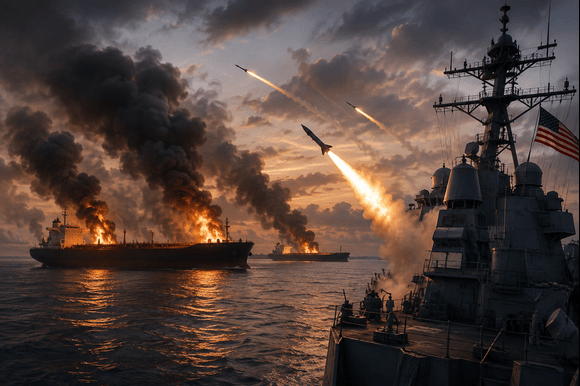
The United States military says it has carried out strikes against three oil tankers linked to Iran after ballistic missiles were launched toward two American naval vessels operating in the region, escalating an already tense confrontation between Washington and Tehran.
US Central Command (Centcom) said on Saturday that American forces targeted three tankers that it described as being connected to Iran’s oil-smuggling network. According to the US military, one vessel operating near Kharg Island and a second tanker located close to the Strait of Hormuz were “permanently disabled”, while a third tanker in the Gulf of Oman was “completely destroyed”.
The announcement came after Centcom said the Islamic Revolutionary Guard Corps (IRGC) had launched multiple attacks aimed at US naval forces. The American military said the missiles were directed toward an aircraft carrier and a guided-missile destroyer, but that both vessels successfully avoided the attacks.
Centcom said no American service members were injured in the missile attacks. The command described the incidents as another direct challenge from Iran’s military forces against US assets operating in and around the strategically important waterways of the Middle East.
Iranian state media had earlier reported that an Iranian oil tanker had been hit off the coast of Kharg Island. However, Tehran had not immediately publicly acknowledged carrying out missile attacks against the American ships when the US military announced the strikes.
Admiral Brad Cooper, commander of US Central Command, issued a strong warning to Iran following the attacks. He said the US response was intended to make clear that attacks on American military forces would result in significant economic and military consequences for Iran.
“Let the message to the IRGC be clear: If you shoot at two of our ships, we will impose an even higher economic cost – taking out three of yours,” Cooper said in a statement released on Saturday.
He added that the United States would continue taking measures to protect its forces operating in the region and warned that Washington could target more elements of Iran’s oil industry if the confrontation continued.
“We will not hesitate to defend American forces, and if necessary, destroy Iran’s limited and exposed oil fleet,” Cooper said.
Centcom alleged that the three tankers targeted by the US were connected to what it described as a multi-billion-dollar “shadow network” used to generate revenue for the IRGC and Iranian-backed armed groups operating across the region.
The US military has repeatedly accused Iran of using covert shipping networks to evade international sanctions and continue exporting oil. Washington says revenues generated through these networks help finance the IRGC and its regional allies and proxies.
The latest strikes represent another major escalation in the confrontation between the United States and Iran. The attacks come less than a week after fighting between the two sides resumed following a period in which direct hostilities had appeared to ease.
The United States resumed military operations on Sunday, when American forces said they had destroyed two rocket launchers that could potentially have been used to deploy naval mines in the Strait of Hormuz. The strategically vital waterway is one of the world’s most important routes for international oil and gas shipments.
On Tuesday, US President Donald Trump said American forces had carried out another “very heavy attack” against Iranian targets. Despite the intensity of the renewed military action, Trump suggested that the latest phase of fighting would not continue indefinitely, saying that the conflict would not last “too long”.
Iran subsequently retaliated against American interests and military-related targets across the region. Iranian attacks were reported in several countries that host US military facilities or have close security relationships with Washington, including the United Arab Emirates, Bahrain, Kuwait and Jordan.
The widening confrontation has raised concerns that the conflict could spread beyond Iran and the immediate battlefield, potentially placing American troops, regional allies and commercial shipping at greater risk.
The Strait of Hormuz has become one of the central flashpoints in the conflict. The narrow maritime passage connects the Persian Gulf with the Gulf of Oman and serves as a critical transit route for a substantial share of the world’s energy supplies.
Any prolonged disruption to shipping through the strait could have significant consequences for global oil markets, with traders already closely monitoring developments in the region.
The latest military exchanges have also created political pressure for the Trump administration, particularly as Americans face concerns over rising energy costs. With the US midterm elections scheduled for November, the economic impact of the conflict has become an increasingly important domestic political issue.
The White House is facing questions over the financial cost of the military campaign as well as the potential effect of prolonged fighting on fuel prices and household expenses.
On Thursday, US Vice-President JD Vance also responded to allegations made by Iran concerning civilian casualties caused by American military operations. Iranian authorities said US strikes had killed at least four people, including two children, during a wedding ceremony in southern Iran.
Vance said he was “extremely sceptical” about Iran’s account of the incident but confirmed that the United States would investigate the allegations.
The Iranian Red Crescent Society said that shrapnel from a missile struck a wedding ceremony being held at a home in Sirik on Tuesday. Iranian officials subsequently described the incident as a “war crime”, intensifying accusations between Tehran and Washington over civilian casualties during the conflict.
The allegations have added another humanitarian dimension to the rapidly escalating confrontation. While the United States has disputed Iran’s account of the wedding incident, Tehran has continued to accuse Washington of carrying out attacks that have resulted in civilian deaths.
The latest hostilities also come against the backdrop of a previously agreed 60-day ceasefire between the United States and Iran. That ceasefire formally expired last month, and there has been little evidence of a new diplomatic agreement capable of preventing further military confrontation.
Following the expiration of the ceasefire, President Trump warned that Washington would introduce tougher economic measures against Iran. He also threatened countries that continued to assist Tehran or maintain business relationships with the Iranian government.
The US administration has argued that economic pressure is necessary to restrict Iran’s ability to finance its military activities and regional allies. Iran, meanwhile, has consistently rejected US demands and accused Washington of attempting to weaken the country through military and economic pressure.
The current conflict has roots in a major escalation that began on 28 February, when the United States and Israel launched extensive strikes against Iranian targets.
Iran responded with attacks against Israel, American military installations and allied countries across the Gulf. The fighting also severely disrupted commercial shipping through the Strait of Hormuz, effectively preventing much of the normal maritime traffic from moving through the strategic waterway.
The disruption has had consequences far beyond the immediate conflict zone. Oil prices have risen as markets have reacted to the threat of reduced energy exports and the possibility that the Strait of Hormuz could remain inaccessible to international shipping for an extended period.
The waterway is particularly important to the global energy market because large volumes of crude oil and liquefied natural gas pass through it every day. Any sustained interruption could therefore put additional upward pressure on energy prices and increase transportation and insurance costs for international shipping companies.
The latest US strikes against the three Iran-linked tankers are likely to increase concerns about the security of commercial vessels operating in the region.
Iran has previously demonstrated its ability to threaten shipping in and around the Strait of Hormuz, while the United States has deployed substantial naval and air assets to protect its forces and maintain freedom of navigation.
The destruction or disabling of the three tankers could also intensify the economic pressure on Iran’s oil sector. Washington has made clear that it considers Iran’s oil exports a major source of funding for the IRGC and other groups supported by Tehran.
At the same time, the confrontation carries significant risks for the United States. American forces stationed throughout the Middle East remain potential targets for Iranian missiles and other military operations, raising the possibility of further casualties or a broader regional conflict.
For Iran, the strikes on its oil-linked vessels represent another blow to an economy already affected by years of international sanctions. Tehran has repeatedly sought alternative methods of selling oil and maintaining access to international markets despite US restrictions.
The exchange of attacks also underscores the increasingly direct nature of the conflict. Rather than remaining limited to isolated strikes against military installations, the confrontation is now affecting commercial shipping, energy infrastructure and economic networks connected to both countries.
With no clear diplomatic settlement on the horizon, there are growing concerns that additional military action could follow.
The United States has warned that it will continue defending its forces and targeting networks it believes provide financial support to the IRGC. Iran, for its part, has continued to demonstrate its willingness to strike US and allied targets across the region.
The latest tanker strikes therefore represent not only another military confrontation but also a direct warning from Washington that Iranian attacks on American naval forces could trigger increasingly costly responses.
As tensions continue to rise, international governments and energy markets are closely watching the Strait of Hormuz. Any further escalation in the area could threaten one of the world’s most important energy corridors, potentially pushing global oil prices higher and creating additional economic pressure on consumers.
The developments also leave the Trump administration facing a difficult balance between protecting US military personnel and avoiding a prolonged regional war that could carry significant financial, political and humanitarian costs.
For now, the US military says it remains prepared to respond to further attacks, while the absence of a renewed diplomatic agreement between Washington and Tehran leaves the region facing continued uncertainty and the possibility of further escalation.