


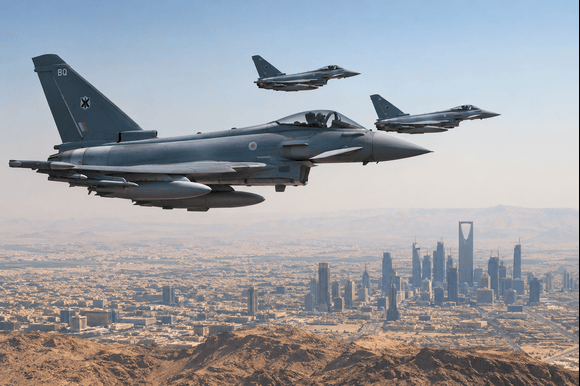
The United Kingdom will deploy Royal Air Force (RAF) Typhoon fighter jets to Saudi Arabia to strengthen the kingdom’s air defences amid escalating missile and drone attacks by Yemen’s Iran-backed Houthi movement, the British government has announced.
The defensive deployment, authorised by Prime Minister Andy Burnham, is intended to help protect Saudi cities, critical infrastructure and energy facilities from further aerial attacks.
The decision follows a series of Houthi strikes targeting the Saudi capital, Riyadh, and energy installations along the kingdom’s coast, raising concerns about the potential for further escalation across the region.
Defence Secretary Wes Streeting confirmed the deployment in a written statement on Tuesday, stressing that British aircraft would operate exclusively in a defensive capacity.
“These aircraft will operate in a defensive role and will not conduct offensive strikes against the Houthis,” Streeting said.
The UK will also send military advisers and an RAF A400M transport aircraft to assist with moving defence equipment within Saudi Arabia. The measures form part of Britain’s existing military support for the kingdom as it responds to growing aerial threats.
Deadly Houthi Attacks Raise Security Concerns
The British announcement comes after a series of deadly attacks attributed to the Houthis, including strikes targeting Saudi Arabia’s airports and other strategic locations.
Saudi authorities said last week that 19 people had been killed in Houthi attacks on the kingdom’s airports.
One missile strike on Riyadh’s international airport on 10 October reportedly killed 13 people and injured 308 others, making it the deadliest attack in Saudi Arabia in more than a decade.
The attacks have heightened concerns about the security of Saudi Arabia’s civilian infrastructure and the potential consequences for regional stability.
The Houthis have continued launching attacks in retaliation for Saudi strikes against areas under their control in western Yemen, including the capital, Sanaa.
The group has repeatedly threatened to intensify its operations against Saudi targets. Earlier this month, Houthi military spokesman Brigadier General Yahya Saree vowed to continue what he described as “escalating operations deep inside Saudi Arabia”.
The latest developments have placed additional pressure on regional governments and international partners to strengthen defensive measures and prevent further civilian casualties.
Houthi Missile Strike Kills Dozens in Yemen
The escalating violence has also caused significant casualties inside Yemen, where the Houthis remain locked in a prolonged conflict with the internationally recognised government.
More than 70 security personnel were reportedly killed earlier this week when a Houthi missile struck a military camp in the central Yemeni province of Shabwa.
A spokesman for the Saudi-backed Yemeni armed forces said the group had launched three ballistic missiles at al-Alam camp near the city of Ataq.
The Houthis’ military spokesman said the operation had targeted “Saudi enemy concentrations”.
The competing accounts reflect the wider conflict between the Houthi movement and forces supporting Yemen’s internationally recognised government, which is backed by Saudi Arabia.
The Houthis seized control of Sanaa in 2014, forcing the internationally recognised authorities from the capital and triggering a wider regional intervention.
The conflict has since caused widespread destruction, displacement and civilian suffering, while repeatedly threatening the security of neighbouring countries.
Conflicting Casualty Figures Highlight Scale of Conflict
Casualty figures released by authorities on opposing sides of the conflict illustrate the continuing intensity of the fighting.
According to the Houthi-run health ministry in north-western Yemen, Saudi air and artillery strikes have killed at least 141 people and injured another 395 since 3 September.
Meanwhile, Yemen’s government health ministry reported last week that at least 1,282 people had been killed across the country since 6 August.
The figures were reported by the respective authorities and could not be independently verified from the information provided.
The continuing exchange of missile attacks, airstrikes and artillery fire has raised fears that the conflict could intensify further, increasing the risks to civilians and critical infrastructure on both sides of the border.
UK Expands Military Support for Saudi Arabia
Alongside deploying the Typhoon jets, Britain will provide military advisers and an RAF A400M transport aircraft to support the movement of defensive equipment within Saudi Arabia.
The UK is already supplying equipment designed to protect the kingdom against aerial attacks, while also providing air-to-air refuelling support for defensive Saudi operations.
Streeting confirmed that the refuelling arrangement had been extended by a further 90 days.
In a separate statement, the defence secretary said the attack on Riyadh’s airport demonstrated the seriousness of the threat posed by the Houthis.
“That’s why today I have approved further UK military support,” he added.
The British government said the additional assistance was intended to help Saudi Arabia defend itself against attacks while limiting the risk of further regional destabilisation.
The deployment places RAF Typhoon aircraft in a defensive role, with the stated objective of protecting Saudi territory rather than carrying out offensive strikes against Houthi positions.
Regional Escalation Threatens Energy Supplies
Streeting also warned that violence across the Gulf was disrupting energy supplies and driving up costs for households and businesses.
Saudi Arabia is a major global oil producer, making the security of its energy infrastructure important for international markets. Any prolonged disruption affecting production, transportation or regional shipping could have wider economic consequences.
The latest Houthi attacks have therefore raised concerns extending beyond the immediate security of Saudi cities and military facilities.
Britain’s decision to reinforce Saudi Arabia’s defences reflects growing concern about the potential consequences of continued missile and drone attacks, particularly if they spread to additional targets or disrupt essential infrastructure.
As the conflict continues, the UK says its military assistance will focus on defensive capabilities. However, further Houthi attacks or retaliatory operations could increase pressure on regional governments to take additional security measures.
The situation remains volatile, with the risk of further casualties and disruption continuing to pose challenges for Saudi Arabia, Yemen and their international partners.