


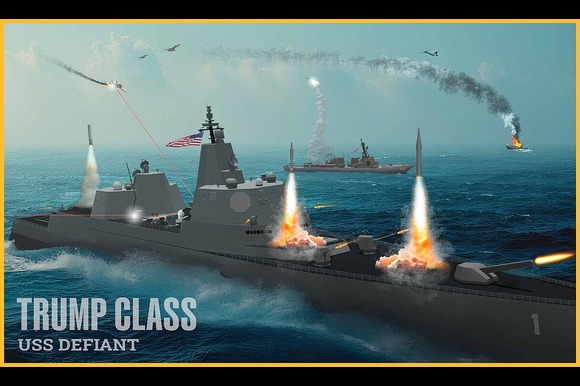
US President Donald Trump has unveiled plans for a new class of warships he says will redefine American naval power, announcing the development of what he called a “Trump-class” of battleships that would be larger, faster and vastly more powerful than any previous US-built warship.
Speaking on Monday at his Mar-a-Lago resort in Florida, Trump said the proposed vessels would form the backbone of a broader naval expansion programme he dubbed the “Golden Fleet”, aimed at securing long-term US maritime dominance. The announcement was made alongside a visual rendering of the ships, which appeared to feature Trump’s likeness on their hulls.
“We had big battleships. These are bigger,” Trump said. “They’ll be 100 times the force, the power of the old ships, and there’s never been anything like them.”
According to Trump, the new warships would incorporate cutting-edge military technology, including artificial intelligence systems and directed-energy laser weapons. He said they would also be equipped with hypersonic missiles, nuclear-capable cruise missiles and electromagnetic rail guns—technologies that are currently at various stages of research and development within the US Navy.
“Each one of these will be the largest battleship in the history of our country, the largest battleship in the history of the world,” Trump said. He dismissed suggestions that the programme was designed to counter any specific adversary, describing the vessels instead as “a counter to everybody”.
Trump said construction would initially begin with two ships, but that the programme could expand to 10 vessels, and potentially as many as 25, over an unspecified timeframe. He added that work on the first two ships would begin “immediately”, with the lead vessel to be named the USS Defiant.
Both Trump and Navy Secretary John Phelan described the Trump-class ships as a modern spiritual successor to the battleships that dominated naval warfare in the 20th century. Historically, however, battleships were defined as heavily armoured vessels armed with massive guns designed to engage enemy ships or bombard targets on land.
Such ships reached their peak during the Second World War. The largest US examples, the Iowa-class battleships, displaced roughly 60,000 tonnes. In the decades that followed, battleships fell out of favour as aircraft carriers, submarines and long-range missile systems became the central elements of modern naval strategy.
Trump drew historical parallels with the “Great White Fleet”, commissioned by President Theodore Roosevelt in the early 1900s as a demonstration of American naval strength, and referenced a classic Second World War documentary series on naval warfare.
“Victory at Sea. I don’t know if anyone has seen Victory at Sea, but it was a classic,” Trump said, adding that the new ships would help “maintain American military supremacy”.
Details published on a newly launched Golden Fleet website describe the proposed vessel as a “guided missile battleship” comparable in size to the Iowa-class ships, but significantly lighter. The new design is expected to displace around 35,000 tonnes—about half the weight of its Second World War-era predecessors—and operate with substantially smaller crews of between 650 and 850 sailors.
Unlike traditional battleships, the primary armament of the Trump-class vessels would be missiles rather than large-calibre naval guns, reflecting the shift toward missile-centric naval warfare.
Trump said the naval expansion would be accompanied by renewed pressure on defence contractors to accelerate production schedules and control costs. He announced plans to meet with major defence firms next week to address delays and cost overruns, and to examine whether executive pay, stock buybacks and dividend payments are undermining manufacturing output.
“We don’t want executives making $50m a year, issuing big dividends and doing buybacks while production of F-35s and other jets is lagging,” Trump said.
The proposal represents one of Trump’s most ambitious military announcements to date, though questions remain over cost, feasibility, congressional approval and how the ships would fit into existing US naval doctrine.