


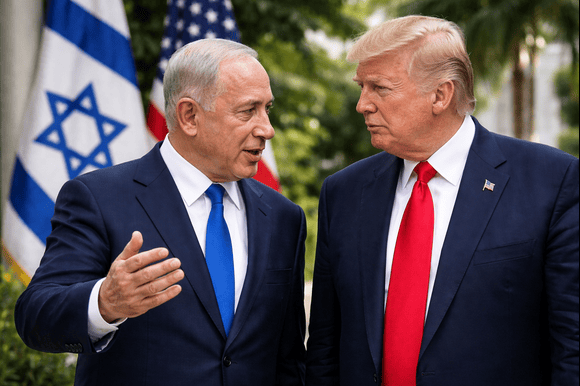
Washington, DC – Israeli Prime Minister Benjamin Netanyahu has long warned of a grave Iranian threat to Israel and the wider world, a stance he has maintained for more than three decades.
In June, US President Donald Trump acted on those warnings by ordering strikes on Tehran’s nuclear facilities. Yet Netanyahu appears unsatisfied and is expected to press for additional military action against Iran when he visits Trump at Mar-a-Lago in Florida on Sunday, this time emphasizing Tehran’s missile program.
Israeli officials and their American allies have again sounded alarms, arguing that Iran’s missile capabilities demand urgent attention. However, analysts suggest that another confrontation with Iran could conflict sharply with Trump’s stated foreign policy priorities.
Sina Toossi, senior fellow at the Center for International Policy think tank, noted that while Trump seeks to deepen economic cooperation and foster diplomatic ties between Israel and Arab states, Netanyahu is aiming for military dominance in the region.
“This desire for perpetual US involvement, for perpetual wars against Iran to really break the Iranian state, reflects Israel’s aim for unchallenged dominance, hegemony, and expansionism,” Toossi said.
“And I think that’s at the root of Netanyahu’s objectives and the direction he wants to steer the US toward, but this clashes with US interests, which prioritize regional stability without direct American military intervention.”
Since brokering a truce in Gaza, which Israel has reportedly violated almost daily, Trump, portraying himself as a peacemaker, has claimed to have delivered Middle East peace for the first time in 3,000 years. His administration’s recently released National Security Strategy (NSS) describes the region as “emerging as a place of partnership, friendship, and investment,” and suggests it is no longer a top US priority.
Shifting Focus to Missiles
As the US seeks to reduce its military footprint in the Middle East, Israel appears to be lobbying for a conflict that could entangle Washington. Historically, Israel has highlighted Iran’s nuclear program as its primary security threat. Trump, however, maintains that the June strikes effectively eliminated Tehran’s nuclear capabilities.
Regardless of the accuracy of that assessment, analysts say Israel has shifted its focus to Iran’s missile program to maintain pressure without contradicting the US president.
Trita Parsi, executive vice president at the Quincy Institute, a US think tank advocating diplomacy, said, “Since Trump has declared—rightly or wrongly—that the nuclear issue is resolved, Israel is refocusing on missiles to keep Tehran under scrutiny.”
“Israelis will continuously shift the goalposts to ensure confrontation with Iran remains ongoing,” Parsi added.
Iran has consistently maintained that its nuclear program is peaceful, in contrast to Israel, which is widely believed to possess an undeclared nuclear arsenal. Tehran has not launched missiles against Israel unprovoked. During the June conflict, Iran fired hundreds of missiles at Israel, some breaching its air defense systems, while Israel initiated military action without apparent provocation.
Israeli Focus on Ballistic Missiles
Israel and its allies continue to emphasize the Iranian missile threat, warning of production increases and capabilities.
“While Israel’s Operation Rising Lion destroyed much of Iran’s ballistic missile capacity, estimates suggest 1,500 missiles remain out of 3,000 previously held,” the American Israel Public Affairs Committee (AIPAC) stated in an email to supporters.
The ballistic missile threat is expected to dominate discussions when Netanyahu meets Trump at Mar-a-Lago on Monday. Senator Lindsey Graham, a prominent Iran hawk close to Trump, recently reiterated concerns over Iran’s long-range missiles, warning that Tehran’s growing arsenal could overwhelm Israel’s Iron Dome air defense system.
Israeli Defence Minister Israel Katz also underscored Iran’s missile capabilities, signaling Israel’s refusal to tolerate regional threats.
“The defense establishment is closely monitoring developments, and naturally, I cannot elaborate beyond that,” Katz told The Times of Israel. “But on one principle, there is no dispute: What was before October 7 will not be again. We will not allow threats of annihilation against the state of Israel.”
Critics argue Israel’s objective extends beyond countering existential threats, aiming instead to maintain regional hegemony, potentially seeking regime change or periodic strikes to weaken Iran militarily.
“The Israelis will return every six months with another plan to bomb Iran,” Parsi said. “If Trump acquiesces again, as in June, he will face repeated pressure every June and December until he halts it.”
US Domestic Politics and the Trump Base
While hawkish voices once dominated Trump’s Republican base, many now oppose military interventions, emphasizing domestic priorities. Influential media figures and America First advocates, including Tucker Carlson and the late Charlie Kirk, cautioned against renewed US involvement in Iran.
Nonetheless, congressional Republicans largely remain pro-Israel, and Trump’s aides, such as Secretary of State Marco Rubio, maintain hawkish stances. Pro-Israel donors, including Miriam Adelson, are also expected to exert pressure.
“Toossi noted that political calculations for war with Iran are especially relevant with the 2026 midterms approaching, determining Congressional control,” he said.
Risk of Escalation
In June, Trump claimed success after US strikes, supporting Israel and damaging Iran’s nuclear program while avoiding a protracted conflict. A ceasefire was achieved after 12 days, following an Iranian missile attack on a US base in Qatar, which caused no casualties.
Analysts warn that a second round of strikes could escalate rapidly. Parsi emphasized that Iran’s restraint in June is unlikely to recur.
“The Iranian response would be much harsher and quicker, as they will not tolerate being bombed every six months,” he said. “Israel may act unilaterally, expecting US defense support, gradually drawing America into conflict.”
Parsi urged Trump to prevent Israel from initiating such a war: “If they don’t want Israel to start that war, you tell Israel, ‘Don’t start that war. We are completely out.’ That would be the America First approach.”
Parsi referenced Trump’s National Security Strategy, which indicates the US focus on the Middle East will diminish as the region pursues greater cooperation. He concluded, “Previous administrations have voiced similar intentions. It’s time to follow through.”