

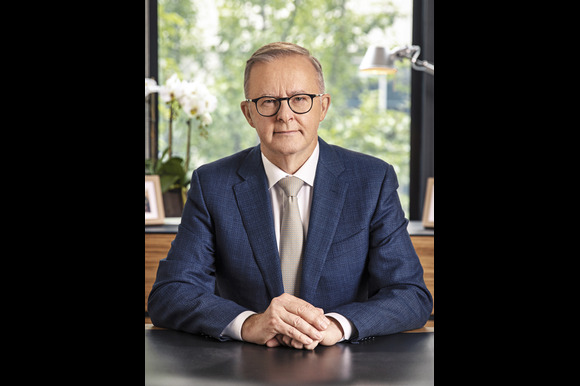
Australian Prime Minister Anthony Albanese has announced a sweeping crackdown on hate speech after Sunday’s deadly shooting at Bondi Beach, which targeted a Jewish festival and left 15 people dead.
The attack took place during an event marking the first day of Hanukkah, when two gunmen opened fire on the crowd. The incident has sent shockwaves across Australia and prompted renewed debate over extremism, antisemitism and public safety.
Speaking to reporters in Canberra, Albanese said his government would introduce new laws aimed at curbing “those who spread hate, division and radicalisation”. He stressed that the measures were necessary to protect social cohesion and prevent further acts of violence.
Under the proposed changes, the home affairs minister will be granted expanded powers to cancel or refuse visas for individuals found to be promoting hate. A new national taskforce will also be established to ensure the education system “prevents, tackles and properly responds to antisemitism”.
The legislative package will include penalties for preachers and leaders who advocate violence, the creation of a new federal offence of “aggravated hate speech”, and the introduction of “hate” as an aggravating factor in sentencing for crimes involving online threats and harassment.
“Every Jewish Australian has the right to feel safe, valued and respected for the contribution that they make to our great nation,” Albanese said. He described the perpetrators as terrorists inspired by Islamic State ideology who had sought to turn Australians against one another.
“The terrorists, inspired by ISIS, sought to turn Australians against each other,” he said. “Australians have responded to that act of hatred with love and sympathy for those in mourning.”
Security concerns have remained high in the days following the shooting. On Thursday, New South Wales Police detained seven men in southwest Sydney after receiving a tip that a “violent act was possibly being planned”. In a statement, police said there was no identified link between those detentions and the investigation into Sunday’s Bondi attack.
Authorities said two vehicles were intercepted on George Street. Videos shared by local media appeared to show armed police officers detaining individuals on the street just hours after Albanese delivered his address.
Antisemitism envoy Jillian Segal, who also spoke at the press conference, said Australia was at “a very important moment not only for our community, but for fighting antisemitism around the world”. Albanese confirmed that his government would be “fully supporting and adopting” the recommendations Segal outlined in a report released in July.
That report, however, sparked controversy at the time of its release. Critics raised concerns about its implications for free speech, particularly proposals to monitor universities and arts organisations and potentially withhold funding if they were deemed to have failed to act against antisemitism. Some feared such measures could be used to suppress pro-Palestinian protests or legitimate political expression.
The Jewish Council of Australia welcomed Albanese’s commitment to action, including his emphasis on gun reform and tackling online hate. At the same time, it expressed concern that aspects of the announcement echoed long-standing proposals from the pro-Israel lobby that, it argued, were unrelated to addressing violent extremism.
“If education initiatives like university scorecards become a form of ideological policing – particularly where they are used to limit legitimate criticism of Israel – they will only make Jews less safe, and do the opposite of combating antisemitism,” said Dr Max Kaiser, executive officer of the Jewish Council of Australia.
Albanese also acknowledged criticism from members of the Jewish community who say his government failed to do enough to counter antisemitism following the 7 October attack on Israel by Hamas. He conceded that more could have been done earlier.
“I accept my responsibility for the part in that as prime minister of Australia,” he said. “But what I also do is accept my responsibility to lead the nation and unite the nation. Because what people are looking for at this time isn’t more division.”
Home Affairs Minister Tony Burke said the government was effectively lowering the tolerance threshold for hate speech. He argued that some individuals had exploited Australia’s free speech protections by pushing language that was deeply dehumanising without crossing into explicit calls for violence.
“There have been individuals who have managed to exploit a nation that had different principles of freedom of speech and have gone right to the limits of language that is clearly dehumanising, unacceptable, having no place in Australia, but have not quite crossed the threshold to violence,” Burke said.
Daniel Aghion, president of the Executive Council of Australian Jewry, the peak body representing Jewish Australians, said he would reserve judgement until the full details of the measures were released. “I would need to see the details before making an assessment as to whether the measures are likely to live up to their billing,” he said.
He added that Jewish leaders had repeatedly warned of the dangers of failing to confront antisemitism decisively in the wake of the 7 October attacks. “It is an absolute tragedy that it has taken a massacre of Jewish and other Australians for that step to be taken,” Aghion said.