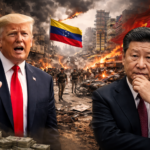

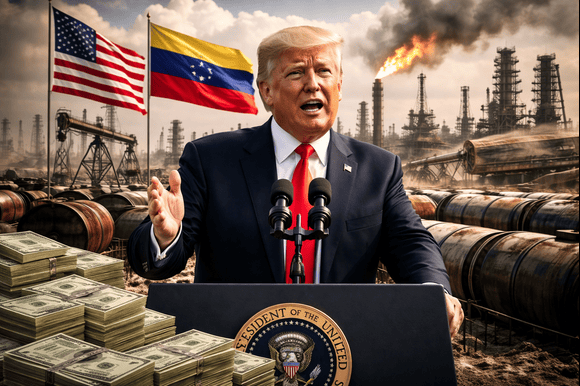
US President Donald Trump has said Venezuela will hand over between 30 and 50 million barrels of oil — valued at roughly $2.8bn (£2.1bn) — to the United States following a US-backed military operation that removed President Nicolás Maduro from power.
In a post on social media, Trump said the oil would be sold at prevailing market prices and that he would personally oversee the proceeds, ensuring the funds are used to benefit both Venezuelans and Americans.
The announcement follows Trump’s recent claim that the US oil industry would be fully operational in Venezuela within 18 months, with substantial American investment expected to flow into the country.
However, energy analysts previously told the BBC that restoring Venezuela’s oil output could require tens of billions of dollars and may take up to a decade to achieve.
Writing on Truth Social on Tuesday, Trump said: “I am pleased to announce that the Interim Authorities in Venezuela will be turning over between 30 and 50 MILLION barrels of high-quality, sanctioned oil to the United States of America.
“This oil will be sold at its market price, and the money will be controlled by me, as President of the United States of America, to ensure it is used to benefit the people of Venezuela and the United States.”
The statement came one day after Delcy Rodríguez, formerly Venezuela’s vice-president, was sworn in as interim president. Nicolás Maduro has since been transported to the United States, where he faces charges related to drug trafficking and weapons offences.
Speaking to NBC News on Monday, Trump said: “Having a Venezuela that’s an oil producer is good for the United States because it keeps oil prices down.”
According to CBS, the BBC’s US partner, representatives from major American petroleum companies are expected to meet Trump administration officials later this week.
Despite the president’s optimism, analysts who spoke to the BBC expressed doubts that Trump’s plans would significantly affect global oil supplies — or prices — in the near term.
They noted that energy companies would first need assurances of political stability and legal certainty, and that even once investments begin, production gains would take years to materialise. Trump, however, has insisted that US oil firms are capable of repairing Venezuela’s long-neglected energy infrastructure.
Venezuela holds an estimated 303 billion barrels of oil — the largest proven reserves in the world — but production has steadily declined since the early 2000s due to mismanagement, underinvestment and sanctions.
The Trump administration views those reserves as a major opportunity to strengthen US energy interests.
Yet expanding Venezuelan production would be costly for American firms. The country’s crude is heavy and difficult to refine, and at present only one US company — Chevron — operates in Venezuela.
Asked to comment on Trump’s plans, Chevron spokesperson Bill Turenne said the company “remains focused on the safety and wellbeing of our employees, as well as the integrity of our assets.”
He added: “We continue to operate in full compliance with all applicable laws and regulations.”
ConocoPhillips, another major US oil firm that no longer operates in Venezuela, said it was closely following developments.
“We are monitoring developments in Venezuela and their potential implications for global energy supply and stability,” spokesperson Dennis Nuss said. “It would be premature to speculate on any future business activities or investments.”
ExxonMobil did not immediately respond to requests for comment.
While defending the removal of Maduro from Caracas, Trump also accused Venezuela of having “unilaterally seized and stolen American oil.”
Vice-President JD Vance echoed those claims on X after Maduro’s arrest, stating that Venezuela had expropriated American oil assets and “used that stolen property to enrich itself and fund narcoterrorist activities.”
However, experts say the reality is more nuanced.
US oil companies have operated in Venezuela for decades under licence agreements. The industry was nationalised in 1976, and in 2007 then-president Hugo Chávez imposed tighter state control over remaining foreign-owned assets, including those belonging to US firms.
In 2019, a World Bank arbitration tribunal ordered Venezuela to pay $8.7bn in compensation to ConocoPhillips for the 2007 nationalisation. That amount has yet to be paid, meaning at least one US oil company is still owed significant compensation.
BBC Verify correspondent Ben Chu said claims that Venezuela “stole” American oil oversimplify the situation. Experts note that the oil itself was never legally owned by foreign companies, but by the Venezuelan state.