

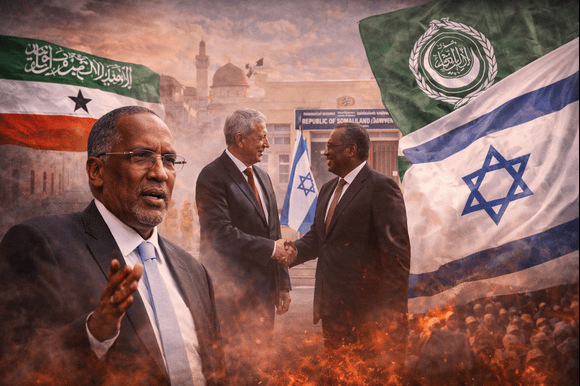
A senior figure from Somaliland’s ruling political establishment has strongly defended the self-declared republic’s decision to establish formal relations with Israel, rejecting criticism from Arab and Muslim countries as inconsistent and politically motivated.
Speaking in a tense interview with Al Jazeera Mubasher on Wednesday, Hersi Ali Haji Hassan, chairman of the governing Waddani party, said Somaliland had little alternative but to seek diplomatic recognition wherever it could after decades of international neglect. His remarks came days after Israeli Foreign Minister Gideon Saar made a highly controversial visit to Hargeisa, Somaliland’s largest city and administrative centre — the first such visit since Israel formally recognised Somaliland’s independence in late December.
“We are not in a position where we can pick and choose,” Hassan said. “We are operating under necessity. What we need is official international recognition.”
“There is simply no alternative before us except to welcome any country that recognises our right to exist,” he added, noting that Somaliland has been ignored for more than three decades.
The visit has sparked sharp diplomatic backlash. Somalia’s federal government in Mogadishu, which continues to regard Somaliland as part of its sovereign territory, condemned the move as a breach of Somalia’s territorial integrity. Regional and international bodies, including the Arab League and the Organisation of Islamic Cooperation (OIC), also issued statements denouncing what they described as a legitimisation of a “separatist entity.”
Hassan dismissed those objections outright.
“We have existed as an independent state for 34 years,” he said. “The Arab League’s rejection means nothing to us. They never accepted us as members, nor did they give us any meaningful attention during those decades.”
When questioned about why Somaliland would choose to normalise relations with Israel while facing isolation across much of the region, Hassan pointed to precedents set by other Muslim-majority and Arab states.
“Somaliland is not the only one that has normalised relations with Israel,” he said. “Several Arab and Islamic countries maintain extensive political and economic ties with Israel — including Egypt, Turkiye, Jordan and the United Arab Emirates.”
Concerns over a military presence
The emerging relationship has fuelled speculation among regional observers that Israel could seek to establish a military presence in Somaliland, potentially gaining strategic access to the southern gateway of the Red Sea.
Asked directly whether Somaliland would permit Israel to set up a military base on its territory, Hassan declined to give a definitive answer.
“We have only initiated diplomatic relations,” he said. “This issue has not been discussed at this stage.”
When pressed repeatedly on whether Somaliland might agree to such a request in the future, Hassan deflected.
“Ask that question when the time comes,” he said. “Right now, the question is premature.”
He maintained that the current focus of the relationship is diplomatic and economic cooperation, with the primary objective being international recognition rather than security arrangements.
‘A political relationship, not a religious one’
The interview became increasingly confrontational when the discussion turned to Israel’s war on Gaza. Presenter Ahmed Taha challenged Hassan on the ethical implications of establishing ties with a state accused by rights groups of committing genocide, questioning how Somaliland could ignore the suffering of “two million besieged Palestinians.”
Hassan attempted to draw a distinction between political engagement and religious or moral solidarity, arguing that the Gaza conflict had effectively “ended” following a US-brokered initiative in October 2025 — a reference to a ceasefire agreement backed by United States President Donald Trump. Despite the ceasefire, Israeli forces have continued to kill hundreds of Palestinians in Gaza.
“Our dealings with Israel are political,” Hassan said. “Political engagement is not prohibited by religion. Our position on the Palestinian people is no different from that of Arab and Islamic countries.”
“We are distant from these conflicts,” he added. “Our priority is international recognition. That is the central issue for us.”
Hassan’s remarks are likely to further inflame regional tensions as Somaliland’s diplomatic realignment continues to draw scrutiny from Somalia, neighbouring states and the wider Muslim world.