


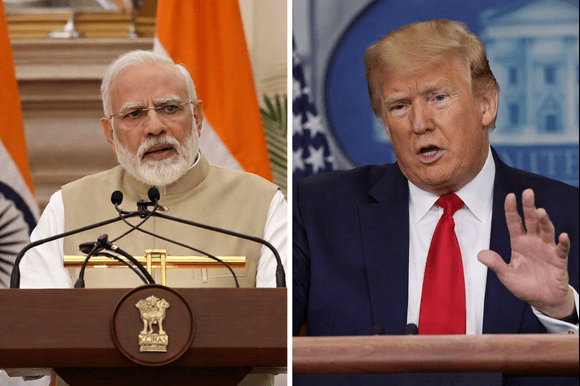
India has rejected claims by US Commerce Secretary Howard Lutnick that negotiations over a bilateral trade deal stalled because Prime Minister Narendra Modi did not place a phone call to President Donald Trump, pushing back strongly against the suggestion that diplomatic protocol derailed the talks.
The dispute comes amid heightened trade tensions between the two countries. In August, President Trump imposed steep 50% tariffs on Indian goods, including additional penalties tied to India’s continued purchase of Russian oil, after negotiations over a trade agreement failed to reach a conclusion.
Although both sides have since returned to the negotiating table, there remains no clear timeline for when a deal might be finalised. Several informal deadlines have passed without resolution, and key differences continue to divide Washington and New Delhi.
Among the most significant unresolved issues is agriculture. The United States has been pressing India to open up its tightly regulated farm sector, a demand that New Delhi has consistently resisted, citing the need to protect farmers and food security. Despite these obstacles, Lutnick suggested recently that the agreement was close to being finalised at an earlier stage.
“It was all set up,” Lutnick said on a podcast released on Friday. “I said [to the Indian side] you’ve got to have Modi call the president. They were uncomfortable doing it, so Modi didn’t call.”
The White House has so far declined to comment on Lutnick’s remarks.
India, however, responded firmly, saying Lutnick’s characterisation of the discussions was inaccurate. On Friday, foreign ministry spokesperson Randhir Jaiswal told reporters that the portrayal of the talks did not reflect the reality of the negotiations.
“India and the US were committed to negotiating a bilateral trade agreement as far back as 13 February last year,” Jaiswal said. “Since then, both sides have held multiple rounds of negotiations to arrive at a balanced and mutually beneficial trade agreement. On several occasions, we have been close to a deal.”
Jaiswal added that Modi and Trump had spoken by phone eight times last year, covering “different aspects of our wide-ranging partnership,” contradicting the suggestion that a lack of communication had stalled progress.
Speaking on the All-In Podcast, a business and technology programme hosted by four venture capitalists, Lutnick described Trump’s approach to deal-making as a “staircase,” in which the first party to move receives the most favourable terms.
According to Lutnick, India was the second country, after the United Kingdom, to enter trade negotiations with the US. He claimed Washington gave New Delhi “three Fridays” to conclude the deal. While Lutnick said his role was to negotiate the framework and prepare the agreement, he insisted that Trump alone closed such deals, and that India’s reluctance to arrange a direct call with the president ultimately caused the talks to falter.
Lutnick also said that after the talks with India stalled, the US went on to finalise agreements with several other countries, including Indonesia and Vietnam.
“When India came back later saying they were ready to take the initial deal, the train had left the station,” he added.
However, the precise terms of the agreement Lutnick says India missed remain unclear. Agriculture has consistently been a central sticking point, with Washington seeking greater market access and Delhi refusing to compromise on protections for its farm sector.
In December, US Trade Representative Jamieson Greer told senators in Washington that the US had received what he described as the “best ever offer” from India, while also calling the country a “tough nut to crack.”
Trump himself has made a series of pointed remarks about India and Modi in recent days, including warnings that tariffs could be raised further if New Delhi does not stop importing Russian oil.
India significantly increased its purchases of discounted Russian crude following the outbreak of the war in Ukraine, arguing that it must prioritise the energy needs of its vast population. Since the tariffs took effect, however, Indian refiners have reportedly begun reducing imports from Moscow.
Lutnick’s comments also follow remarks earlier this week by US Senator Lindsey Graham, who said Trump had “greenlit” a tough sanctions bill targeting Russia. If approved by Congress, the legislation could impose even harsher secondary sanctions and tariffs on countries that continue doing business with Moscow.
Jaiswal said India was aware of the proposed legislation and was closely monitoring developments, reiterating that energy security remains a core national concern.
Despite the 50% tariffs, India’s goods exports to the US rose by more than 22% in November compared with the same month a year earlier.
Nevertheless, the tariffs and accompanying rhetoric have strained relations between the two countries. Modi, who once shared a notably warm rapport with Trump, was among the first global leaders to visit the White House after Trump’s inauguration.
Since then, ties have cooled. India has repeatedly denied Trump’s claims that he brokered a ceasefire between India and Pakistan following a four-day conflict in May. In June, New Delhi said Modi had told Trump that India would never accept third-party mediation on the Kashmir dispute.
Although the two leaders have spoken several times since, including a call in September when Trump phoned to wish Modi a happy birthday, the broader relationship has continued to face mounting challenges.