


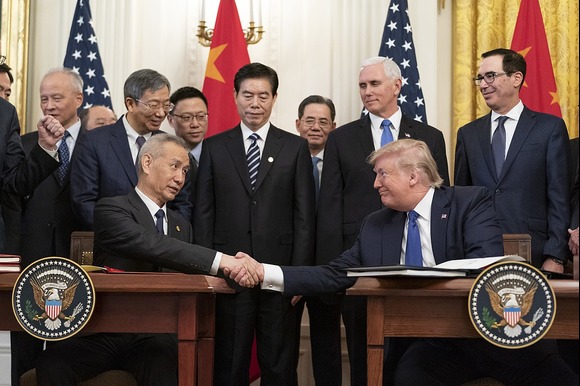
China has reported unprecedented export figures for 2025, despite widespread disruption in the global economy triggered by US President Donald Trump’s aggressive tariff policies and trade stance.
Data released by Beijing on Wednesday showed that China recorded the largest trade surplus ever achieved by any country, reaching $1.19tn (£890bn). The figure represents the gap between the value of China’s exports and its imports and marks the first time the country’s annual surplus has exceeded the $1tn threshold, surpassing the previous record of $993bn set in 2024.
The figures also revealed that China posted monthly export surpluses of more than $100bn on seven occasions last year, indicating that the impact of Trump’s tariff campaign on China’s overall trade has been limited. While Chinese exports to the United States declined, those losses were offset by stronger trade flows with other regions, particularly South East Asia, Africa and Latin America.
Speaking at a press briefing on Wednesday, Wang Jun, deputy director of China’s customs authority, described the results as “remarkable and hard-earned” in the context of major shifts and mounting challenges in the global trading system.
Wang highlighted strong growth in exports related to green energy technologies, artificial intelligence-linked products and robotics, reflecting China’s push into higher-value manufacturing and advanced industries.
Analysts said the massive surplus was driven by sustained international demand for Chinese goods, alongside expanding trade ties with partners across South Asia, Africa and Europe. At the same time, weak conditions at home have reduced China’s appetite for imports.
China’s domestic economy has been under strain from a prolonged property sector crisis and rising debt levels, factors that have made companies reluctant to invest and households cautious about spending.
As a consequence, import growth remained sluggish, increasing by only 0.5% over the year, according to the latest official data.
Other factors boosting exports included a weaker yuan, strong industrial output and persistent inflation in many Western economies, all of which have made Chinese products more competitive on the global market.
However, the record surplus presents what some analysts describe as a double-edged sword for Beijing. Deborah Elms, a trade policy expert at the Hinrich Foundation, said the figures represent a “mixed blessing”.
While China has benefited from higher overseas sales and job creation linked to its export sector, Elms warned that Chinese goods are likely to come under “increasing scrutiny” in foreign markets where local industries are struggling to compete with lower-priced imports.
Elms added that China’s export momentum is expected to extend into 2026, as Chinese products and services become more deeply embedded in global supply chains and business networks.
For Beijing, the data will be interpreted as evidence that China has built a broad and diversified customer base beyond the United States. Nonetheless, Wang cautioned that the external environment remains uncertain, noting that several countries have complained their markets are being flooded with inexpensive Chinese goods that domestic producers cannot match.
Businesses are also preparing for another volatile year marked by trade tensions and the possibility of further tariffs under the Trump administration.
In April last year, President Trump unsettled global markets by announcing sweeping tariffs on imports from more than 90 countries. China was hit particularly hard, as it remains the largest exporter of goods to the US.
The dispute between the world’s two biggest economies escalated into a war of words, with both sides at one point threatening blanket tariffs running into triple-digit percentages.
At the time, trade analysts viewed the standoff as a critical test of China’s dependence on the US market, a claim Beijing has long rejected, arguing that American demand represents only one of many export destinations.
Tensions eased somewhat after a meeting between President Trump and Chinese leader Xi Jinping in South Korea in October, allowing both sides to step back from a full-scale collapse in trade relations.
However, a range of lower-level tariffs remains in place, continuing to weigh heavily on Chinese exports to the United States.