

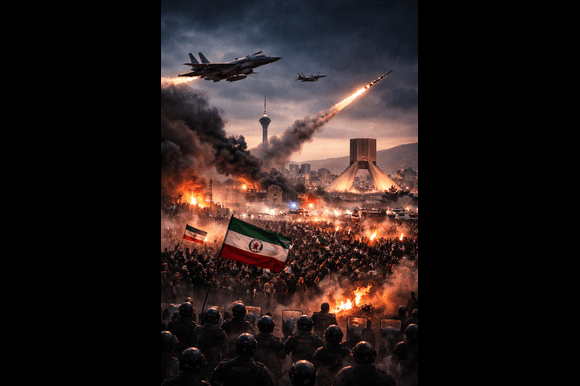
US and Tehran are locked in escalating rhetoric over Iran’s antigovernment protests, with Iranian Foreign Minister Abbas Araghchi declaring that his government is prepared for war after US President Donald Trump threatened military action in response to Tehran’s crackdown on the demonstrations.
A spokesperson for the United Nations High Commissioner for Human Rights, Volker Turk, citing UN sources within Iran, said on Tuesday that “hundreds” of people were believed to have been killed since the protests began in Tehran more than two weeks ago. The unrest, which initially targeted Iran’s economic crisis, has since grown into broader antigovernment demonstrations nationwide. Speaking via a statement read out by spokesperson Jeremy Laurence, Turk said: “This cycle of horrific violence cannot continue. The Iranian people and their demands for fairness, equality and justice must be heard.”
Turk also expressed alarm at recent public statements by some Iranian judicial officials suggesting that the death penalty could be applied to protesters through expedited legal proceedings. He criticized the Iranian government’s repeated labeling of demonstrators as “terrorists.”
The semi-official Tasnim news agency reported on Sunday that 109 security personnel had been killed during the protests. While Iranian authorities have not confirmed the number of civilian casualties, opposition groups outside the country assert that hundreds of demonstrators have died. Al Jazeera has not independently verified either figure.
The UN statement comes amid sharply rising tensions between Tehran and Washington, as both sides exchange threats and accusations regarding the unrest. Iran’s intelligence agency reported on Tuesday that US-made arms and explosives had been seized from “militants” hiding the weapons in several homes. State television added that these “terrorist groups” were linked to Israel and had entered Iran through its eastern border, intending to carry out assassinations and sabotage using the seized arms.
In a separate claim, Iran’s top military commander, Abdolrahim Mousavi, accused the US and Israel of deploying members of ISIL (ISIS) within Iran to carry out attacks, though no evidence was provided.
The statements follow Araghchi’s exclusive interview with Al Jazeera, in which he said Iranian authorities had recordings of foreign voices issuing orders to “terrorist agents” to fire on police and protesters. Iranian officials have consistently accused the US and Israel of sending “foreign agents” to foment unrest.
“The internet was only cut after we confronted terrorist operations and realised that orders were coming from outside the country,” Araghchi told Al Jazeera. “We have recorded voices instructing terrorist agents from abroad to fire on police and demonstrators if authorities were not present, intending to spread killing.”
Responding to Washington’s threats of military action over the crackdown, Araghchi said Iran was prepared for war if the US wanted “to test” it. “If Washington wants to test the military option it has tested before, we are ready for it,” he added, while urging the US to pursue “the wise option” of dialogue and warning against those attempting to drag Washington into war to advance Israel’s interests. He noted that communications with US special envoy Steve Witkoff had “continued before and after the protests and are still ongoing.”
Meanwhile, the office of US Vice President JD Vance said on Tuesday that top Trump administration officials are preparing a range of diplomatic and military options to present to the president regarding the unrest. “Vice President Vance and Secretary of State [Marco] Rubio together are presenting a suite of options to the president, ranging from a diplomatic approach to military actions,” said William Martin, Vance’s communications director.
Hardline Republican Senator Lindsey Graham has called on Trump to increase pressure on Iran’s leadership, asserting that the “biggest prize” of his presidency would be the “demise of the Iranian state led by the ayatollah.” Graham recommended US military action focused on targeting “the infrastructure that allows the killing to happen,” while stopping short of endorsing a ground invasion. Experts note that deploying US troops against Iran’s battle-hardened Islamic Revolutionary Guard Corps would risk severe American losses.
The warnings follow Trump’s remarks on Sunday that he was considering “strong options” in response to Iran’s crackdown. The protests, which began last month over a plunging currency, have expanded into broad antigovernment demonstrations that have resulted in multiple deaths and prompted Iranian authorities to cut off internet access nationwide.
In addition to potential military measures, Trump has warned countries engaging in trade with Iran that they could face 25 percent tariffs on any business conducted with the US. He announced the decision via social media on Monday, describing it as “final and conclusive,” but offering few additional details.
The move drew a sharp rebuke from China. In a statement issued in Washington, the Chinese embassy said Beijing “firmly opposes any illicit unilateral sanctions and long-arm jurisdiction” and vowed to take “all necessary measures” to safeguard its interests.
As protests continue and security restrictions tighten, Washington which does not maintain formal diplomatic relations with Tehran urged its citizens in Iran to leave the country immediately via Armenia or Turkiye. “Leave Iran now. Have a plan for departing Iran that does not rely on US government help,” the US virtual embassy in Iran said in a Tuesday security alert.
Iranian authorities have “restricted access to mobile, landline, and national internet networks,” while airlines continue to limit or cancel flights to and from the country, with several suspending services until Friday, the alert said.
The internet shutdown in Iran has lasted more than 100 hours, according to the London-based cybersecurity monitor NetBlocks, with national connectivity hovering at approximately 1 percent of normal levels.
Despite restrictions, mobile users were briefly able to make international calls on Tuesday, The Associated Press reported, though SMS messaging remains down and internet users can only access locally approved websites.
Witnesses described a heavy security presence in central Tehran, with anti-riot police wearing helmets and body armour, armed with shotguns, tear gas launchers, and shields at key intersections. Several banks and government offices were reportedly burned during the unrest, causing banking services to struggle without internet connectivity.
Reporting from Tehran, Araghchi indicated internet access would soon be restored, though no timeline was provided. The limited reactivation of international calls could signal that the government recognises the need to de-escalate the situation.
Araghchi added that hundreds of thousands of demonstrators had rallied in support of the government on Monday night a turnout authorities are presenting as evidence of public backing.
He maintained that the government is attempting to differentiate between economic and political grievances, acknowledging legitimate complaints about the rising cost of living and the collapsing rial, but asserting it will not tolerate political unrest. “The state says on the one hand it understands the complicated economic situation for the people, but it’s not going to tolerate any unrest,” he said.