

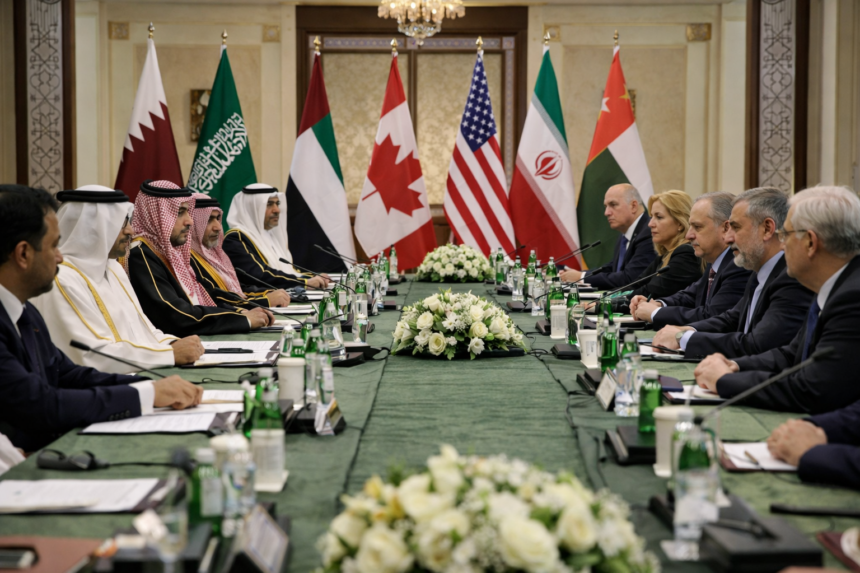
Arab Gulf states have been watching developments in neighbouring Iran with growing anxiety as the country has been swept by nationwide protests, while United States President Donald Trump has openly threatened possible military action against Tehran — a prospect many Gulf governments fear could plunge the region into widespread instability.
Behind closed doors, Saudi Arabia has reportedly been urging the US administration to avoid launching strikes against Iran. At the same time, Qatar and Oman have focused on diplomatic efforts aimed at reopening channels between Iranian and American officials. According to observers, the three countries intensified their diplomatic engagement after reports emerged on Wednesday suggesting that contacts between Washington and Tehran had broken down, fuelling concerns that a military attack could be imminent.
“They were all worried because traditional channels between the US and Iran were not being used, at least from the US side,” said Anna Jacobs Khalaf, a Gulf analyst and non-resident fellow at the Arab Gulf States Institute. “GCC officials simply didn’t know what US intentions were,” added Muhanad Seloom, an assistant professor of critical security studies at the Doha Institute for Graduate Studies.
Tensions rose sharply after Trump repeatedly warned of military action against Iran over the deadly crackdown accompanying the protests. Iranian authorities say more than 100 members of the security forces have been killed in clashes with demonstrators, while opposition activists claim the true death toll includes more than 1,000 protesters since unrest began in late December. Al Jazeera has not been able to independently verify either figure. Trump went further by urging Iranians to seize state institutions, declaring that “help is on the way”. Although he did not specify what form any action might take, his remarks left governments across the region bracing for escalation.
Arab Gulf nations fear that a US strike on Iran could send oil prices soaring, undermine their image as stable destinations for business and investment, and provoke retaliatory Iranian attacks on their territory.
Such concerns are rooted in experience. In 2019, Iran-aligned Houthi forces in Yemen targeted Saudi Arabia’s oil facilities, temporarily slashing the kingdom’s oil output. More recently, last June, Iran struck Qatar’s Al Udeid airbase — home to US forces — following an American attack on a major Iranian nuclear facility.
Although Tehran gave advance warning of that strike, which effectively ended the 12-day war between Israel and Iran, it set a dangerous precedent. Despite suffering setbacks to its military capabilities during that conflict, Iran retains a formidable arsenal capable of targeting US interests and allies across the region.
“Iran has ballistic missiles, supersonic missiles and proxy militia groups spread around,” said Seloom. “If they are given a reason to hit, they would.”
On Wednesday, a senior Iranian official told Reuters that Tehran had warned several regional states — including Saudi Arabia, the United Arab Emirates and Turkiye — that US military bases on their soil would be targeted if Washington attacks Iran. Shortly afterwards, some personnel were withdrawn from the Al Udeid airbase.
Later that day, Trump told reporters at the White House that he had received information suggesting that “the killing in Iran is stopping, is stopped … and there’s no plan for executions”. While some saw his comments as a potential path toward de-escalation, the US president stopped short of ruling out military action altogether.
Each member of the Gulf Cooperation Council has its own complex history with Iran, but analysts say all share deep concerns about what could follow a major conflict — particularly who might fill the vacuum if Supreme Leader Ayatollah Ali Khamenei were removed or if Iran’s political system were to collapse suddenly.
For Gulf states, the memory of Iraq after the 2003 US-led invasion looms large. That conflict led to years of chaos, a brutal civil war, the rise of al-Qaeda and ultimately the emergence of ISIL (ISIS). Leaders in the Gulf are determined to avoid seeing a similar scenario unfold in a country of more than 90 million people, with vast weapons stockpiles and a weakened yet still active network of regional allies.
“They may want to see Iran’s leadership weakened, but they are far more worried about chaos, uncertainty and the possibility of even more radical forces coming to power,” Khalaf said.
Countries such as Qatar, Kuwait and Oman have developed ways to coexist with Iran, their neighbour across the Gulf. Qatar even shares with Iran the world’s largest natural gas field. The UAE, particularly Dubai, is a major trading hub for Iranian commerce, and the two countries maintain strong economic ties — meaning unrest or conflict in Iran would have serious consequences for Emirati interests.
Despite this, Emirati officials have remained largely silent in recent days, having diverged from other GCC states by forging closer ties with Israel and taking different stances on conflicts in Sudan and Yemen.
Saudi Arabia and Iran, long bitter rivals, have in recent years shifted toward a more pragmatic relationship centred on maintaining communication and avoiding direct confrontation. Riyadh, in particular, is wary of regional instability as it pursues ambitious economic reforms aimed at reducing dependence on oil and expanding tourism — objectives that rely heavily on sustained regional calm.
“Saudi Arabia is not comfortable with regime change anywhere,” Khalaf said. “It is radical, extreme, and the outcomes are uncertain and risky.”
“Our objective is stability and calm so that we can focus our resources on building a better future for our people,” Saudi Minister of State for Foreign Affairs Adel Al-Jubeir said on Thursday.
Still, Saudi political analyst Khaled Batarfi noted that Riyadh would not oppose gradual changes in Iran, particularly if they produced a leadership more willing to curb nuclear and missile programmes and adopt a less confrontational stance toward the US.
“But a sudden shift — a full regime collapse with the risk of fragmentation — would not benefit anyone,” Batarfi said. “The region is already on fire, and we don’t need to add another blaze at our doorstep.”