


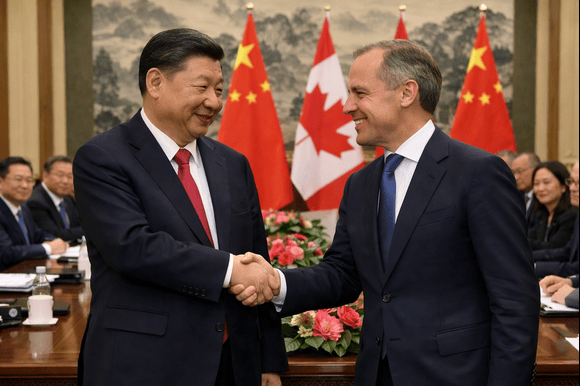
Chinese President Xi Jinping and Canadian Prime Minister Mark Carney have announced a significant reduction in tariffs, signalling a reset in bilateral ties following a high-level meeting in Beijing.
Under the agreement, China is set to cut tariffs on Canadian canola oil from 85% to 15% by 1 March. In return, Canada will apply a most-favoured-nation tariff rate of 6.1% on Chinese electric vehicles, Carney told reporters. The deal marks a major breakthrough after years of strained relations and retaliatory trade measures between the two countries.
Xi described the agreement as a “turnaround” in China–Canada relations, while the outcome also represents a diplomatic win for Carney, who is the first Canadian leader to visit China in nearly a decade. The prime minister has been seeking to diversify Canada’s trade relationships away from the United States, its largest trading partner, amid uncertainty caused by former US President Donald Trump’s on-again, off-again tariffs.
The renewed cooperation could also pave the way for increased Chinese investment in Canada, a development that places Beijing’s economic footprint closer to the United States. Carney appeared to suggest that Washington’s trade policies had played a role in driving Ottawa closer to Beijing, noting that recent US tariffs had pushed one of America’s closest allies toward closer engagement with its biggest strategic rival.
Speaking to journalists, Carney said Canada’s relationship with China had become more “predictable” in recent months and described his discussions with Chinese officials as “realistic and respectful”. However, he stressed that Ottawa and Beijing do not see eye to eye on all issues. He said he made Canada’s “red lines” clear to Xi, including concerns over human rights, alleged election interference and the need for clear “guardrails” in the relationship.
“We take the world as it is – not as we wish it to be,” Carney said when questioned about China’s human rights record.
Analysts believe Carney’s visit could serve as a model for other countries grappling with the impact of US tariffs and seeking alternative trade partnerships. At the same time, Xi has been positioning China as a stable and reliable global partner, urging more pragmatic engagement and promoting what Beijing often calls “win-win” cooperation.
Recent developments suggest this approach is gaining traction. The South Korean president and the Irish prime minister have both visited Beijing in recent weeks, while visits by the UK prime minister and the German chancellor are also expected.
Carney said the global landscape had “changed dramatically” and that how Canada positions itself now “will shape our future for decades to come”. Earlier in his three-day visit, he remarked that renewed cooperation between Canada and China could help define a “new world order”, adding that the multilateral system had been “eroded, to use a polite term, or undercut”.
As delegations from both countries met at Beijing’s Great Hall of the People on Friday, Xi said that the “healthy and stable development of China–Canada relations is conducive to world peace, stability, development and prosperity”.