

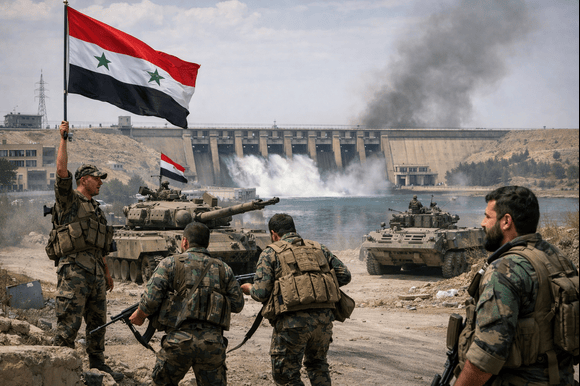
The Syrian army has asserted full control over the key city of Tabqa and its military airbase on the Euphrates River, widening a fast-moving offensive across Raqqa province, according to state-run media.
Information Minister Hamza al-Mustafa said in a statement early Sunday that government forces had secured Tabqa along with the nearby Euphrates Dam — the largest hydroelectric facility in Syria — after driving out fighters linked to the Kurdistan Workers’ Party (PKK). Damascus also accused the Kurdish-led Syrian Democratic Forces (SDF) and affiliated PKK factions of executing prisoners and detainees during their withdrawal from the area.
The PKK is designated a “terrorist organisation” by Turkiye, the European Union and the United States.
In remarks relayed by al-Mustafa, the Syrian government said the alleged killings — “particularly of civilians” — constituted “a fully-fledged crime under the Geneva Conventions” and a blatant breach of international humanitarian law.
Swift Syrian military advance
Reporting from Aleppo, Al Jazeera correspondent Zein Basravi said the tempo of combat in northern Syria has intensified dramatically, with government forces rapidly redirecting operations towards Raqqa.
“Rapid is the right word,” Basravi said, noting that heavy fighting for neighbourhoods in Aleppo occurred less than two weeks ago, while other SDF-held strongholds have reverted to government control within just the past 24 hours. “It feels like a history lesson unfolding overnight,” he added.
Basravi said Syrian troops have now shifted their military focus from Aleppo province into Raqqa, pushing deeper into territory previously controlled by the SDF. “What we are witnessing is a swift advance of Syrian forces,” he said, describing movements from border towns toward major population centres. He also reported unconfirmed clashes inside Tabqa, where government troops appear poised to begin clearance operations similar to those conducted elsewhere.
According to Basravi, the army is moving quickly through Arab-majority towns where there has not always been strong local backing for the Kurdish-led SDF.
The SDF, he said, is now under pressure from what he described as a “massive pincer movement” spanning both Aleppo and Raqqa provinces, forcing withdrawals that increasingly resemble defensive retreats.
Footage circulating online appeared to show SDF units evacuating a military hospital as fighting intensified near Tabqa’s southern entrance.
Raqqa, which served as ISIL’s self-proclaimed capital from January 2014 until its capture in October 2017 by the US-backed SDF, was left devastated after years of extremist rule marked by widespread atrocities and mass civilian deaths.
SDF fighters surrender
Local officials reported that Raqqa’s water supply was disrupted after an explosion damaged key pipelines near the old bridge. State news agency SANA said SDF forces had blown up the bridge spanning the Euphrates River.
The army’s operations command said earlier that government troops had taken control of the Mansoura Dam and several surrounding towns, positioning them less than 5km (3 miles) from Raqqa’s western entrance. It later confirmed that 64 SDF fighters surrendered in the Mansoura area after being encircled.
In a separate announcement, the military said its units entered Tabqa “from multiple axes” while encircling PKK fighters inside the military airbase.
The advance followed the capture of numerous villages near al-Rasafa and a demand for SDF leadership to withdraw east of the Euphrates River.
Fighting has also spread to eastern Deir Az Zor, where tribal forces said they were engaging SDF units across several towns in coordination with the Syrian army. A tribal military source said multiple positions had been seized and urged tribal members serving within the SDF to surrender their weapons.
The SDF, meanwhile, said government forces launched attacks on its positions in several Deir Az Zor towns, accusing the army of carrying out artillery shelling east of the Euphrates. The military said it was dispatching reinforcements to the province as operations expanded across northeast Syria.
Agreement under strain
Speaking to Al Jazeera, William Lawrence, a former US diplomat and now a professor at the American University, said the unfolding events differ sharply from what was outlined in an agreement reached in March last year.
“I’m surprised by how fast this is happening,” Lawrence said, explaining that the March 10 deal envisioned a gradual, phased withdrawal. “The SDF was supposed to pull back from these areas, and the Syrian army was meant to move in and replace it.” Instead, he said, government forces are advancing “much faster than planned”, leaving the SDF caught between an organised retreat under the agreement and a more chaotic tactical withdrawal.
Lawrence warned that both sides were now undermining the deal. “What we’re seeing is a violation of the spirit — if not the letter — of the agreement,” he said, describing the situation as a disorderly transfer of control rather than the intended phased handover.
He also cautioned Washington against prioritising security concerns at the expense of politics. “The United States needs to focus as much on political solutions as on security,” Lawrence said, warning that an overly narrow counterterrorism approach could jeopardise any durable settlement.
Talks were also held in Erbil, Iraq, between US envoy Tom Barrack and SDF commander Mazloum Abdi, also known as Mazloum Kobani, though no details of the discussions were made public.