


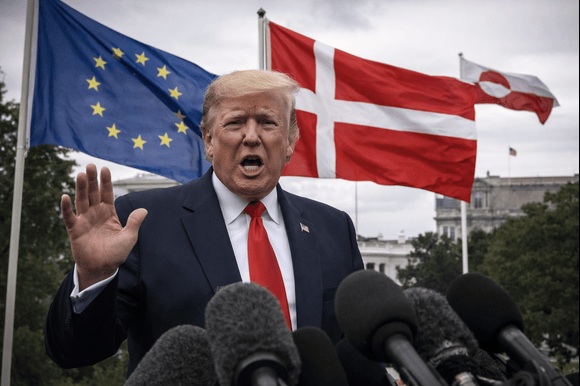
United States President Donald Trump has announced a series of escalating tariffs targeting several European allies, accusing them of opposing Washington’s efforts to acquire Greenland, as he intensifies a controversial campaign to bring the self-governing Danish territory under US control.
In a post on his social media platform Truth Social on Saturday, Trump said a 10 percent tariff would be imposed from February 1 on imports from Denmark, Finland, France, Germany, Norway, Sweden, the Netherlands and the United Kingdom. He added that the levies would increase to 25 percent on June 1 and remain in place until the United States reaches an agreement to purchase Greenland.
European leaders swiftly dismissed Trump’s declaration. French President Emmanuel Macron said attempts at intimidation would not sway Europe’s position. “No threat or pressure will influence us — not in Ukraine, not in Greenland, and nowhere else when faced with such circumstances,” Macron said.
Writing on the social media platform X, Macron described the tariff threat as unacceptable, warning it had no place in the current situation. “Europeans will respond in a united and coordinated way should these measures be confirmed. We will ensure that European sovereignty is defended,” he said.
UK Prime Minister Keir Starmer also issued an unusually direct rebuke, saying Britain would confront Washington over the issue. “Imposing tariffs on allies for acting in the collective security interests of NATO is completely wrong,” Starmer wrote on X.
European Union foreign policy chief Kaja Kallas cautioned that tariffs would damage economic prosperity on both sides of the Atlantic. “This would make both Europe and the United States poorer,” she said, adding that geopolitical rivals would benefit most. “China and Russia must be delighted. They are the ones who gain from divisions among allies.”
Trump suggested in his lengthy post that the tariffs were retaliation for visits by European officials to Greenland “for purposes unknown”. He accused the eight countries of playing a “very dangerous game” by resisting US control of the island. The United States, he claimed, had sought to acquire Greenland for more than 150 years, and the “need to ACQUIRE” it had become increasingly critical to plans for a new US missile defence system known as the Golden Dome, which he said could also provide “possible protection of Canada”.
Reporting from Washington, DC, Al Jazeera correspondent Mike Hanna described the move as unprecedented. “President Trump is clearly taking this extremely seriously, imposing trade penalties on America’s closest allies,” Hanna said, noting Trump’s characteristically capitalised warnings about the “safety, security and survival of our planet”.
Protests across Denmark and Greenland
Trump’s announcement came as thousands of demonstrators took to the streets across Denmark to protest his repeated threats to seize control of Greenland.
In Copenhagen, crowds waved Danish and city flags while chanting slogans including “Kalaallit Nunaat”, the island’s name in the Greenlandic language.
Meanwhile, in Nuuk, Greenland’s capital, hundreds of residents braved freezing temperatures, rain and icy conditions to march in defence of the territory’s right to self-governance.
Al Jazeera correspondent Rory Challands, reporting from the Nuuk rally, said news of Trump’s decision to escalate pressure through tariffs would be deeply unsettling for those who had just returned from the protests.
“They understand that there is little they could do if Donald Trump genuinely decided to deploy troops,” Challands said.
“Denmark also knows that its options are extremely limited if the US president were to take such a step. Over recent weeks, Copenhagen has tried to reassure Washington that it can take Arctic security seriously,” he added.
NATO tensions deepen
The tariff threat takes what Challands described as an “internal NATO dispute” to a new and more dangerous stage, intensifying strains within an alliance formed in 1949 to guarantee collective security across Europe and North America.
Since returning to office in January, Trump has repeatedly argued that Greenland should fall under US control. Earlier this week, he said any outcome short of American ownership of the island would be “unacceptable”.
According to a poll published in January last year, 85 percent of Greenland’s population opposes joining the United States, while just 6 percent support the idea.
Although both Greenland and Denmark have firmly rejected the notion that the island could be “owned” by the US, diplomatic efforts to persuade the Trump administration to abandon the proposal appear to have made little progress.
“It’s clear that the president has this desire to take over Greenland,” Denmark’s Foreign Minister Lars Lokke Rasmussen said this week after meeting US Secretary of State Marco Rubio in Washington. “So far, our attempts to change that view have not succeeded.”