


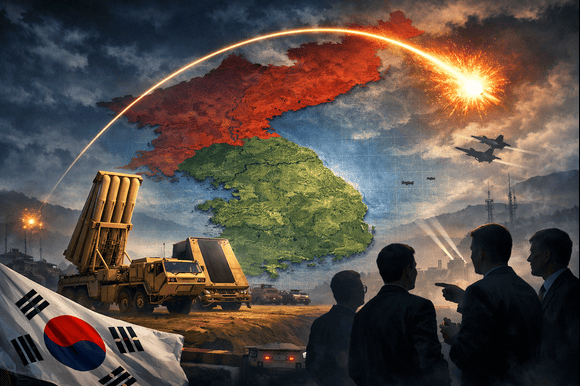
The United States is reportedly relocating components of a missile defence system stationed in South Korea to the Middle East, according to officials cited by the The Washington Post and several South Korean news outlets.
The reported redeployment comes 12 days after the outbreak of the ongoing conflict involving the US and Israel against Iran. It also follows reports suggesting that Iran had destroyed a crucial radar installation used by the Terminal High-Altitude Area Defense system—commonly known as Terminal High-Altitude Area Defense (THAAD)—which had been operating in Jordan.
The THAAD missile defence system was originally deployed to South Korea in 2017 to shield the country from potential missile threats posed by nuclear-armed North Korea.
At the time of its installation, the move sparked widespread protests among South Koreans who feared that hosting the system could make their country a more prominent military target. Meanwhile, China strongly criticised the deployment, warning that it could destabilise the regional security balance.
Why the THAAD system may be relocated
Earlier this week, the Washington Post reported that certain components of the THAAD system were being transferred from South Korea to the Middle East. The report cited two officials familiar with the matter.
The development comes as the United States and Israel continue to carry out military strikes against Iran, while Tehran responds with waves of drones and ballistic missiles targeting Israeli territory and US military installations across the region.
It remains unclear exactly how large Iran’s missile arsenal is. However, according to calculations by the The New York Times, Iran has already launched more than 500 ballistic missiles since the conflict escalated.
Although many of those missiles have been intercepted by existing defence systems, analysts say the sheer volume of incoming projectiles could be placing significant strain on US missile defence resources. Observers also believe that Iran may be preparing for a prolonged war of attrition that could draw in additional Middle Eastern countries, including key US allies.
In that context, THAAD—which is specifically designed to intercept high-altitude ballistic missiles—could play a critical role in strengthening defensive capabilities in the region.
Earlier this month, reports indicated that an Iranian strike had destroyed a radar valued at around $300 million that belonged to an existing THAAD battery in Jordan.
How the THAAD system works
The anti-missile defence system is manufactured by the US defence contractor Lockheed Martin. Each THAAD battery includes six mobile launchers, and each launcher carries eight interceptor missiles. The system also incorporates a powerful radar used to detect incoming threats.
THAAD is designed to destroy short- and medium-range ballistic missiles using what is known as “hit-to-kill” technology. Instead of relying on explosives, the interceptor missile collides directly with the incoming warhead, using kinetic energy to neutralise it.
One of the system’s most significant advantages is that it can intercept missiles at extremely high altitudes, even outside the Earth’s atmosphere. This capability was considered particularly important in South Korea, where the system could potentially intercept and destroy nuclear-armed missiles launched from North Korea.
Each THAAD battery costs roughly $1 billion (£766 million) and typically requires a crew of around 100 personnel to operate it.
The United States currently operates only eight THAAD systems worldwide. Two of those are deployed in the Middle East—one in Jordan and another in Israel—while United Arab Emirates and Saudi Arabia together operate three additional systems of their own.
Concerns about stretched defence capabilities
According to one US official quoted by the Washington Post, the potential relocation of THAAD components from South Korea is intended as a “precautionary measure.”
However, some analysts believe the move could indicate that US missile defence resources are already under significant strain.
Professor John Nilsson-Wright from University of Cambridge said the redeployment likely reflects the need for Washington to compensate for the heavy use of missile defence systems currently protecting US assets in the Middle East.
South Korean media organisations, including SBS and Yonhap News Agency, have reported that THAAD launchers are already being transported out of the Seongju airbase located south of Seoul.
South Korean President Lee Jae-myung acknowledged that Seoul had formally opposed the removal of US weapons systems from the country.
“It appears there has recently been controversy over US forces in Korea transferring certain weapons, such as artillery batteries and air defence systems, out of the country,” Lee said during a cabinet meeting.
“While we have voiced our opposition, the reality is that we cannot fully enforce our position.”
When questioned about whether the move could weaken South Korea’s deterrence strategy, Lee insisted that it would not significantly undermine the country’s security.
“I can say with certainty that it would not,” he said.
Nilsson-Wright described Lee’s remarks as an unusual public display of concern by the South Korean government.
He said the comments highlighted Seoul’s legitimate worries that the redeployment could weaken South Korea’s defensive posture.
Reactions from other countries
When asked about the possible relocation on Wednesday, Chinese Foreign Ministry spokesman Guo Jiakun reiterated that Beijing’s opposition to the deployment of THAAD missiles in the Republic of Korea remained unchanged.
China was the most outspoken critic when the system was first installed in South Korea in 2017.
Beijing argued that the deployment strengthened US military influence in the region and acted as a counterbalance to China’s growing strategic power.
Although Washington and Seoul insisted that the system was designed purely to defend against North Korean missile threats, China maintained that the powerful radar used by THAAD could monitor deep into Chinese territory.
According to Beijing, the radar could detect Chinese missile launches, potentially undermining China’s strategic deterrence capabilities.
In response to the deployment, China implemented several unofficial economic retaliations against South Korea. These included discouraging tourism to South Korea, banning group tours for several years, restricting imports of Korean products, and cancelling numerous K-pop performances in China.
While China may welcome the potential removal of the system, Professor Ian Chong from the National University of Singapore said Beijing would likely view it as a meaningful victory only if the removal became permanent.
However, analysts also suggest that China may view the growing conflict in the Middle East as strategically beneficial if it distracts the United States from maintaining its military readiness in the Indo-Pacific region.
Questions about regional security
So far, North Korea has not publicly responded to reports about the redeployment.
Nilsson-Wright said North Korean leader Kim Jong Un is unlikely to immediately exploit the situation, although some analysts warn that limited provocations by Pyongyang cannot be ruled out.
The broader concern among security experts is whether a prolonged confrontation with Iran could drain US missile defence resources.
As Professor Chong noted, the key question now is whether a sustained conflict in the Middle East might deplete US missile supplies to such an extent that responding effectively to crises in other regions becomes increasingly difficult.