
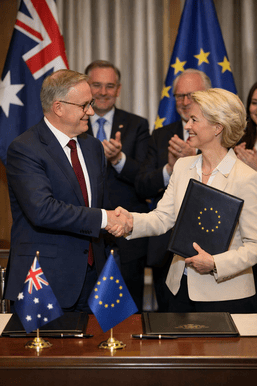
Australia and the European Union have formally reached a landmark free trade agreement following eight years of extensive negotiations, marking a significant step forward in economic and strategic ties between the two partners.
The deal, valued at approximately A$10bn ($7bn; £5.2bn), was signed on Tuesday, with Anthony Albanese and Ursula von der Leyen both hailing it as a mutually beneficial “win-win” outcome. In addition to eliminating nearly all tariffs on traded goods, the agreement also deepens collaboration in areas such as defence and critical minerals, reflecting a broader strategic alignment.
Von der Leyen emphasized that the agreement is rooted in strengthening “collective resilience” at a time when the global landscape is undergoing profound shifts. She pointed to an increasingly complex world where major powers are leveraging tariffs as tools of influence and exploiting supply chain dependencies, an apparent reference to trade strategies employed by the United States under Donald Trump, as well as China’s dominant position in critical minerals.
Highlighting the importance of long-term cooperation, von der Leyen stated that “trust matters more than transactions,” adding that the relationship between Australia and the EU is distinctive and built to endure over time.
A key feature of the agreement is the removal of almost all EU tariffs on a wide range of Australian agricultural exports. Products set to benefit include wine, fruit and vegetables, olive oil, seafood, most dairy items, as well as grains such as wheat and barley. The Australian government estimates that the elimination of tariffs will save local wine producers and exporters around A$37m.
At the same time, Australian consumers are expected to gain access to more affordable European goods, including wine, spirits, biscuits, chocolates and pasta, as import costs decline under the agreement.
One of the more sensitive aspects of the negotiations involved the use of traditional European food names. Under the deal, Australian producers will still be permitted to sell Italian-style sparkling wine under the name “prosecco” within the domestic market, although the term will be gradually phased out for exports over a ten-year period. Similarly, Australian manufacturers can continue using names such as parmesan, while products like feta will be subject to grandfathering provisions and extended transition periods.
The issue of naming rights has long been contentious, particularly for European producers seeking to protect geographical indications. Notably, Australia has become the only country outside Italy to secure EU approval to continue using the term prosecco under specific conditions.
Addressing this issue, Albanese pointed to Australia’s multicultural heritage, noting that the country’s food traditions have been shaped by generations of migrants. He highlighted contributions from Greek, Italian and Eastern European communities, linking products such as feta, parmesan and kransky sausages to Australia’s enduring cultural ties with Europe.
Von der Leyen described the agreement as achieving a “perfect balance,” enabling Australian exporters to access European markets more easily while also expanding the availability of EU-made products within Australia.
However, not all sectors have welcomed the outcome. Meat and Livestock Australia expressed disappointment with the provisions for meat exports. Andrew McDonald, representing the organization, criticized the agreement for falling short of expectations, noting that Australian producers had sought an annual export quota of at least 50,000 tonnes. The deal instead allows for approximately 30,000 tonnes, a significant increase from the previous 3,389 tonnes but still below industry demands.
McDonald described the result as a missed opportunity for Australia’s red meat sector, including producers, processors and exporters.
Beyond trade, the agreement also establishes a new framework for enhanced cooperation in security and defence. This includes closer collaboration in the defence industry, counter-terrorism efforts, space initiatives and maritime security.
In addition, von der Leyen announced plans for deeper joint engagement on critical minerals projects, particularly in areas such as lithium and tungsten, underscoring the strategic importance of securing reliable supply chains for key resources in an evolving global economy.