


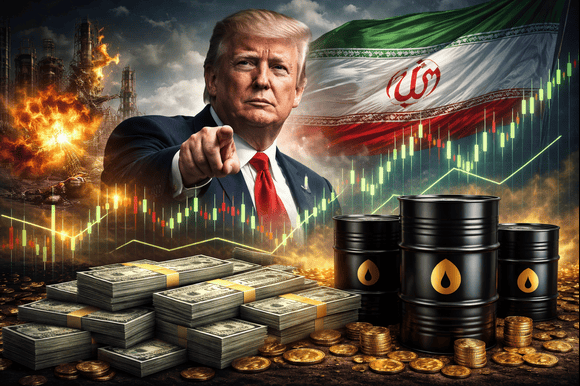
Unusual trading activity involving hundreds of millions of dollars in oil contracts has raised fresh concerns after it occurred just minutes before US President Donald Trump announced on Monday that the United States would delay planned strikes on Iranian energy infrastructure.
Market data reviewed by the BBC indicates that trading volumes surged dramatically roughly fifteen minutes before the president posted on social media confirming the decision. Shortly after the announcement, oil prices plunged sharply, falling by around 14% within minutes. Traders who had anticipated the unexpected development and placed bets accordingly stood to make significant profits.
Several market analysts have pointed out that the timing and scale of the trades appear unusual, raising the possibility that some investors may have acted with prior knowledge of the announcement. Officials have emphasized that any such activity would be taken seriously, stating that the administration does not “tolerate any official illegally profiting from insider knowledge.”
Global financial markets have been highly volatile in recent days due to escalating tensions in the Middle East. Share prices have declined amid rising oil and gas costs, although intermittent hopes of de-escalation have triggered sudden reversals, with oil prices dropping and stock markets rebounding sharply.
Over the weekend, President Trump warned that the US could “obliterate” Iran’s power infrastructure if Tehran failed to reopen the strategically critical Strait of Hormuz within 48 hours. Roughly 20% of the world’s oil and gas supplies typically pass through this key waterway.
Although markets were closed at the time of that warning, they reacted strongly when trading resumed on Monday. Asian markets dropped significantly at the open, while oil prices climbed amid fears of further escalation.
However, at 07:04 Eastern Time (11:04 GMT), before US markets officially opened for the week, President Trump posted on his Truth Social platform that Washington had held “very good and productive conversations” with Tehran aimed at achieving a “complete and total resolution” to hostilities.
The reaction was immediate. Stock markets rebounded, and the benchmark US oil price fell to approximately $84 per barrel. Since then, analysts and observers have closely examined the sequence of trades leading up to the announcement.
At 06:49 ET, traders executed 734 contracts for West Texas Intermediate crude oil on the New York Mercantile Exchange. Just one minute later, the number of trades surged to 2,168, representing roughly $170 million in value.
A similar pattern was observed in Brent crude trading, the other major global oil benchmark. Between 06:48 and 06:50 ET, trading volume jumped dramatically from just 20 contracts to more than 1,650, equivalent to approximately $150 million.
Historical data suggests that such levels of trading activity are highly unusual for that time of day on a typical Monday, further intensifying scrutiny.
The pattern was not limited to oil markets. Comparable spikes were also recorded in futures contracts tied to major stock indices, including the S&P 500 and the Euro Stoxx 50. These trades indicate that investors were also betting on a rise in the value of leading companies in both the US and Europe shortly before the president’s statement.
“This appears abnormal, for sure,” said Mukesh Sahdev, chief oil analyst at XAnalysts. He noted that at the time, there were no clear indications of meaningful diplomatic engagement between the US and Iran, making the scale of bets on falling oil prices particularly striking.
The timing has fueled speculation about whether some traders may have had advance knowledge of the policy shift. Rachel Winter, a partner at Killik & Co, said that many investors appeared to position themselves to profit from a drop in oil prices shortly before the announcement.
“So there has been some speculation about insider trading. We don’t know if that’s the case, but it is something that may warrant investigation,” she said.
Later in the day, the Iranian government denied that any negotiations had taken place, dismissing the reports as “fake news.” Oil prices edged higher again following those comments.
In a statement posted on X, Mohammad-Bagher Ghalibaf, Speaker of Iran’s parliament, accused the US of using misinformation to manipulate financial and energy markets, claiming such tactics were aimed at escaping mounting regional pressures.
The BBC has reached out to regulators including the Commodity Futures Trading Commission and the Financial Conduct Authority for comment on the unusual trading activity.
This is not the first instance in which US foreign policy developments have coincided with sudden spikes in speculative trading. In January, betting activity surged on Polymarket, where users speculated on the political future of Nicolás Maduro. Within hours of the spike in wagers, Maduro was reportedly detained by American forces, with one account earning more than $436,000 from an initial bet of $32,537.