


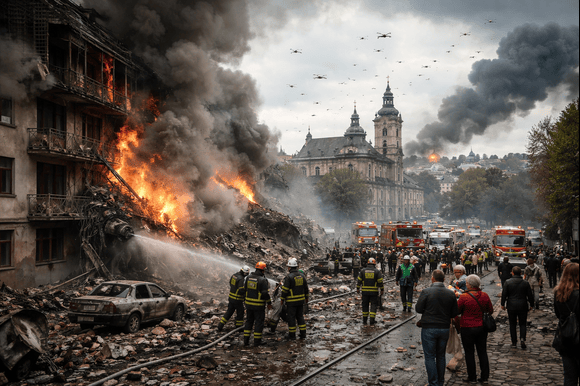
Russia has carried out a rare and extensive daytime assault on Ukraine, striking multiple cities across the western part of the country with more than 400 drones on Tuesday afternoon, marking a significant escalation in the scale and timing of attacks.
According to Lviv regional governor Maksym Kozytskyi, the strikes caused damage to the historic Bernardine monastery, a 16th-century UNESCO-listed site. Footage released by local authorities showed flames engulfing the roof of a nearby residential building, highlighting the intensity of the bombardment and the threat posed to both cultural landmarks and civilian areas.
In addition to Lviv, several other western cities came under attack, including Ivano-Frankivsk, Vinnytsia, and Ternopil. Officials reported casualties and widespread destruction across these regions. Svitlana Onyshchuk, head of the Ivano-Frankivsk region, confirmed that at least two people were killed in the strikes, while four others were injured, among them a six-year-old child. She added that numerous structures, including residential buildings and a maternity hospital, sustained significant damage.
In Lviv, Mayor Andriy Sadovyi reported that at least 13 people had been injured, cautioning that the number could rise as emergency teams continue search and rescue operations. The attacks have placed additional strain on already stretched emergency services and raised concerns over the targeting of civilian infrastructure.
The daytime strikes followed a series of heavy overnight attacks that left at least five people dead in different parts of the country. Authorities reported that a 61-year-old woman was killed when a drone struck an electric train in Kharkiv early Tuesday morning. Additional fatalities were recorded in Zaporizhzhia, Kherson, and Poltava, further underlining the widespread nature of the assault.
Although Ukraine has endured more than four years of continuous conflict, with many regions suffering repeated strikes, the western part of the country has generally experienced fewer and less frequent attacks compared to areas closer to the Russian border in the east. Tuesday’s offensive therefore represents a notable shift, bringing large-scale destruction to regions that have previously been relatively less affected.
Yurii Ihnat, spokesperson for the Ukrainian Air Force, said that a substantial number of drones entered Ukrainian airspace from the north, moving in coordinated formations. He described the operation as highly organized and unusually broad in scope.
“The geography of the strikes during the daytime was wider than what we saw overnight,” Ihnat said, adding that the scale of the assault makes it one of the most significant attacks within a single 24-hour period since the conflict began.
The coordinated strikes have intensified fears of further escalation, as Ukrainian authorities continue to assess the damage and respond to one of the most expansive drone offensives in recent months.