

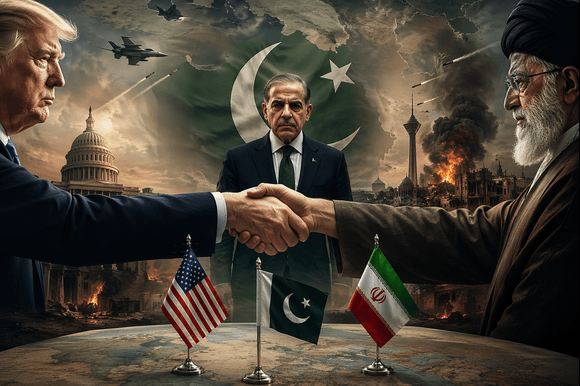
As Pakistan celebrates a significant diplomatic breakthrough in helping secure a two-week ceasefire between the United States and Iran, its leadership is now preparing to host crucial peace talks that could determine the future of the fragile truce.
Authorities in the capital, Islamabad, have declared a two-day public holiday ahead of the anticipated negotiations, which are scheduled to begin on Saturday. While uncertainty still surrounds whether the talks will proceed as planned, the city has already taken on a noticeably subdued atmosphere. Streets have quieted, and security has been significantly tightened, with nearly 10,000 police officers and personnel deployed to ensure safety during the high-stakes diplomatic event.
The importance of these talks extends far beyond the region. Countries across the world are closely watching developments, eager for an end to hostilities and the reopening of the Strait of Hormuz—a critical maritime corridor through which roughly 20% of the global oil supply passed before the conflict disrupted flows. The continued closure of this route has heightened concerns over energy security and global economic stability.
For Pakistan, however, the stakes are not only global but deeply national. Analysts warn that the country faces a potential “nightmare scenario” if negotiations fail and tensions escalate further. Abdul Basit, a specialist at Nanyang Technological University, has cautioned that Pakistan risks being drawn into a broader regional conflict, particularly given its defense commitments to Saudi Arabia.
Basit points out that Islamabad has already reaffirmed its intention to honor a mutual defense pact signed with Riyadh last year. In the event of a wider conflict involving Iran and Saudi Arabia, Pakistan could find itself stretched across multiple fronts. “Three of Pakistan’s borders could effectively become active conflict zones,” he explains, referencing existing tensions with Afghanistan and India. Compounding the challenge are ongoing insurgencies within two of Pakistan’s provinces, placing additional strain on the country’s security apparatus.
Despite these risks, a sense of national pride has swept across Pakistani social media, where citizens are celebrating what many see as a historic diplomatic achievement. Memes and messages praising the country’s role in averting a larger catastrophe have gone viral, reflecting a rare moment of unity and optimism.
“This is a victory in the sense that no other country was able to broker this ceasefire when the world was on the brink of disaster,” Basit notes. “Pakistan played a decisive role in preventing what could have been a much wider war.”
The success comes at a crucial time for Pakistan, which has faced years of political turbulence, economic instability, and intense rivalry with India. Just two years ago, the country was on the verge of a sovereign debt default, making this diplomatic accomplishment particularly significant for its global standing.
A key factor behind Pakistan’s success has been its unique position as a trusted intermediary among multiple stakeholders, including the US, Iran, and Gulf nations. Central to this effort is the country’s powerful military chief, Asim Munir, who has led much of the reconciliation process.
According to Mushahid Hussain Syed, Munir enjoys a strong rapport with US President Donald Trump, who reportedly regards him as a favored military counterpart. Analysts suggest that Munir’s early engagement with the Trump administration helped build trust and laid the groundwork for cooperation.
Maleeha Lodhi highlights two key developments that strengthened ties with Washington. First, Pakistan, acting on intelligence from the Central Intelligence Agency, handed over a suspect linked to the 2021 Kabul airport bombing—an attack that killed more than 180 people, including 13 US service members. Second, Pakistan successfully communicated its role in helping prevent a broader conflict with India, which resonated positively with the US administration.
Pakistan has also sought to deepen economic ties with the US. In September 2025, the Frontier Works Organisation signed a $500 million investment agreement with an American firm focused on critical minerals—resources increasingly viewed as vital to national security. Additionally, a partnership involving World Liberty Financial aims to integrate digital currency solutions into Pakistan’s financial system, further strengthening connections with influential figures in Trump’s circle.
Despite these close ties, Pakistan has maintained what officials describe as a “principled stance” throughout the conflict. Islamabad condemned initial US-Israeli strikes on Iran, while also criticizing Iran’s subsequent attacks on Saudi oil infrastructure. On 7 April, Pakistan abstained from a United Nations Security Council resolution calling for coordinated efforts to reopen the Strait of Hormuz, arguing that it failed to address the root causes of the conflict.
This balanced approach has helped Islamabad retain credibility with both Iran and Gulf states, according to Syed. Diplomatic efforts led by Prime Minister Shehbaz Sharif and Foreign Minister Ishaq Dar have also been instrumental. Over the past five weeks, the two leaders have engaged with officials across major global capitals, including Washington, Moscow, Beijing, Ankara, Cairo, and key European and Gulf cities.
On the day the ceasefire was announced, Sharif held what he described as a “warm and substantive” conversation with Iran’s President Masoud Pezeshkian, who reaffirmed Tehran’s willingness to participate in the upcoming talks and expressed appreciation for Pakistan’s mediation efforts.
Pakistan’s longstanding relationship with Iran has also played a vital role. The two countries share a 920-kilometer border and have cooperated for decades on issues ranging from border security to managing instability in Afghanistan. According to Asif Durrani, both nations have faced similar challenges, including militant activity and refugee flows.
Religious and cultural ties have further reinforced trust. While Pakistan is predominantly Sunni, it is home to one of the world’s largest Shia populations. Each year, thousands of Pakistani pilgrims travel to Iran, strengthening people-to-people connections between the two nations.
As the scheduled start of talks approaches, uncertainty remains. The ceasefire is already showing signs of strain, and doubts persist over whether both sides will ultimately come to the negotiating table. Aizaz Chaudhry has warned that while securing the ceasefire was a significant achievement, reaching a comprehensive and lasting agreement will be far more challenging.
Complicating matters further are ongoing regional tensions. Israel has intensified military operations in Lebanon, with recent strikes reportedly causing significant casualties. Israeli officials have indicated that the ceasefire with Iran does not extend to Lebanon, raising fears that the conflict could widen.
Lodhi notes that this development is a source of concern for Pakistani officials, who believe that Washington must play a key role in restraining further escalation. Ultimately, however, analysts agree that Pakistan’s role as a mediator has limits.
“As a facilitator, Pakistan can bring parties to the table,” Durrani explains. “But it cannot force them to reach an agreement. The final outcome depends on whether those involved are willing to seize the opportunity for peace.”
With the world watching closely, Pakistan now finds itself at the center of one of the most consequential diplomatic efforts in recent history—one that could either stabilize a volatile region or unravel into a far more dangerous conflict.