

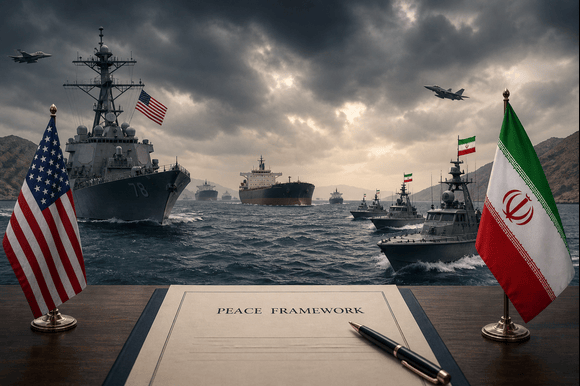
Iran has reportedly received a response from the United States regarding its most recent peace proposal, according to media outlets affiliated with the Iranian state.
A spokesperson for Iran’s foreign ministry stated that the reply transmitted through Pakistan is currently under review, as cited by Tasnim news agency.
So far, Washington has not officially confirmed that it has responded to Tehran. On Saturday, President Donald Trump said he would “soon be reviewing the plan that Iran has just sent to us,” while expressing skepticism about its acceptability.
Reports from Iranian state media indicate that Tehran’s 14-point proposal calls on the United States to withdraw military forces from areas near Iran’s borders, lift its naval blockade on Iranian ports, and bring an end to all hostilities including Israel’s ongoing military actions in Lebanon.
The proposal also pushes for a comprehensive agreement between the two nations to be finalized within a 30-day timeframe.
According to those same reports, Iran urged both sides involved in the conflict to prioritize “ending the war” rather than prolonging a temporary ceasefire arrangement.
Responding to the proposal on Truth Social late Saturday, Trump wrote: “They have not yet paid a big enough price for what they have done to Humanity, and the World, over the last 47 years.”
Speaking earlier to reporters in Palm Beach, Florida, he said he had not yet reviewed the full details of the plan. “They told me about the concept of the deal,” he said. “They’re going to give me the exact wording now.”
When asked about the possibility of resuming military strikes inside Iran, Trump said such action remained “a possibility.”
“If they misbehave. If they do something bad,” he said. “But right now we’ll see.”
At the same time, Trump signaled reluctance to fully disengage from the conflict, stating, “we’re not leaving” and adding that continued involvement was necessary to prevent future escalation within “two years or five years.”
Iranian outlets said the new proposal was formulated in response to a previously suggested nine-point plan from the United States, which outlined a two-month ceasefire.
On Friday, Trump sent a letter to members of Congress claiming that the conflict had effectively been “terminated” following the ceasefire that began on 8 April — despite maintaining that Iran continues to pose a “significant” threat to US personnel and interests in the region.
He also argued that the ongoing naval blockade of Iranian ports should not be considered an extension of hostilities.
“It’s a very friendly blockade,” Trump said. “Nobody is even challenging it.”
Additionally, Trump asserted that he was not bound by the usual deadline for congressional authorization of military action, arguing that the ceasefire effectively paused the timeline.
Under US law, a president must secure congressional approval within 60 days of notifying lawmakers of military operations or otherwise bring those actions to an end.
Friday marked the 60th day since Trump formally notified Congress of US strikes on Iran on 2 March. Those strikes were launched jointly by the United States and Israel on 28 February.
Throughout his remarks, Trump reiterated his longstanding position that “Iran can never have a nuclear weapon.”
Iran, for its part, has consistently denied pursuing nuclear weapons, insisting its nuclear program is intended solely for peaceful purposes. However, it remains the only non-nuclear-armed state to have enriched uranium to levels approaching weapons-grade.
Trump’s latest comments come amid increasing unease among US lawmakers — including members of his own Republican Party — over what many see as an expensive and strategically unclear conflict.
Senator Josh Hawley of Missouri urged the administration to begin scaling back US involvement, emphasizing the need for congressional approval if the conflict is to continue.
“I don’t really want to do that,” Hawley said. “I want to wind it down.”
Meanwhile, Senator Lisa Murkowski of Alaska, a frequent critic of Trump, questioned both the effectiveness of the military campaign and the prospects for meaningful negotiations.
“While the administration may point to ongoing negotiations, events on the ground and the rhetoric coming out of Tehran tell a different story,” she said.
“But if the US steps back abruptly and prematurely, we almost certainly leave their critical capabilities intact.
“And those are not risks that I’m willing to take. But the answer is not a blank check for another endless war,” Murkowski added.