


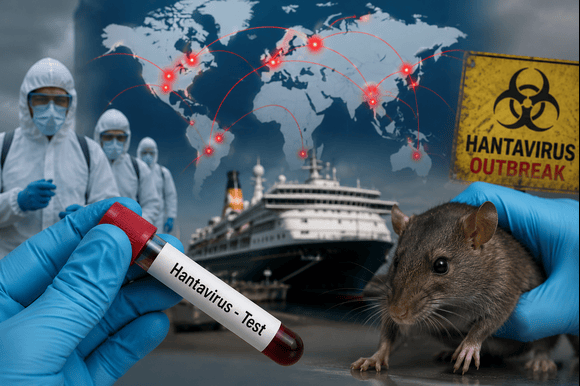
Health officials around the world are closely monitoring a growing hantavirus outbreak connected to an international cruise ship, as governments intensify screening, quarantine measures, and contact tracing efforts to prevent further spread of the rare but dangerous disease.
The outbreak, linked to the Dutch-operated cruise vessel MV Hondius, has already resulted in several confirmed infections and multiple deaths, prompting a coordinated response from global health agencies including the World Health Organization (WHO).
Despite increasing concern, experts have stressed that the situation is very different from the COVID-19 pandemic and that the broader public risk currently remains low.
What Is Hantavirus?
Hantavirus refers to a family of viruses usually carried by rodents and transmitted to humans through exposure to infected animals, their droppings, urine, or saliva. The disease can lead to serious illnesses affecting the lungs, kidneys, and cardiovascular system.
In North and South America, hantavirus infections are commonly associated with Hantavirus Cardiopulmonary Syndrome (HCPS), a severe respiratory condition that can rapidly become life-threatening. In serious cases, fatality rates can be extremely high.
Most strains of hantavirus are not easily transmitted between humans. However, the Andes strain — which has been linked to the current outbreak — is considered unusual because limited person-to-person transmission can occur after prolonged close contact.
Cruise Ship Outbreak Under Investigation
The latest outbreak began after passengers aboard the MV Hondius started developing serious respiratory symptoms during a voyage that included stops near parts of Argentina and the South Atlantic region.
Investigators believe the virus may have initially been contracted on land before the ship departed, possibly through environmental exposure in areas where hantavirus infections are known to occur naturally.
Additional infections later emerged among both passengers and crew members from several countries, raising fears that limited human transmission may have occurred during the voyage.
The outbreak has so far been linked to multiple deaths, while several infected individuals continue receiving treatment or medical observation in isolation facilities.
Health experts believe close interactions in confined spaces aboard the ship may have contributed to the spread among certain passengers.
United States and Europe Monitor Returning Travellers
Passengers connected to the outbreak have now returned to several countries, including the United States, France, Switzerland, and the Netherlands, leading authorities to launch extensive monitoring operations.
US officials confirmed that a group of passengers was flown back under strict medical precautions after potential exposure to the virus. At least one traveller later tested positive for the Andes strain of hantavirus, while another displayed mild symptoms consistent with infection.
Some of the affected individuals were transferred to specialised high-security medical units for further treatment and observation.
Health authorities have stated that passengers exposed to the virus may remain under monitoring for several weeks because hantavirus symptoms can take a long time to appear after infection.
WHO Urges Public Not to Panic
The World Health Organization has repeatedly attempted to reassure the public, emphasizing that hantavirus does not spread in the same way as highly contagious airborne viruses such as COVID-19.
According to WHO officials, transmission generally requires much closer and longer exposure to infected individuals or contaminated environments.
Experts noted that human-to-human transmission involving the Andes strain remains uncommon and has historically been limited to close family members, caregivers, or people sharing enclosed spaces for extended periods.
Still, the international movement of cruise passengers before the outbreak was fully detected has forced governments to adopt a cautious approach.
Common Symptoms of Hantavirus Infection
Medical experts are advising healthcare workers and travellers to remain alert for possible hantavirus symptoms, which often resemble common flu-like illnesses during the early stages.
Typical symptoms may include:
- Fever
- Extreme tiredness
- Muscle pain
- Headaches
- Chills
- Vomiting and nausea
- Stomach pain
- Diarrhoea
As the illness worsens, patients may develop serious breathing problems, chest tightness, coughing, and severe respiratory distress that can require intensive medical care.
No Approved Vaccine Available Yet
Currently, there is no approved vaccine or targeted antiviral treatment for hantavirus infections.
Doctors mainly rely on supportive care, including oxygen therapy, respiratory support, and intensive care treatment to help patients survive severe complications. Early diagnosis remains critical in improving survival chances.
The latest outbreak has also renewed interest in medical research focused on developing vaccines and antibody-based therapies for hantavirus strains.
Researchers in the United States and other countries are reportedly working on experimental treatments that have shown encouraging results in early laboratory testing. However, experts caution that commercially available vaccines or medications may still be years away.
International Contact Tracing Expands
The outbreak has triggered a major international public health response involving health authorities across Europe, North America, and South America.
Officials are currently tracing passengers, airline travellers, healthcare workers, and others who may have had close contact with infected individuals.
Dozens of people from multiple countries are now undergoing quarantine procedures, medical testing, or symptom monitoring as investigations continue.
Health agencies have also increased the distribution of diagnostic testing kits to improve early detection capabilities in countries potentially affected by returning travellers.
Experts Say Situation Differs From COVID-19
Public concern has grown rapidly online, with many social media users comparing the outbreak to the early days of the coronavirus pandemic. However, infectious disease specialists insist the current threat level is significantly different.
Unlike COVID-19, hantavirus is not believed to spread efficiently through casual everyday contact or widespread airborne transmission. Scientists say the current outbreak still fits patterns previously observed with the Andes strain, where transmission remains limited and relatively difficult.
Public health experts continue advising people to avoid contact with rodents and take precautions when cleaning enclosed areas where rodent contamination may be present.
As investigations continue, governments and international health agencies remain focused on containing the outbreak, protecting exposed travellers, and preventing any wider international spread of the virus.