

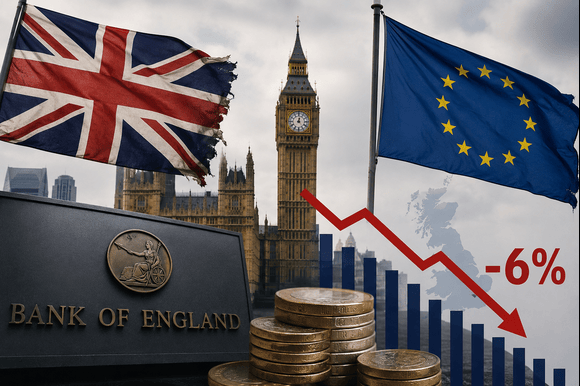
A decade after the United Kingdom voted to leave the European Union, a major new economic study has concluded that Brexit has reduced the size of the UK economy by approximately 6%, according to an analysis based on internal Bank of England data covering thousands of British businesses.
The research, conducted by economists including Professor Nick Bloom of Stanford University and researchers with access to Bank of England datasets, examined the decisions, expectations and financial performance of companies across the UK since the 2016 referendum. By analysing this information, the study attempted to estimate how the British economy might have performed had the country remained in the European Union.
According to the findings, roughly half of the economic damage resulted from the uncertainty and disruption that followed the referendum result, while the remaining impact stemmed from increased trade barriers after Britain formally left the EU customs union and single market in 2021.
The researchers sought to recreate an alternative economic scenario in which Brexit never occurred, comparing it with actual economic outcomes over the past ten years. Their analysis suggests that the UK economy is now around 6% smaller than it otherwise would have been.
The study represents one of the most comprehensive attempts yet to measure the long-term consequences of Brexit. It draws on unique company-level information gathered through the Decision Maker Panel, a survey established by the Bank of England in 2016 specifically to monitor how businesses were responding to Brexit-related developments.
The panel includes thousands of firms from different sectors of the economy and is regularly used by policymakers when assessing economic conditions and setting interest rates. Researchers examined years of responses from participating companies, tracking their exposure to Brexit-related changes, their assessments of the impact on operations and investment, and the subsequent performance recorded in their financial accounts.
Professor Bloom said the findings reinforce earlier evidence suggesting that Brexit has had a measurable negative impact on growth. He argued that the UK economy had been performing strongly before the referendum and could have continued to grow more rapidly in the absence of the disruption caused by leaving the EU.
“The company-level data provide important confirmation of the broader economic evidence,” Bloom said. “The effects of Brexit did not appear immediately but accumulated over time.”
The paper’s conclusions note that while the economic consequences developed gradually, they nevertheless had a substantial impact on Britain’s economic performance over the decade following the referendum.
“In the case of Brexit, there was a substantial economic impact on the United Kingdom, but it arose gradually over the subsequent decade,” the study states.
The findings come as senior Bank of England officials have become increasingly open in discussing the economic effects of Brexit in speeches, interviews and public appearances.
Bank of England Governor Andrew Bailey recently acknowledged that Brexit had reduced economic activity and growth. Speaking to reporters, Bailey said the decision had affected Britain’s ability to trade with its largest nearby markets.
“I think the level of activity and growth in the economy has been lower,” Bailey said. “If you reduce the size of the markets that we trade with and reduce our export markets, that tends to have a negative impact on growth.”
He also noted that productivity and market size had been affected by the UK’s departure from the European Union.
However, Bailey stressed that some fears surrounding Brexit had not materialised to the extent many had anticipated. In particular, he said the impact on Britain’s financial services industry, while negative, had been significantly less severe than many forecasts made during the referendum campaign.
“The effect on financial services was not good,” Bailey said, “but it was nowhere near as detrimental as many people predicted at the time.”
Not all economists agree on the scale of Brexit’s impact. Some policy analysts argue that estimating how the UK economy would have performed under an alternative scenario is inherently difficult. They contend that studies attempting to isolate Brexit’s effects may overstate the damage because they must account for a series of major global events that have affected economies worldwide over the past decade.
Among those factors are the COVID-19 pandemic, supply chain disruptions, geopolitical tensions, inflationary pressures and the European energy crisis that followed Russia’s invasion of Ukraine. Critics say these events make it challenging to separate Brexit-related effects from broader global economic trends.
Some analysts have also argued that comparisons with other economies may not fully reflect developments such as the exceptional performance of the United States technology sector and higher levels of American business investment during the same period.
Nevertheless, the latest research combines the company-level evidence with five additional established economic modelling techniques. While the Decision Maker Panel data indicates a 6% reduction in economic output, the broader collection of methodologies suggests an average economic impact closer to 8%.
The study has been released shortly before the tenth anniversary of the Brexit referendum, a milestone that has renewed debate about the long-term costs and benefits of the UK’s departure from the European Union.
Although the paper was co-authored by economists working with Bank of England data, it includes a formal disclaimer stating that the conclusions do not necessarily represent the official views of the central bank.
The publication comes at a time when the British government is seeking to improve cooperation with European partners. Prime Minister Sir Keir Starmer has announced plans to meet EU leaders at a summit in July, where discussions are expected to focus on agreements covering food and agricultural exports, electricity cooperation and emissions trading arrangements.
Additional areas of policy coordination and regulatory alignment are also expected to be on the agenda as both sides explore ways to strengthen economic ties while remaining outside the framework of EU membership.
The renewed engagement with European partners highlights the continuing importance of UK-EU relations, even as economists, policymakers and businesses continue to assess the lasting economic legacy of Brexit ten years after voters chose to leave the bloc.