


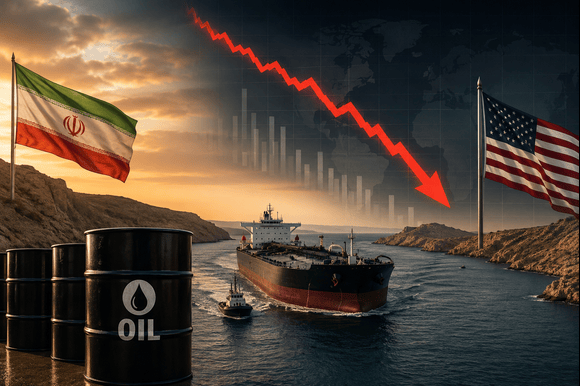
Oil prices dropped to their lowest levels in three weeks on Tuesday after senior US officials raised hopes that an agreement with Iran could soon allow commercial shipping to resume through the strategically vital Strait of Hormuz.
US Secretary of State Marco Rubio and Treasury Secretary Scott Bessent said discussions had made progress and suggested that shipments through the key waterway could potentially restart as early as this week.
The prospect of easing supply disruptions triggered a sharp decline in global oil prices. Brent crude, the international benchmark, fell by almost 5% to below $80 (£60) a barrel after the developments were announced.
The oil market has remained highly volatile, however, as earlier negotiations aimed at reducing tensions between the United States and Iran have repeatedly failed to produce a lasting breakthrough. The uncertainty has caused major fluctuations in crude prices and has ultimately resulted in higher fuel costs for drivers around the world.
Alongside the decline in Brent crude, US West Texas Intermediate oil prices dropped by more than 5% to around $76 a barrel on Tuesday. Both major oil contracts fell to their lowest levels since 13 July as traders reacted to the possibility that oil shipments could soon move more freely through the region.
Rubio said discussions involving Iran and Oman had produced progress on plans to increase the number of vessels passing through the Strait of Hormuz, although he stressed that a final agreement had not yet been reached.
“There’s been progress made in those talks, but not finality yet. We’re hoping that will happen very shortly,” Rubio told reporters at the State Department.
Bessent also expressed optimism that an agreement to reopen the waterway could be completed within days. Speaking to CNBC, he said there was a possibility that a deal could be reached as soon as Tuesday or Wednesday.
“There’s a chance we may have a deal today or tomorrow to open the strait and move towards a more normalized position in this conflict,” Bessent said.
When asked whether Iran would be permitted to impose charges on ships using the route, Bessent said the proposed arrangement would involve “freedom of movement.”
Despite the positive statements from senior US officials, no details have been released regarding the possible terms of an agreement or the measures that could be introduced to guarantee the safe movement of commercial vessels.
Iran has maintained that it is not holding direct negotiations with the United States and has no intention of doing so. Tehran says it is instead engaged in discussions with Oman, which has played a key mediating role in efforts to reduce tensions.
A spokesman for Iran’s foreign ministry said talks with Omani officials regarding a new mechanism for vessels travelling through the Strait of Hormuz had been constructive and positive.
Qatar, another important mediator between Washington and Tehran, said it was continuing to work with other regional partners to support a diplomatic solution to the conflict. However, Qatari officials acknowledged that no direct talks between the United States and Iran were currently scheduled.
The Strait of Hormuz has remained at the centre of negotiations between Washington and Tehran because of its critical importance to global energy supplies. Before the conflict began in late February, approximately one-fifth of the world’s daily oil and liquefied natural gas shipments passed through the narrow waterway.
Iran has halted most commercial traffic through the Strait since the conflict began, while the United States has imposed a naval blockade on Iranian ports across the region.
A separate blockade has also affected Saudi Arabia’s ports along the Red Sea. The restrictions were imposed by Yemen’s Iran-backed Houthi movement on 20 July, creating additional pressure on regional shipping routes.
The Red Sea route became an increasingly important alternative after Iran restricted access through the Strait of Hormuz. However, the route has also become significantly more dangerous, with a growing number of attacks on commercial vessels reported during the past week.
On Tuesday, an Indian-flagged vessel was struck and sunk by a projectile near Yemeni waters, according to India’s shipping minister. All 14 people on board were rescued.
Analysts believe that the risks facing ships transporting oil and other goods through the Middle East are now at their highest point since the Iran conflict began.
Danni Hewson, head of financial analysis at AJ Bell, said investors remained cautious because previous diplomatic efforts had repeatedly raised hopes before failing to produce a lasting agreement.
“Investors are acutely aware of how many times we’ve already been at this point in the war and how fragile the process of securing lasting agreements can be,” Hewson said.
The prolonged disruption to oil shipments has pushed fuel prices higher in many countries. In the United Kingdom, petrol prices have returned to levels last recorded at the beginning of the conflict.
According to the RAC motoring group, the average price of a litre of petrol in the UK has reached £1.60.
Fuel costs have also increased sharply in the United States. Data from the American Automobile Association showed that the average price of gasoline had risen above $4 a gallon, while diesel prices were approaching $5.40 a gallon.
Oil prices have experienced dramatic swings throughout the conflict. Crude prices have surged above $120 a barrel during periods of heightened military tensions and have fallen sharply whenever negotiations appeared to offer a possible diplomatic breakthrough.
The elevated oil prices have generated major financial gains for some of the world’s largest energy companies. BP, Shell, Chevron and Exxon Mobil have reported strong profits as higher crude prices boosted revenues across the industry.
However, Hewson said that despite the substantial earnings generated by oil companies, the sector remained heavily influenced by the policies and decisions of US President Donald Trump.
She said energy companies were still “at the mercy” of Trump’s “machinations,” highlighting the uncertainty surrounding US policy and the future direction of negotiations with Iran.
On Monday, Trump warned that Iran was facing its “last chance” to accept an agreement that would allow commercial shipping to resume through the Strait of Hormuz.
The US president said he had cancelled planned “massive” military strikes against Iran in order to give diplomatic negotiations another opportunity to succeed.
Financial markets reacted positively to the latest developments. US stock markets were trading higher on Tuesday as the decline in oil prices eased concerns about inflation and the economic impact of prolonged supply disruptions.
Investor sentiment was also supported by strong corporate results connected to artificial intelligence, which helped offset concerns over rising technology spending.
Wall Street investors have experienced increasing uncertainty in recent weeks as earnings reports from major technology companies indicated that investment in artificial intelligence is expected to continue rising rapidly.
The combination of lower oil prices, renewed hopes for a diplomatic agreement and strong AI-related corporate earnings helped improve market confidence. However, investors remain cautious as negotiations over the Strait of Hormuz continue and the possibility of another breakdown in diplomacy remains.
The future direction of oil prices is expected to depend heavily on whether the United States, Iran and regional mediators can secure a lasting arrangement that restores safe and unrestricted commercial shipping through the strategically important waterway.