


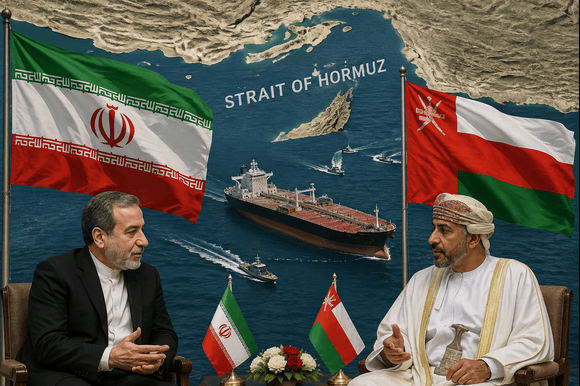
Oman has said that positive discussions are under way with Iran over a possible agreement aimed at securing a shipping route through the Strait of Hormuz, although Tehran has warned that any agreement reached would not necessarily result in the immediate reopening of the strategically important waterway.
Both Oman and Iran indicated on Saturday that negotiations were moving forward, but neither side provided a clear timeline for when an agreement could be completed. Oman’s Foreign Ministry also warned that any attacks against commercial vessels could undermine efforts to establish safe shipping arrangements through the strait.
Iranian Foreign Minister Abbas Araghchi said negotiations had entered their final stages, but stressed that reopening the Strait of Hormuz remained dependent on the fulfilment of additional conditions.
“The reopening of the Strait of Hormuz is subject to other conditions,” Araghchi said, indicating that progress in discussions over a shipping arrangement should not be interpreted as an immediate decision to restore normal maritime traffic.
Iran has effectively blocked access through the Strait of Hormuz since the United States and Israel launched attacks in February. The narrow waterway is one of the world’s most important energy routes, with roughly one-fifth of global oil and natural gas supplies normally passing through it.
In recent days, negotiations have centred on the possibility of creating a new shipping arrangement through the strait involving Iran and Oman. Under the proposal, both countries would have responsibility for the route, with the aim of creating a system that would allow commercial vessels to resume passage safely.
However, Araghchi made clear that a broader reopening of the waterway would depend on several other issues being resolved. He gave only limited details about Tehran’s conditions but said Iran was seeking compensation from the United States over what it described as Washington’s violations of an agreement reached in June.
The agreement, known as a Memorandum of Understanding (MoU), had been intended to stop the fighting and provide a framework for further negotiations aimed at ending the conflict. However, the arrangement quickly collapsed, with diplomatic efforts also breaking down and attacks between the opposing sides resuming only days after the agreement was signed.
Iran’s security chief, Mohammad Baqer Zolqadr, separately told the semi-official Tasnim news agency that the Strait of Hormuz would remain closed until the United States changed its conduct toward Iran.
Zolqadr said Washington would need to satisfy six demands put forward by Tehran before the waterway could reopen. Among those demands, he cited an end to threats against Iran, the lifting of what Tehran describes as a US naval blockade of Iranian ports, and the release of Iranian assets that remain frozen.
The dispute over the Strait of Hormuz comes amid wider tensions affecting regional shipping. Another blockade has affected Saudi Arabian ports in the Red Sea, where Yemen’s Iran-backed Houthi movement has imposed restrictions since 20 July.
US President Donald Trump said earlier this week that a deal with Iran “could be soon”, raising expectations that negotiations could lead to a breakthrough. However, US Vice-President JD Vance adopted a more cautious tone on Saturday, warning that significant work remained despite the progress reported in negotiations.
“We’re really in the middle of the game here,” Vance told Fox News. “This thing is not over.”
Vance said the United States was continuing to use diplomatic, economic and military measures in an effort to secure what he described as the best possible outcome for the American people.
“We’re applying a whole host of tools – diplomatic, economic [and] military tools – to ensure that we get the best outcome for the American people,” he said.
Vance also claimed that the same volume of oil would ultimately leave the Gulf as before the US military operation began on 28 February, although he did not provide specific details about how that would be achieved.
“What we’re really working through now is how you can actually set up a traffic scheme so that the ships can pass through safely,” Vance said.
One of the major disagreements surrounding the future of the strait has involved reports that Iran could impose charges on vessels seeking to pass through the waterway.
Reuters, citing an Iranian official, previously reported that Tehran was considering fees ranging between 5% and 7% of the value of cargo carried by vessels travelling through the Strait of Hormuz.
Vance sought to play down those reports, saying that Iranian officials had told Washington that Tehran did not intend to introduce a toll for vessels using the strait.
“The Iranians have told us they have no plans to toll the Strait of Hormuz,” Vance said.
Oman’s call for shipping to remain protected from attacks came as the United Arab Emirates said that Iran had targeted a tanker connected to Abu Dhabi National Oil Company (Adnoc), the UAE’s state-owned energy company.
The UAE Foreign Ministry said on Saturday that an “hostile Iranian attack” had struck an Adnoc-affiliated tanker with a missile while the vessel was travelling through the region. According to the ministry, no casualties were reported in the incident.
The incident added to concerns over the safety of commercial shipping as diplomatic efforts continue to establish a secure passage through one of the world’s most important maritime chokepoints.
Later on Saturday, the United Kingdom Maritime Trade Operations (UKMTO) agency reported that a vessel had also been struck by an “unknown projectile” off the coast of Oman.
UKMTO said the impact caused a fire on the vessel, although the fire was subsequently extinguished. No casualties were reported.
It remained unclear whether the vessel reported by UKMTO was the same ship identified by the UAE authorities as having been targeted in the reported Iranian attack.
The latest incidents have increased pressure on Tehran, Oman and other regional and international actors to establish a workable system for safe passage through the Strait of Hormuz. With negotiations continuing but the reopening of the waterway still dependent on wider political and security conditions, uncertainty remains over when normal shipping traffic will fully resume.